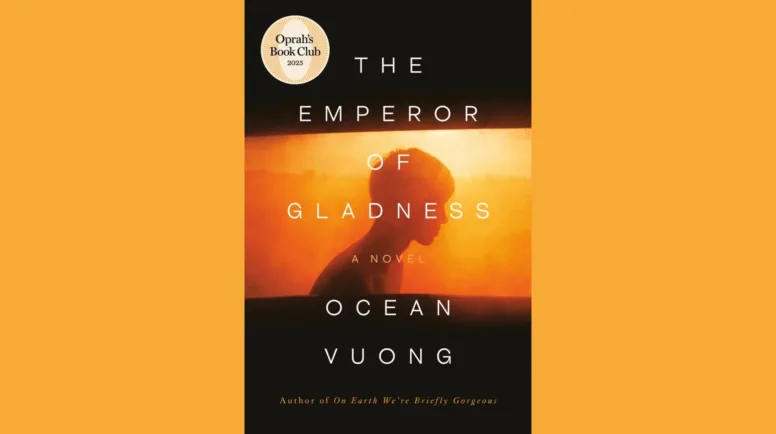
The Emperor of Gladness
Ocean Vuong
Penguin Press, 416 pages
Published May 13, 2025
In fictional East Gladness, Connecticut, opioid and other substance addictions are as unremarkable as the dearth of living-wage jobs and broken promises of the neoliberal economic order. Ocean Vuong is unsparing in his diagnosis that unfettered capitalism, as a guiding principle, inflicts social and spiritual costs on individuals and communities. In the opening pages of The Emperor of Gladness, the dynamic nearly reaches its logical conclusion as Hai, a queer Vietnamese immigrant and recent college drop-out grieving the overdose of his partner, decides to jump off a bridge.
Hai is saved by the unexpected power of human connection across generations and social backgrounds forged in survival and sustained through mutual care. When Grazina, a devout Christian and octogenarian immigrant, intervenes, an unlikely bond forms; Hai becomes a live-in caretaker for this widow with mid-stage dementia while Grazina offers Hai a secluded place to resume his life.
Religious institutions in The Emperor of Gladness are limited to a substance recovery center – “lots and lots of Jesus, about fourteen renditions of the Holy Son, from what Hai could count” – yet faith is common and something proximate to the Spirit is present as Vuong’s characters move from isolated hopelessness to belonging. “How strange to feel something so close to mercy, whatever that was,” Hai reflects on his first night living with Grazina, “and stranger still that it would be found in here of all places, at the end of a road of ruined houses by a toxic river.”
Grazina’s mercy prompts Hai to reconcile with his cousin and join a crew of humble misfits working at a fast-casual restaurant. The employees exhibit varying degrees of dislocation and possess a shared goal to serve food with “the taste of the holidays without the pain of the holidays.” It’s still a near-minimum wage job in which food is re-heated rather than cooked – the only homemade item on the menu is BJ’s cornbread prepared on Sundays and treated with near sacramental reverence – but Vuong’s richly imagined characters push back against the material and spiritual scarcity of their surroundings, recognizing collective strength in shared rejection.
They experience a taste of the kingdom of heaven as they heal broken bodies and relationships, visit the incarcerated, feed the unhoused and endure together. Christian readers will draw parallels between the novel’s setting in the 2009 recession, where the disinherited reckon with hollow American narratives of upward economic mobility and the early church’s social and economic marginalization at odds with Rome’s imperial hegemony.
Here and throughout The Emperor of Gladness, Vuong pairs the shame and thwarted hopes of lowly characters with their refusal to let the dominant social imagination discard them. The shared resolve of this informal community unambiguously recalls Paul’s first letter to the Corinthians: “not many of you were wise by human standards, not many were powerful, not many were of noble birth. But God chose what is foolish in the world to shame the wise; God chose what is weak in the world to shame the strong” (1 Corinthians 1:26-27).
In his bold, heartfelt second novel, Vuong connects the work of solidarity-building with serving the kingdom of heaven, even in the smallest of ways. When neighbors recognize a shared need for belonging and spiritual meaning, their willingness to truly see one another – and respond – is transformative.
Presbyterian Outlook supports local bookstores. Join us! Click on the link below to purchase The Emperor of Gladness from BookShop, an online bookstore with a mission to financially support local, independent bookstores. As an affiliate, Outlook will also earn a commission from your purchase.
Sign up for Page Turners, our monthly email newsletter, to receive book-related content in your inbox once a month.