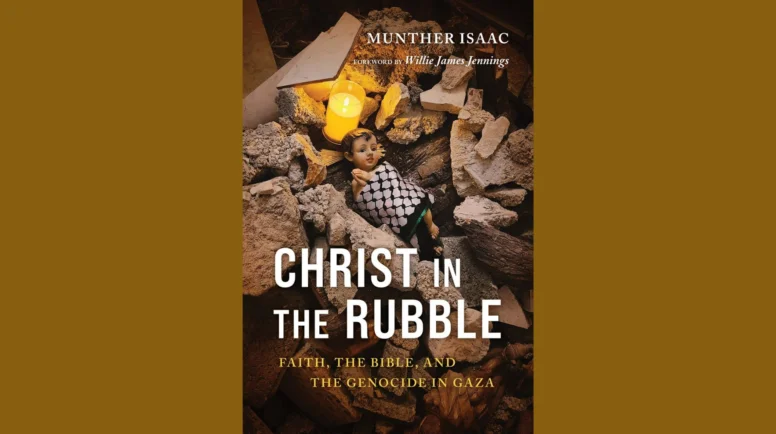
Christ in the Rubble: Faith, the Bible, and the Genocide in Gaza
By Munther Isaac
Eerdmans, 279 pages
Published March 27, 2025
Munther Isaac believes in an almighty God, and he sees God and Christ in the rubble of Gaza, where Palestinian children, women, families, first responders and international aid workers lie buried. A Palestinian Christian, Isaac is also a biblical theologian from Bethlehem, a Lutheran pastor and a respected author. Christ in the Rubble recounts his public ministry and spiritual struggles during the first year of the Hamas vs. Israel war, which started on October 7, 2023. As an advocate for the civilians of Gaza, he holds both Hamas and the current Israeli government responsible for a war in which the disproportionate deaths and suffering of Gazans are glaringly apparent.
He turns his pacifist convictions against both Hamas’ violence against Israeli citizens and the Israeli government for their ongoing military occupation of Gaza, as well as their merciless bombardments of civilians and infrastructure. He describes the long-term Israeli project of a Jewish homeland, started in 1947, as “settler colonialism” and “apartheid,” and he differentiates between ancient Israel and Judah in the Bible and the modern nation-state of Israel.
Isaac reserves his strongest criticisms for Christian Zionists, ecumenical Christians involved in Christian-Jewish dialogue, and fellow evangelical Christians who supported Israel’s right to defend itself after being invaded. He critiques them for providing moral-spiritual cover for Israel’s war crimes and acts of genocide in Gaza and holds them complicit in the loss of life. He also criticizes Arab governments in the region for not doing enough to bring about a ceasefire and rebukes former US President Biden and Congress for resupplying Israel’s armaments.
As in the Book of Job, where Job’s friends offer counsel as Job proclaims his innocence before them and God, Isaac sees his people, especially Gazan civilians, as innocent victims of nefarious forces. He views antisemitism as a sin of Western Christianity and the Holocaust as a European genocide. Yet, it is Palestinians who are dispossessed of their land to accommodate a growing Jewish population. The author particularly calls out Western Christians who lecture his people on showing greater respect for human rights while Palestinians’ rights to self-determination, security and life have been long denied by the Israeli government.
Isaac believes in an “almighty” God and wonders where God is amidst the suffering; he draws upon Martin Luther’s theology of the cross to find Christ in the rubble, in solidarity with those who suffer. But questions remain: how can an almighty, suffering God help where there are more Christian Zionists (who support Israel’s cause as justified) than there are Jews (who hold contesting views about Israel)? How does Isaac’s non-violent resistance serve the people when international organizations and other nations pursue other means (often violent) to create a Palestinian state? And how much have Palestinian political leaders of the former PLO, Fatah and Hamas truly helped their people?
I was left wondering how the author sustains his pacifist convictions when facing the outcomes of Israeli political decision-makers and their forces. Perhaps visions of an exiled people’s resurrection (Ezekiel 37) and final judgment of the nations (Matthew 25) sustain such a counter-intuitive stance? And given his pacifist convictions, I hoped for some words on behalf of the Israeli and international hostages, living and dead, who remain captives in the tunnels of Gaza.
Presbyterian Outlook supports local bookstores. Join us! Click on the link below to purchase Christ in the Rubble: Faith, the Bible, and the Genocide in Gaza from BookShop, an online bookstore with a mission to financially support local, independent bookstores. As an affiliate, Outlook will also earn a commission from your purchase.
Sign up for Page Turners, our monthly email newsletter, to receive book-related content in your inbox once a month