Looking into the lectionary
Revised Common Lectionary
22nd Sunday after Pentecost
November 9, 2025
Luke 20:27–38
Resurrection and women’s freedom: what Jesus’ answer to the Sadducees reveals
When the Sadducees confront Jesus with an extreme question about marriage and resurrection in Luke 20:27–38, we glimpse how little has changed in more than two millennia. We can almost imagine a similar moment today — like the man outside my hometown football stadium carrying a banner: “Ask me why you’re going to hell.”
The Sadducees — who do not believe in the resurrection — try to trap Jesus with a hypothetical. They ask about a woman who, according to Levitical law, has been married to seven brothers, each in turn after the previous one dies. With resurrection, they argue, which brother will be her rightful husband?
They expect Jesus to deny either the law or the resurrection. Instead, he expands everyone’s imagination.
A story of resistance and freedom
To see why Jesus’ response is so revolutionary — especially for women — consider Catherine of Siena.
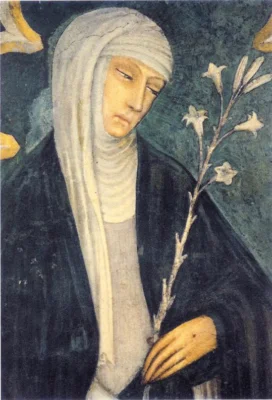
Born in 1347, Catherine was the 25th child in her family — a number that makes most modern bodies tired just hearing it. At the age of 16, Catherine’s parents tried to insist she marry her brother-in-law following the death of her sister, echoing the very situation described by the Sadducees.
But Catherine refused. She went on a hunger strike and cut off all her hair in hopes of making herself completely unattractive. Her tactic worked. Eventually, she joined the Dominican order — gaining education, spiritual authority and the freedom to live on God’s terms rather than on others’ expectations.
“Neither marry nor are given in marriage”
“Those who belong to this age marry and are given in marriage, but those who are considered worthy of a place in that age and in the resurrection from the dead neither marry nor are given in marriage.” — Luke 20:34–35
For the woman with no agency — passed from brother to brother — the resurrection means freedom.
Jesus doesn’t just thread the needle of the Sadducees’ attempt at logical fallacy; he provides a glimpse of a resurrected life that did not require women to be bound to a man “because they are like angels and are children of God” (Luke 20:36).
“Indeed they cannot die anymore, because they are like angels and are children of God.” — Luke 20:36
In fact, generation after generation of women — including Catherine and so many others — tasted that heavenly freedom in religious life. In dedicating themselves to God, they were educated, traveled, were not expected to bear children, and were able to exercise control in their lives in a way not available to most women right up to my own mother, who marched for the passage of the Equal Rights Amendment.
Resurrection: freedom now
The hope of resurrection is not simply a promise for later. It announces freedom here and now:
- freedom from systems that diminish our agency,
- freedom from expectations that shrink who we are created to be,
- freedom from the idea that our worth depends on whom we belong to.
The promise of resurrection invites us to live as God has called and created us to be — a truth as radical in 2025 as it was when Christ walked among us.
Questions for reflection on Luke 20:27–38
- What does spiritual or vocational freedom feel like to you?
- Where do you sense God freeing you to live more fully as a beloved child of God? Where have you felt constrained or obligated?
- What assumptions of “this age” might God be calling you to release so you can be unbound?
View the corresponding Order of Worship for the Twenty-second Sunday after Pentecost.
Sign up for worship resources in your inbox every Monday.