This article appears on Presbyterian Outlook with the permission of the Presbyterian News Service. The Outlook has a paywall to help fund our independent journalism. If our paywall prevents you from reading the full story, you can read it freely at pcusa.org/news.
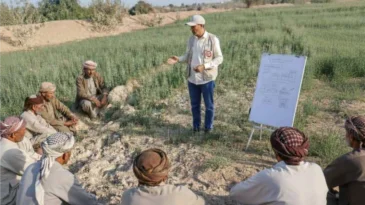
In California’s Central Valley, where mandarin orange groves stretch across sunbaked fields, immigrant families from Mexico, Guatemala, Honduras and Punjab work the harvests that feed America. As these hardworking communities buy their first homes in small valley towns, the Presbyterian Church (U.S.A.) is learning to be nimble enough to meet them where they are.
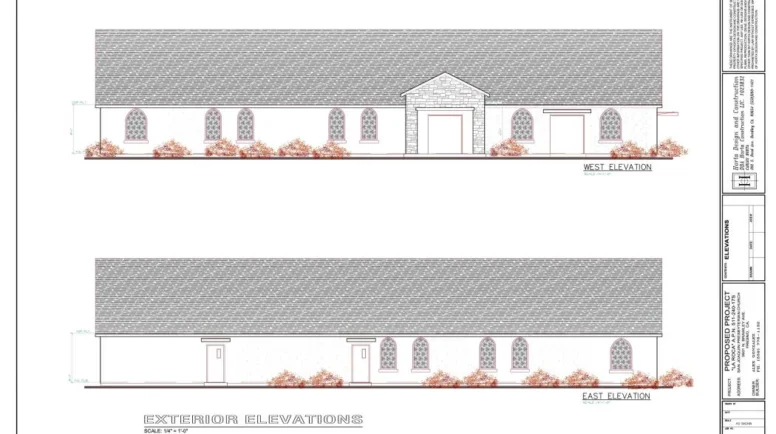
This is the place where pastor Alex Gonzalez fulfills his calling as a church planter and leadership developer. His multi-site vision of ministry to immigrant communities is transforming how the Presbytery of San Joaquin serves its rapidly changing communities. His new worshiping community, Fuente de Gracia, recently received a $50,000 Walton Award from the PC(USA)’s 1001 New Worshiping Communities movement — funding that will help construct the presbytery’s first new building in decades.
“We haven’t built anything from the ground up for a while,” said the Rev. Ara Guekguezian, executive presbyter of the Presbytery of San Joaquin.“To be adding a property is exciting for people that have been a part of the presbytery for the past generation. They remember the days that they were building churches all over the place.”
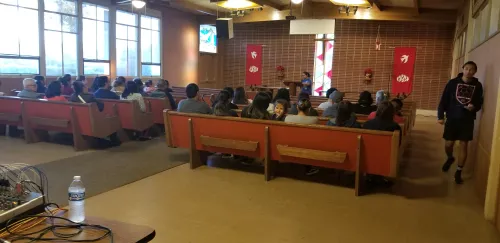
The Central Valley embodies California’s innovative spirit, Guekguezian explained, but it’s fundamentally an agricultural region where immigrant workers form the backbone of the economy. “When Armenians like my family came here, they worked in packing houses and worked in the fields, and then the Southeast Asian refugees came, same thing,” he said. “People from Mexico, Guatemala, El Salvador, Honduras, Bolivia, Colombia — they come here and work, and they immigrate here and build lives here for generations.”
As communities shift within a single generation, Presbyterian churches struggle to adapt. “We’re not very nimble like the Roman Catholic Church, who can place priests who speak the language in the communities,” Guekguezian acknowledged. “We have churches where English is the second language for people surrounding the church, and for some it’s very weak. It’s hard for them to worship God in a language that they’re not sure of.”
Fuente de Gracia offers a different model. Rather than a single congregation, it’s a multi-campus ministry currently operating in Sanger in partnership with the Evangelical Lutheran Church in America’s Sierra Pacific Synod. The new $850,000 building in northwest Fresno — funded through the Presbyterian Investment and Loan Program, presbytery resources and the Walton Award — will become Fuente de Gracia’s Fresno campus.
“Alex’s vision is that it will be a missional congregation,” Guekguezian said, noting the strategic location west of Highway 99, which functions as a barrier many residents never cross. “There isn’t another expression of the Reformed faith on the west side of the major freeway that runs through the Central Valley.”

But Gonzalez’s vision extends beyond buildings. His calling, Guekguezian explained, is “to develop strong leadership, identify people with spiritual gifts and leadership qualities, and then partner with the presbytery and the denomination in equipping these leaders.”
The presbytery relies heavily on commissioned ruling elders — lay leaders who receive focused training to serve congregations. Gonzalez provides initial mentorship, then the presbytery offers advanced instruction through resources including online classes at Whitworth University and educational videos created by mid council leaders. “With the Fuente de Gracia people, Gonzalez’s training would be a little more intensive and a little deeper,” Guekguezian said.
This model is already proving replicable. Fresno Punjabi Church, another new worshiping community in the presbytery that currently meets at University Presbyterian Church in Fresno, is exploring a similar multi-site approach, with plans for campuses in Merced and Bakersfield. Meanwhile, Fuente de Gracia envisions additional locations in Madera and communities along the “orange belt,” where former citrus-packing towns need revitalization.
“The Walton Award recognizes outstanding new worshiping communities that are working in creative ways to bring the gospel to their local communities,” the Rev. Bethany Fox and the Rev. Karen Rohrer, co-chairs of the Mission Development Resources Committee, wrote in their recommendation that Fuente de Gracia be awarded a Walton grant. The award supports NWCs “whose work advances the mission of the PC(USA) in partnership with their mid councils.”
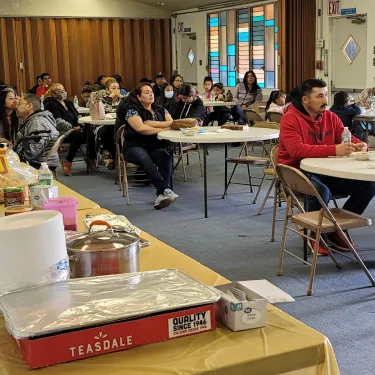
For Fuente de Gracia, the funding arrives at a critical moment. “The cost of construction materials has increased in a substantial way, and this $50,000 gives us the ability to build the building we envisioned instead of having to cut back in any substantial way,” Guekguezian said.
With 20 congregations and five fellowships serving communities from 10 to 200 worshipers, the Presbytery of San Joaquin sees Fuente de Gracia as a model for sustainable ministry in immigrant communities. As Guekguezian put it, the project reflects “our commitment as a presbytery” to being present where the need is greatest.