This article appears on Presbyterian Outlook with the permission of the Presbyterian News Service. The Outlook has a paywall to help fund our independent journalism. If our paywall prevents you from reading the full story, you can read it freely at pcusa.org/news.
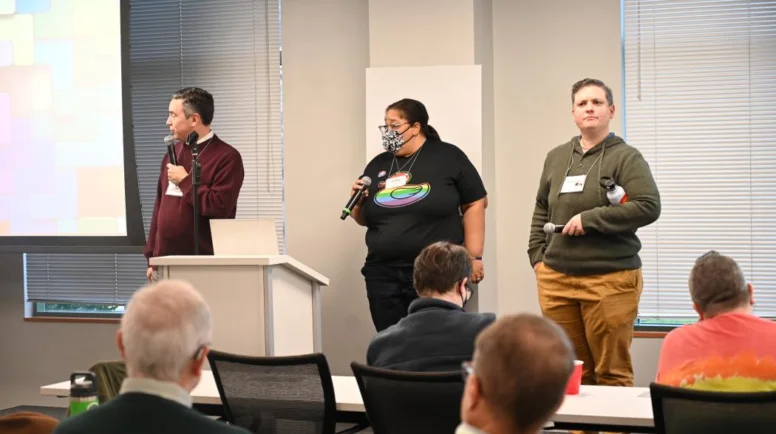
A list of seven things queer people would like the church to know, which came from a survey with more than 300 responses, was disseminated and discussed during the National Queer Presbyterian Gathering this week.
Melonee Tubb, who staffs three advocacy committees in the Interim Unified Agency for the Presbyterian Church (U.S.A.), told the gathering Wednesday that 271 of the 305 respondents identified as queer. Twenty respondents identified as straight people, most of them allies, Tubb said. Twenty-three percent of respondents were transgender or nonbinary, 30% were cis men and 45% were cis women.
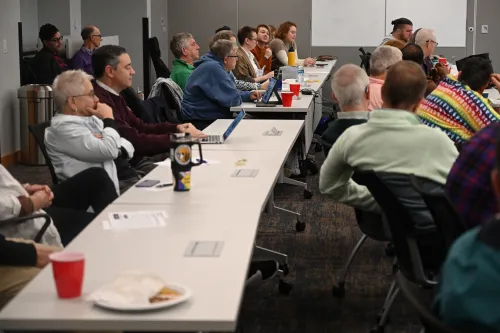
Of the transgender and nonbinary respondents, more than 6 in 10 hold some form of leadership role, Tubb said, adding, “In a small group, that’s an incredible number of leaders.”
Tubb described the seven main themes revealed in the survey as “not a single narrative but a tapestry of lived faith, calling the church to equity in body, spirit and system.”
Inclusion is more than acceptance; it’s belonging
Across responses, queer Presbyterians describe a clear distinction between being allowed in the room and feeling at home there. True belonging, they say, comes when their identities are celebrated as integral to the life, leadership and witness of the church and not tolerated as differences to be managed. “Congregations are doing the bare minimum and calling it a day,” said one respondent, “but queer people want and deserve more.”
Our safety depends on your courage
Respondents made it clear that quiet sympathy or private affirmation does not create safety. Visibility, they emphasized, is what builds trust. Many said they never know whether a congregation will be safe or not. Some described scanning church websites and social media for clues before walking through the door. “Queer folks are feeling trampled on by government, by corporations, and particularly vulnerable,” said one respondent. “The church can (and should) stand in the gap.”
We long for connection and community across regions and generations
Queer Presbyterians are hungry for connection — real, ongoing, embodied community that extends beyond individual congregations. Many described feeling scattered and isolated, even within an affirming denomination. The longing isn’t only for social connection but for spiritual kinship: places to share faith, grief and joy with others who understand both queerness and Presbyterian identity. “Resourcing for small conservative communities is unaddressed,” said on respondent. “Help us find each other.”
Policy is not the same as practice
Respondents consistently voiced that policy alone is not enough; the heart of the church must change too. They see a gap between progressive decisions made at the denominational level and the theology still preached, taught or quietly assumed in many congregations. They long for a theological foundation that affirms LGBTQIA+ people not as exceptions to the faith but as expressions of God’s image within it. Trans and nonbinary Presbyterians in particular called for liturgies that bless transitions and celebrate embodiment in all its forms. “We need a denomination-wide teaching blitz on issues of both sexuality and gender expression,” one respondent said.
Queer leadership is already here: support and amplify it
Across the responses there is a confident and hopeful recognition that queer leadership in the church is not something to be developed later but something that already exists and flourishes in many places. Queer pastors, ruling elders, musicians, educators and lay leaders are faithfully guiding congregations, teaching Scripture and building community, and they’re doing this while often carrying the added work of helping others understand what true inclusion looks like. The invitation is not to make space for queer leaders but to notice and honor the space they already hold. “I have created a creative service that’s specifically for people who haven’t felt like church is for them,” said one respondent. “I wish more congregations tried something like that.”
A faithful church speaks aloud
For queer Presbyterians, public witness is both testimony and protection. It’s how the church makes its love visible in a world where silence often signals abandonment. What matters to many respondents is vocal, visible solidarity in public spaces such as Pride events, statements, advocacy and the presence of national leaders who speak clearly when harm is being done. “Clear messaging and obvious support of the LGTBQIA+ community at the national level is essential, along with awareness of the intersectionality of the challenges facing the community in these divisive and damaging political times,” said one respondent.
Joy, resilience and faith are thriving; nurture them
Even in a climate of fear and exclusion, queer people of faith are creating life-giving communities, joyful worship and deep spiritual resilience. Through storytelling, creative liturgy and shared celebration, queer Presbyterians are cultivating joy as resistance and faith as endurance. Many trans and BIPOC respondents described joy as sacred defiance, the celebration of life in a world that has often denied it. The invitation to the wider church is to nurture what already exists: the Spirit’s presence among queer Presbyterians is vibrant and creative, and what it needs is recognition, investment and room to grow. “For LGBTQ people, faith is often more emotional and expressive than in the PC(USA) generally,” said one respondent. “We want a tradition where identity is accepted but also where diverse worship styles are accepted.”