This article appears on Presbyterian Outlook with the permission of the Presbyterian News Service. The Outlook has a paywall to help fund our independent journalism. If our paywall prevents you from reading the full story, you can read it freely at pcusa.org/news.
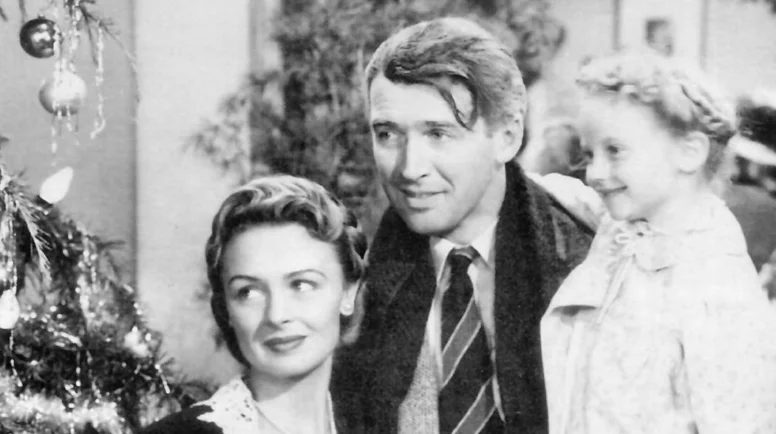
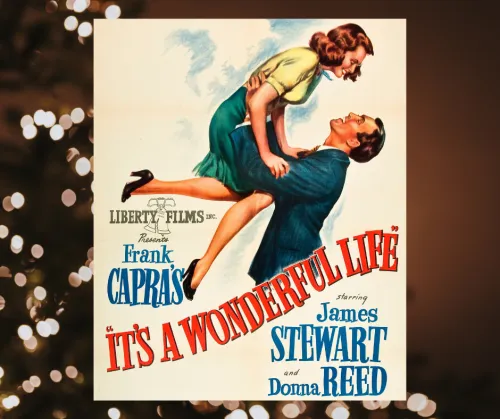
Everyone has a favorite holiday film, whether it’s the box-office-hit “Home Alone” or the classic “Miracle on 34th Street.” But there is one movie that, since its release in 1946, has grown to encapsulate the spirit of the Christmas season and capture the hearts of millions. In the decades since its theatrical release, Frank Capra’s “It’s a Wonderful Life” has grown in popularity immensely, claiming a spot on the American Film Institute’s list of the 100 best American movies ever made and becoming almost synonymous with the Christmas season. You’d never have guessed that it was originally a box office flop, or that it was James Stewart’s first film appearance in five years after serving in World War II— but both are true. Another fun fact about Stewart? The Pennsylvania native was a born-and-raised Presbyterian who attended church all his life.
Jimmy Stewart, born James Maitland Stewart on May 20, 1908, is best known for his distinctive drawl, his everyman screen persona, and his performance as George Bailey in the classic holiday film “It’s a Wonderful Life.” An American actor and military aviator, his film career consisted of more than 80 films, spanning from his start in 1935 to his retirement in 1991. The American Film Institute included him in its list of the 50 greatest American screen legends, placing him at the number three spot for male actors, one spot behind Cary Grant and two behind the inimitable Humphrey Bogart.
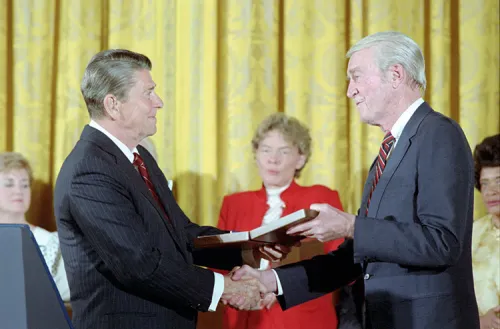
 Not only did Jimmy fly high on stage and in the theaters, but he also lived out his boyhood dream of becoming a Navy pilot, serving during WWII and for decades afterward. In 1985, he was awarded the Presidential Medal of Freedom for both his contributions to American culture and for his dedicated military service.
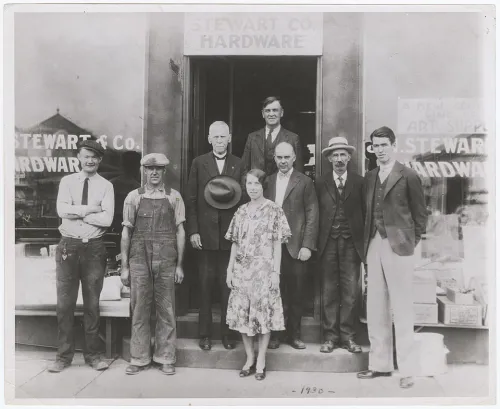
It all started in Indiana, Pennsylvania. Quiet, humble, and devoted, Stewart grew up in a rural coal-mining town a little over an hour’s drive east of Pittsburgh. His family first arrived there in 1772, putting down strong Scots-Irish roots. James was the eldest of three children and the only son. His father, Alexander, ran the family hardware store in town. The J.M. Stewart and Company Hardware Store was named after James’s paternal grandfather, whom he was also named after, and was established in 1853. Whereas James was the eldest and only son, J.M. Stewart had been the 10th and youngest of his brood. Alex hoped that James would take over the shop after attending university, just as he had done for J.M. James, who spent much of his childhood piecing together model airplanes in the basement, had other hopes.
At Princeton University, James studied architecture and joined the Triangle Club, a student group that produced original musicals; his thesis on airport terminal design earned him a scholarship offer in graduate studies, but Jim instead chose to take a chance on the stage. He joined University Actors, an intercollegiate summer stock company performing in Cape Cod, and at the end of the season he and a couple of his performer friends packed up and moved to the Big Apple to try their luck on Broadway.
In 1935, he signed a seven-year contract with Metro-Goldwyn-Mayer. They tossed him from role to role, trying to gauge his strengths and in which roles he’d fit best. And then, in the mid-1930s, he was loaned out to Columbia Studios for Frank Capra’s 1938 film “You Can’t Take It With You”. The film won the Academy Award for Best Picture that year, propelling Stewart from minor role-player to major star. Next up was his role as a U.S. senator in Capra’s 1939 film “Mr. Smith Goes to Washington,” and then his performance in “The Philadelphia Story” alongside Katherine Hepburn and Cary Grant, for which he won the Oscar for Best Actor (though he felt his performance as Mr. Smith the year before deserved it more).
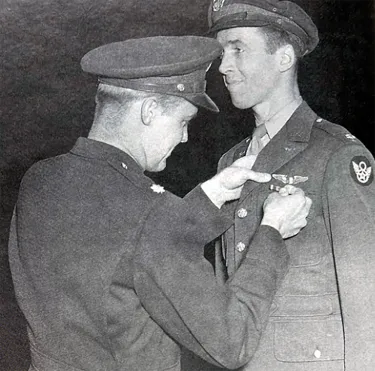
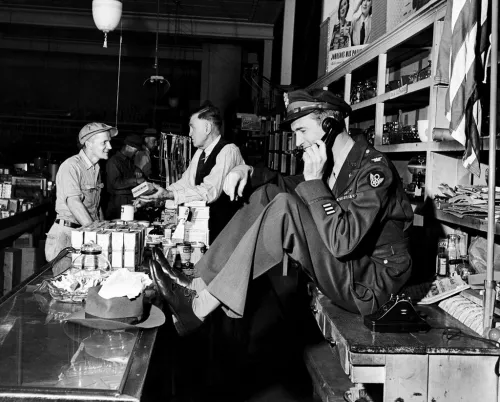
He went on to make quite the name for himself as a leading man of Hollywood, weathering the ebbs and flows of the movie industry for years, starring in both well-received films and box-office-flops until earning his wings with the Army Air Corps in August of 1942. He was the first major American movie star to enlist to fight in WWII, and he served in various positions during his military service: instructing cadets, starring in educational and recruitment documentary films, and acting as commander of a bomber squadron. He flew 20 missions over enemy territory, returning to the U.S. in 1945 as a colonel — making him one of the few Americans to ever rise from private to colonel in only four years.
Upon his return in 1945, James was decorated with the Distinguished Flying Cross and set off for Indiana to check in on his folks. This should come as no surprise, as Jimmy was a dedicated family man — plus, he had to talk to his father about a certain psalm.
You see, Alex Stewart had been there to see off his son in November 1943, when he slipped a note into Jim’s pocket that he’d later discover during his flight to London. It read: “My dear Jim boy. Soon after you read this letter, you will be on your way to the worst danger … Jim, I’m banking on the enclosed copy of the 91st Psalm … I am staking my faith in these words. I feel sure that God will lead you through this mad experience…. I can say no more. I only continue to pray …”
In Gary Fishgall’s biography of him, “Pieces of Time: The Life of James Stewart,” we learn how much this gesture meant to Jimmy: “Religion meant a lot to me for the rest of the war.”
The Stewart family had always been a deeply religious one. From Fishgall’s book we learn that Jimmy’s grandfather J.M. so strongly opposed the purchasing of an organ for use during services at his home sanctuary that he broke from his church and created a new congregation. Alex, Jimmy’s father, continued to attend First United Presbyterian Church, even after his father begat a rival church — he and his wife sang in the choir there, too. The entire family was musical, in that each could play an instrument (Jim played the accordion) and would sing together after meals. Alex Stewart was a conversative Presbyterian and patriotic man, having served in the Spanish-American War and World War I. His son grew up sharing many of the same values.
After returning from overseas, his father’s psalm in hand, James was feeling a bit lost. He was considering moving back to Indiana and working at the family store when he was approached by his old friend Capra, with whom he had made stellar films before the war. Together, they created the magic of Bedford Falls, George Bailey and his family, and the beautiful tale of community and acceptance that is “It’s a Wonderful Life.” Jimmy often credited Capra with giving him a new beginning, allowing him to start again after so much time away.
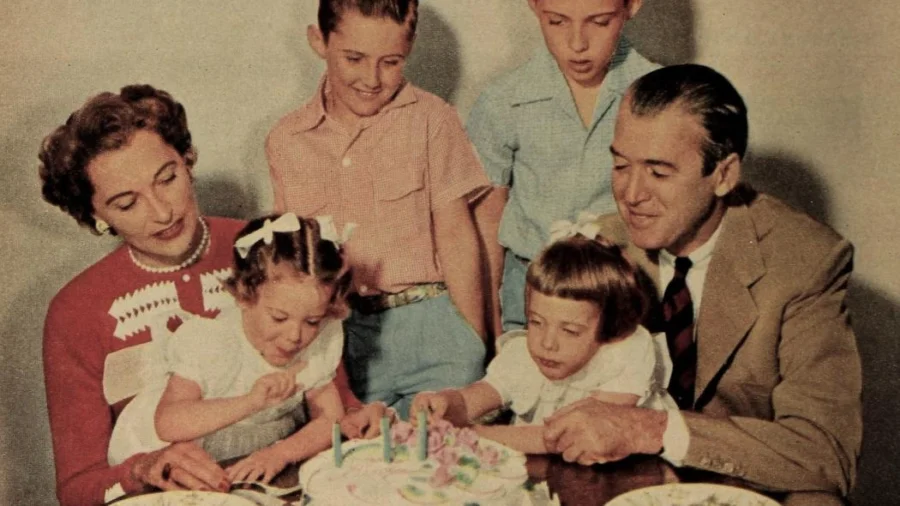
Three years after “It’s a Wonderful Life” was released, Hollywood’s most eligible bachelor got hitched. James Stewart and Gloria Hatrick McLean were married at Brentwood Presbyterian Church in Los Angeles in August 1949. James was 41 when he married Gloria, who was 10 years his junior. James adopted Gloria’s two sons from her previous marriage, Ronald and Michael, and together they welcomed twin daughters Judy and Kelly into the world on May 7, 1951. James moved his family into their Tudor-style home in Beverly Hills a few months after the twins’ birth, where he and his wife would reside for the rest of their lives.
The Brentwood Presbyterian Church remembers Jimmy and his bride with fondness, and notes that “not everyone knows that Jimmy Stewart was an instrumental part of the building of Brentwood Presbyterian Church.” He started attending services there thanks to his father, Alex, who discovered the sanctuary on one of his visits to Jim’s California home. The story is quoted on the church’s website and follows as such: Alex arrived in California and promptly asked his son where he spent his Sundays. When Jimmy stammered something about there not being one nearby, Alex disappeared down the road, only to return with four other men in tow. “You must not have looked very hard, Jim,” his father said to him, “because there’s a Presbyterian church just three blocks from here, and these are the elders.” Apparently, the congregation was building a new sanctuary, and Alex assured them not to worry: “I told them you were a movie star,” he told his son, “and you would help them.”
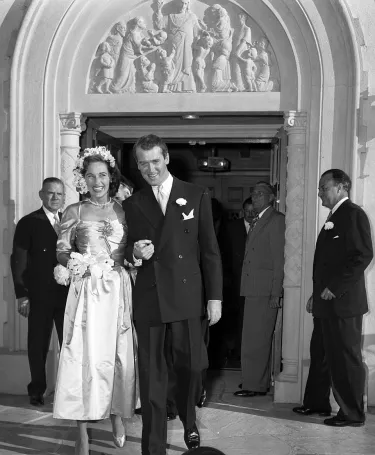
Jimmy attended services at Brentwood Presbyterian Church for years; was married inside its sanctuary; and would take refuge in its pews when his wife Gloria fell ill after their girls were born. After their daughters’ birth, the Stewart family shifted from Brentwood to Beverly Hills, where they began attending Beverly Hills Presbyterian Church. Jim would go on to serve as a ruling elder of this congregation.
James remained active in the Air Force Reserves and attained the rank of brigadier general in July 1959. He retired from service on May 31, 1968. Jimmy was a very private man and refused all attempts by the press for interviews and speaking engagements during his military career and after. He did, however, maintain contact with his wartime pals and attended several reunions as time passed, as his time in the service was so meaningful to him.
He continued to make films, and the last few decades of his career saw him enter the realm of television and make a re-entry into Broadway. He starred in a handful of Westerns, he collaborated with Alfred Hitchcock, and he and Gloria raised their children together. When Jimmy passed from this world on July 2, 1997, more than 3,000 mourners attended his memorial service — Carol Burnett, Bob Hope and Nancy Reagan among them.
His legacy is a lasting one. James Stewart was an actor, accordionist, father, brother, veteran, pilot, son — the list goes on. If you ever find yourself in western Pennsylvania, make a stop in Jimmy’s hometown of Indiana, where his familial roots are still strong and where he was first known as a shy neighborhood boy.
For a long time, Indiana’s only nod toward its connection with Jimmy was a modest historical marker — a plaque outside of 965 Philadelphia Street, his birthplace. But in May 1983, a gala was held in Indiana in honor of Jimmy’s 75th birthday. Thousands attended the grand celebration, where they witnessed the unveiling of a larger-than-life bronze statue of the hometown hero. James was in attendance, of course, and is quoted as saying, “The things I’ve learned here have stayed with me all my life. This is where I made my decisions that certain things were good — hard work, community spirit, God, church, and family.”
In May 1995, The Jimmy Stewart Museum opened in downtown Indiana — an institution organized primarily by residents and community members that highlights Stewart’s film career as well as his life as a World War II military hero, civic leader, and family man.
When he was first approached with the idea of a museum in his honor in the early 1990s, Stewart was hesitant. But after realizing the economic boost such an institution could offer his hometown, which had suffered one of the highest unemployment rates in the state during the 1980s following the closing of the surrounding mines, he acquiesced. The museum was his gift to Indiana, and “It gave a struggling community a chance to come together around an important project,” to which they responded with fervor.
The museum consists of three large galleries, two small galleries, two rotating exhibit hallways, a vintage 50-seat theatre where Stewart’s films are screened, and a gift shop. The collection includes vintage movie costumes and props as well as personal items and awards from Stewart’s life, the majority of which were donated by community members and family. James even handed over one of his two Oscars! The museum lives across the street from the site where The J.M. Stewart and Company Hardware Store once stood. It closed its doors to business in 1961, when James’s father Alex passed. In 1968, when the building was razed, the company that was to develop the lot made sure to preserve a sundial that was original to the Stewart’s storefront. It has since been donated to the museum across the street.
James Stewart’s legacy is alive in Indiana, Pennsylvania — not only through the museum established there in his name, but also in the physical remnants that dot the landscape of the town. There is the sundial that serves as a reminder of the Stewart family store, established along the main thoroughfare in the early 1850s. There is the bronze figure of James standing tall at the courthouse down the street, the gift given to him by his hometown upon his 75th birthday. And at the top of Vinegar Hill, there is the home where a shy young Jimmy pieced together model planes, played the accordion and sang with his family, and adopted the Presbyterian values by which he lived his long and wonderful life.
By McKenna Britton, Presbyterian Historical Society, Presbyterian News Service