This article appears on Presbyterian Outlook with the permission of the Presbyterian News Service. The Outlook has a paywall to help fund our independent journalism. If our paywall prevents you from reading the full story, you can read it freely at pcusa.org/news.
When the Rev. Wade Pond accepted a call as pastor at the Presbyterian Church of Sweet Hollow on Long Island, New York, he determined the transition was the perfect time to re-commit to the sport of pickleball. He had no idea, however, that his personal goal would turn out to be the perfect solution for his new congregation’s financial struggles too.
Now, throughout Long Island, Pond is known as the “pickleball pastor” and his congregation rents out the social hall — transformed into a fully functioning indoor pickleball court— for up to 30 hours a week. The revenue from this creative re-purposing is keeping the church alive.
Pickleball, in which players use paddles to hit a hollow, perforated plastic ball over a net on a small court, was developed in Washington state in 1965. Its creators say it is named after the “pickle boat” in crew, which is made up of oarsmen leftover from the other boats. Pickleball was likewise developed from leftover parts of other sports: a wiffle ball, paddleball paddles, a badminton court, and a net like in tennis.

The sport has been steadily expanding since its invention, but has seen a huge surge in popularity in recent years. According to a 2025 report, an estimated 19.8 million people play pickleball in the U.S., a 311% growth in participation since 2021.
Pond first became familiar with pickleball around 2014 while serving a church in Ohio. He enjoyed the game and played about once a month. When he left Ohio, he left the newfound hobby behind, but when he moved to Long Island in 2022, he decided to get back into it. He did more than casually re-engage — he now refers to himself as “a bona fide pickleball junkie.” He is a sponsored player and professional-level instructor. He’s gotten his wife hooked on the game too.
There is a park in Sweet Hollow just down the street from the Presbyterian church that has several outdoor pickleball courts. Pond played there several times a week and got to know the vibrant local pickleball community. He quickly learned that the available spaces to play were limited.
The outdoor courts aren’t usable during the region’s long cold months or inclement weather. There are private clubs that offer indoor courts, but they require a monthly membership fee alongside steep hourly rental rates. Pond said the desire for an affordable indoor space to play kept coming up in conversation.
Meanwhile, Pond had been hired with the particular goal of revitalizing the church. Like many congregations, Sweet Hollow was a small, older congregation facing decline and an increasingly limited budget. Pond said when he accepted the call to the church, he knew the congregation only had enough money to keep the doors open and cover his ¾-time salary for about three and a half years. It was his job to figure out how to help them find stability and move forward.
Pond’s conversations with the pickleball community gave him an idea. He went the church’s session and pitched the idea of transforming the social hall — already designed as a multi-purpose room — into a pickleball court they could rent out to the community at an affordable hourly rate. One member of the session shared Pond’s enthusiasm for pickleball and encouraged the idea.
While the social hall was used occasionally by a nested Hispanic congregation and for the town’s senior meetings, the room spent most of each week empty and unused, and its design made it surprisingly ideal for pickleball. It was just large enough for a single court with space to slide the chairs that normally occupy the space to the sides. The peaked roof allows the ball to move freely during games.
There were questions about risk of property damage, but Pond was able to thoroughly assuage those concerns by demonstrating that the eight-ounce ball was too lightweight to do harm, even when hurled at walls and windows with significant force. The dusty linoleum floor presented a safety issue because it was slippery, but Pond discovered that the clear coat used on stone patios around pools to prevent slipping could serve the same purpose for the social hall.
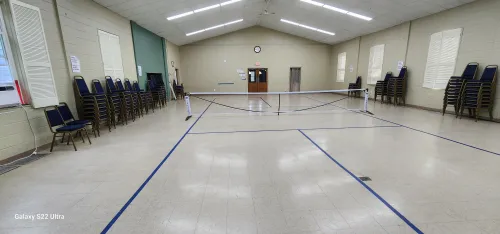
The session agreed to a three-month trial run from October to December 2022, and Pond invited fellow players to rent out the space on occasion. The church raised more than $3,000 from renting out the court during that time. The experiment was deemed a success and they developed a regular schedule. They charge $30 per hour, which is far less than local clubs. The church also doesn’t require a membership fee from pickleball players.
Three years later, the social-hall-turned-pickleball-court has provided $100,000 in steady income to the church. Pond says he advertised the space a couple of times on Facebook, but the schedule has remained full primarily through word of mouth.
Pond says the revenue has provided crucial financial stability to the church.
“If it wasn’t for that income stream, the doors of this church would be closed right now,” Pond said.
The social hall is still used by the church’s nested congregation and for Huntington Town Community Senior meetings, but it turns into a pickleball court for up to 30 hours per week. The church administrator handles the court’s scheduling and rental payments. Most of the renters are regulars who have a set day and time each week, which provides some stability. Pond says rearranging the space as needed is easy.
The church plans to continue renting out its social hall to pickleball players as long as it provides income and meets a community need. Meanwhile, other congregations have begun to ask Pond for advice on how to do something similar in their space. Pond happily offers them his insights and expertise, free of charge.
Pickleball has become something of a ministry for Pond. When pickleball players are using the court, he makes a point going to say hello. While there haven’t been any renters who have joined the church as members, they do often donate to the church’s various mission projects. Pond also puts on an annual “Blessing of the Paddles” service at the park down the street.
Like the church at its best, pickleball is ultimately all about relationships, according to Pond.
“That’s the beauty of the game: it’s incredibly social while also being healthy and active,” Pond said, “and for the people who come into the building to know that they’ve got a space that’s safe and comfortable and accessible and fun — that just enhances their whole experience.”
By Layton Williams Berkes, Presbyterian News Service