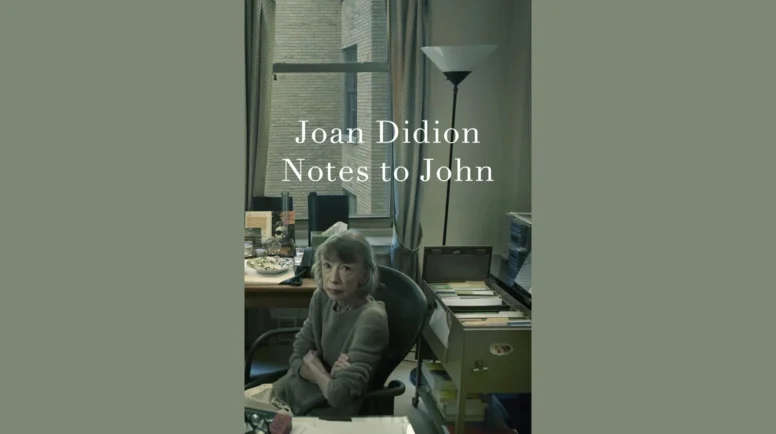
Notes to John
By Joan Didion
Knopf, 224 pages
Published April 22, 2025
Notes to John is set in Times New Roman, a font most publishers would avoid. However, the editor notes that Joan Didion typed this manuscript in this font. Didion died in 2021; soon thereafter, a small file named “Notes to John” was found in her home office, and it contained a series of dated entries from December 29, 1999, to January 3, 2002.
“John” is her husband, John Gregory Dunne. Those familiar with Didion’s nonfiction will recall that Year of Magical Thinking was a reflection on the year following Dunne’s sudden death in December 2003. That book also recounts the declining health of the couple’s daughter, Quintana, who suffered from alcoholism.
Notes to John, then, reads like a prequel. Didion sought the help of a famous psychiatrist, Roger MacKinnon, for help supporting her daughter’s recovery from substance abuse. She recorded their visits, ostensibly for her husband.
I imagined that reading these “notes” would seem like voyeurism, peeking into the impending crisis of a family, but instead, this book most reminded me of the practice of verbatims in Clinical Pastoral Education. A student chaplain recalls a conversation with a patient or family member, then presents the typewritten pages to the supervisor and peer group for learning and feedback. From this perspective, Notes to John is a helpful tool for pastors, chaplains and others initiating difficult conversations with families in crisis.
Notes to John is a helpful tool for pastors, chaplains and others initiating difficult conversations with families in crisis.
Didion is skeptical about her daughter’s Alcoholics Anonymous program, questioning if she needs “faith” and the idea that her daughter “would be sick for the rest of my life.” MacKinnon surprisingly agrees that a patient might recover from addiction, and he is not alone; more recent approaches make a similar claim. Other times, I disagreed, such as when MacKinnon discouraged Didion’s concern that her drinking habits might have influenced her daughter, even after she admitted to having a drink every night before editing her writing because “[alcohol] gave me a little edge.” Sounds like chemical dependency to me!
I was most inspired by how Didion bravely interrogates her childhood, especially her relationship to her mother and its impact on her relationship to Quintana. Here, MacKinnon is astute and helpful. He guides Didion to see how her lack of trust in her mother’s parenting led to anxiety that was transposed on her daughter. MacKinnon’s best advice, “(r)ight now, what [Quintana] needs is your uncritical, empathetic presence,” again reminded me of CPE and offered insight into pastoral care.
I picked up this book because I love Didion’s prose, but Notes to John reads more like medical notes than the polished, serpentine sentences that artfully weave through her other work. I missed her metaphysical musings about faith, life and death — signatures of her nonfiction.
But again, I found myself moved by Didion’s courage. In the language of A.A.’s Step 4, she appears to have taken the scary step of “making a fearless moral inventory.” I can recommend Notes to John to readers seeking insight into family struggles with substance abuse and codependency. While it may also enrich a reader’s understanding of Didion’s Year of Magical Thinking or Blue Nights, I would not recommend Notes to John instead of those books.
Presbyterian Outlook supports local bookstores. Join us! Click on the link below to purchase Notes to John from BookShop, an online bookstore with a mission to financially support local, independent bookstores. As an affiliate, Outlook will also earn a commission from your purchase.
Sign up for Page Turners, our monthly email newsletter, to receive book-related content in your inbox once a month.