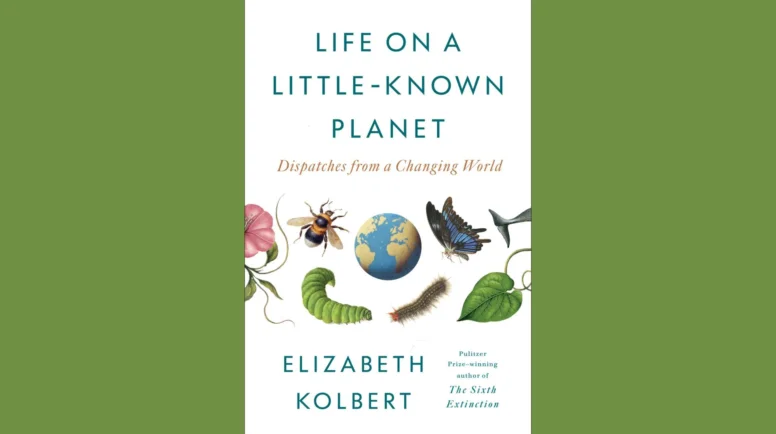
Life on a Little-Known Planet: Dispatches from a Changing World
By Elizabeth Kolbert
Crown, 320 pages
Published November 4, 2025
Like the hobbits in J.R.R. Tolkien’s Lord of the Rings trilogy, we live and think and plan in a Middle-earth. We spend most of our time in the middle consciousness of the everyday; as a rule, we don’t dwell on things we can’t see with our eyes or fathom in our everyday thoughts. We feel most at home somewhere between the biggest and the smallest, the coldest and the hottest, the ancient and the futuristic. Yet, like the hobbits, we all too often find ourselves threatened by the extremities — also, too often, we find that our preoccupation with the everyday has somehow brought on or exacerbated that threat, as in our comfortable accommodation to consumerism. In her newest work, journalist Elizabeth Kolbert invites us to explore those extremities and learn their lessons.
This story is every bit as much, though, about culture as it is about technology…
“Invite” is the operative verb, for Life on a Little-Known Planet: Dispatches from a Changing World is an invitation to learn what we should already know about the little-known planet we call home. Rather than taking an in-your-face approach, Kolbert uses curiosity, concision and humor to invite us to acknowledge what we don’t know about climate change, species extinction, the frontiers of artificial intelligence, the life and death of languages, and the impact of human agency, good and bad, on God’s good earth. Kolbert has an uncanny ability to describe the science and technology of her subject matter in accessible ways, allowing readers to comfortably follow her narrative without becoming immobilized by the enormity of our ignorance or innocence. Moreover, she infuses her essays with enough scientific wonder, eccentric personalities and marvelous illustrations to nudge us along, joining her in dispatches from the outside.
One of the more interesting threads that winds through the book is the realization that possible answers to our environmental dilemmas frequently emerge, not from experts or the privileged and powerful, but from those we might consider outsiders. For example, the Danish island of Samsø has achieved energy neutrality by combining wind, solar and biomass energy sources. This story is every bit as much, though, about culture as it is about technology — Samsø’s people, in their growing acceptance of energy innovation, realized that new technologies demanded a new set of community values and practices. Perhaps, in the vein of Tolkien, the hobbits of the world must act as the attention of the powerful is directed elsewhere.
Kolbert makes no pretense of being a theologian. She is clearly a fine journalist of the natural and scientific worlds, as demonstrated in her work for The New Yorker. Individuals and small groups could read this book and simply enjoy and be edified by its various subjects. Alternatively, church groups might read it in concert with works on environmental ethics or biblical stewardship. In either case, Kolbert’s case studies should not fail to generate passionate and more informed consideration and conversation.
Presbyterian Outlook supports local bookstores. Join us! Click on the link below to purchase Life on a Little-Known Planet from BookShop, an online bookstore with a mission to financially support local, independent bookstores. As an affiliate, Outlook will also earn a commission from your purchase.
Sign up for Page Turners, our monthly email newsletter, to receive book-related content in your inbox once a month.