For many years, we have hosted a Christmas open house. Every year, I bake the big, fussy cake on the Southern Living cover. Committing to that cake spares me from the paralysis of infinite internet options. One baked-in “yes” gives me a host of helpful “noes.”
That principle applies to more than cake. The open house began as a simple gathering — neighbors meeting family, sharing the cake rather than eating it all ourselves. But over time, the guest list ballooned, and the joy drained out. I berated myself: What kind of foolish pastor adds more gatherings during Advent?
Then COVID-19 provided a chance to rethink. I realized there is deep grace in not including everyone all the time.
Draw the circle wide.
We drew the circle smaller: actual neighbors and people who knew our family. The invitation felt more sincere. There was enough time, space and cake for a joyful welcome.
For people who care deeply about inclusion, it is liberating to name the times when more is not always merrier. Gracious exclusion means having the courage to name the “no” required for a sincere “yes.”
As a Christian, I believe fiercely in the wideness of God’s mercy. Y’all means all. When it comes to who is loved, treasured and called to serve, draw the circle wide. And yet, inclusion is not just a posture or a mindset. It requires intention.
Priya Parker, an expert in gatherings, writes that exclusion can protect both your guests and your purpose. Sometimes safety, group closeness and power dynamics make saying “no” essential.
“This is purposeful,” she says, “not personal.”
Inclusion without planning shifts the burden onto the most vulnerable. While planning for a large interfaith gathering, several pastors wanted to leave registration open until the last minute. A rabbi spoke up: “I wish this weren’t the case, but for the sake of safety, we no longer offer registration at the door.” The group decided the purpose — deep sharing — was more important than hospitality to last-minute arrivals. We cut off registration early.
We are working carefully to be a church where neurodiverse children can participate fully. One child with severe autism struggles to sit in the Godly Play circle. He prefers to wander, to gaze out the window in the other room. Without additional support, he might be unsafe, and other children were growing frustrated.
Rather than quietly suggesting he wasn’t welcome, our Christian education director gathered the team.
“Sometimes holding the circle is the most important thing we do,” she said. “We need to think about what it takes to say yes well.”
We added volunteers and gave older children roles in modeling welcome so that this child could join the circle or stay by the window.
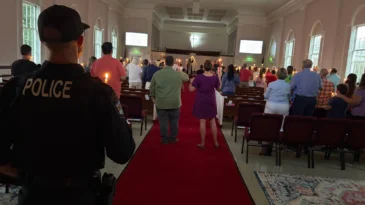
In March, a troubled teenager spray-painted hateful words and symbols near the church. We responded with a bold “yes” and a clear “no.” Children and youth covered the sidewalks with chalk words of love. Teens made a large art structure facing the road that read: You are loved.
The same week, a group of clergy gathered to renounce the hate. When a news microphone was pressed toward my mouth, I said, “No. These words do not belong. These symbols have no place here.”
And yet, inclusion is not just a posture or a mindset. It requires intention.
When pressed to condemn the perpetrator, I refused.
“This was a troubled teen who clearly needs belonging. That’s what we do. If anyone feels lost or lonely, come on in.”
Jesus shocked the world with his “yes” and his “no.”
He welcomed despised tax collectors and healed people whose illness, checkered past or legal status made the crowd uncomfortable. He helped a Roman centurion, an agent of empire who may have caused harm in the larger community. His “yes” was expansive, disruptive and costly.
Yes, he fed the multitudes without a sign-up sheet, but he also gathered a small group in an upper room: guest list limited, logistics arranged, a password required. He said “no” to the masses in service of truth-telling, intimacy and love for his disciples.
He also said “no” to money changers at the Temple, to constant availability at the expense of prayer, and to violence done in his name. Ultimately, he said “no” to self-protection, trusting that God’s “yes” would be enough.
The church, myself included, often wants Jesus’ radical inclusion without his clarity of purpose or the risk of the cross. Sometimes the most courageous, Christlike thing we can do is name the “no” that makes our “yes” true.