This article appears on Presbyterian Outlook with the permission of the Presbyterian News Service. The Outlook has a paywall to help fund our independent journalism. If our paywall prevents you from reading the full story, you can read it freely at pcusa.org/news.
As the 227th General Assembly of the Presbyterian Church (USA) got underway Monday, much of the Committee on Theological Education and Ordination’s time was spent on ORD-07, which involved the Ordination Task Force’s comprehensive report and recommendations.
While that business item’s significant demand of time and attention was anticipated by committee leadership, another item—ORD-10, “Confirmation of New Trustees Elected by PC(U.S.A.) Theological Institutions” brought unexpected attention and debate around recent restructuring at Columbia Theological Seminary and the related elimination of 11 staff positions.
The committee began its work by hearing two seminary presidents offer their own insights on what is important to know about theological education today. The first two business items for the committee were ORD-16 and ORD-15, which called for the confirmation of the election of the Rev. Dr. Maisha Kariamu Handey as president of McCormick Theological Seminary and the Rev. Dr. Travis Frampton as president of Dubuque Theological Seminary. Handy and Frampton each addressed the committee before their confirmations.
Handy emphasized the importance of engaging young people in theological education and fostering deeper connections between theological institutions and congregations. Frampton likewise noted the “inseparable future” of seminaries and churches. He went on to speak specifically to the growing impact of Artificial Intelligence technology on theological education. While he acknowledged the value of AI as a tool, he stated emphatically that theological education is “fundamentally about human formation and human connection” and “transforming the world by transforming people.”
Both ORD-16 and ORD-15 were approved by overwhelming majority. Handy and Frampton will be given time time to address the full assembly next week.
The committee’s third item of business, ORD-10, concerned the confirmation of new trustees at eight of the nine institutional members of the Committee on Theological Education (COTE) as well as reports from COTE’s four covenant member schools. Teaching elder commissioner Barbara Nagy raised concerns about the relative lack of diversity among the slate of trustees, which in turn led to questions about the tangible impact of the committee’s vote on the proposed overture. Resource staff clarified that the committee couldn’t prevent a theological institution from approving its own trustees, but voting against confirming those trustees would be seen as a formal act of disapproval.
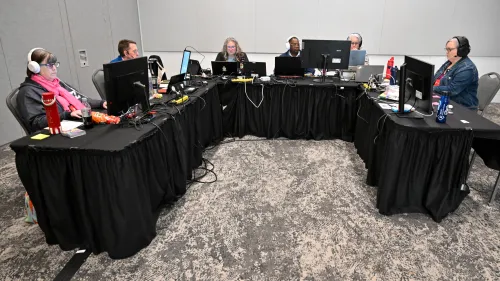
On the heels of this clarification, teaching elder commissioner Daniel McCurdy proposed an amendment to ORD-10, calling for the names of the new trustees at Columbia Theological Seminary to be removed from the roster for approval.
Speaking on the motion, McCurdy described the board of trustees’ ongoing “discriminatory hiring and firing practices” dating back more than half a decade, and including the seminary’s recent announcement on June 9 that it was eliminating 11 positions. McCurdy noted that these decisions had repeatedly and disproportionately impacted people of color, despite the seminary’s stated commitment to diversity, inclusion and equity. McCurdy acknowledged that such a move would be symbolic but emphasized that such a symbol was a necessary call for accountability and to address the existing gap in communication and transparency.
“Don’t ask us to trust you … show us the work,” McCurdy said.
In response to the amendment, Columbia President the Rev. Dr. Victor Aloyo Jr. addressed the committee.
Related reading: “Columbia Theological Seminary announces organizational restructuring” by Columbia Theological Seminary
“Recent restructuring decisions were based on thorough assessment, financial analysis, strategic planning, and consultation to better align the seminary’s resources and structure with its mission,” Aloyo said. “While these decisions have had significant human impact, disagreement alone, especially when based on misinformation, should not determine the evaluation of trustee service.”
Aloyo also clarified that the restructuring changes were based on the positions themselves, rather than concerns with the personnel who filled those positions.
The Rev. Elizabeth Goodrich, Chair of Columbia Seminary’s Board of Trustees, also addressed the committee, calling the trustees “hardworking people” and expressing surprise that they were “asked to defend [the trustees’] work on the GA level.”
Several committee members spoke against the amendment, with one suggesting it was outside the scope of the committee’s responsibility and another saying that such a move against Columbia Seminary would necessarily require equivalent action against all the other seminaries. Multiple people named their personal connections to and trust in the trustees in question.
Young adult advisory delegate Alexander Boltz asked whether there was some kind of alternative action that would allow the committee to express concern without removing the trustees’ names. The Rev. Bill Wildhack, who serves as parliamentarian for the committee, noted that the committee could vote to approve or disapprove the overture with comment and that comment would be included on the record.
Ultimately, McCurdy’s amendment was voted down. However, Boltz proposed the following comment to be added to the committee’s approval: “This committee recommends that the respective Boards of Trustees review hiring and firing practices in respect to increasing diversity, equity, and inclusion as restructuring and reorganization take place, in order to continue to grow into our shared goals of growth within the respective seminaries.”
Boltz’ amendment was approved 55-4. With the addition of Boltz’ comment, ORD-10 passed.
Charlotte Lohrenz, Moderator for the Committee on Theological Education and Ordination, later acknowledged the assumption that ORD-10 would be a straightforward item, but committee leadership worked quickly and diligently to adjust the docket for the remainder of the day.
Both ORD-08 “Recommendation of PC(USA) Schools” and ORD-09 “On a Covenant Between GA and El Seminario Evangelico de Puerto Rico” were passed by the committee without debate.
When the committee took up ORD-14, which called for the establishment of a Korean American Ministry Roundtable, ruling elder Judy Chang offered a video and spoke as an overture advocate. She addressed multiple concerns, particularly around funding, and clarified that the Coordinating Committee of Korean American Presbyteries had already raised more than one-third of the necessary funds, asking for Presbyterian Life & Witness to provide the remaining money in partnership. When one committee member noted that non-Korean Presbyterian congregations face many of the same struggles, Chang acknowledged that the work of the proposed roundtable would benefit the denomination as a whole.
Speaking in favor of the overture, ruling elder commissioner Gerry Farinas of Chicago Presbytery spoke about his own experiences in Korean American congregations, offering insight into the particular challenges faced by congregations transition from first generation Korean-speaking pastors to new generation English-speaking pastors. Farinas pointed out that this roundtable would provide crucial opportunities for these groups to come to the table together to find a common future.
ORD-14 was ultimately approved 55-3.
The committee also approved ORD-11, which recognized the Rev. Dr. Frances Taylor Gench and Dr. James Hudnut-Beumler for lifetime contributions to the church and conferred upon them the Award for Excellence in Theological Education.
In addition to this work, the committee did indeed spend time on its first day on ORD-07’s Ordination Task Force report. Task Force leadership walked through each of the report’s 10 proposed items, and then fielded questions and concerns from the committee. Moderator Lohrenz recognized that a significant percentage of the questions being submitted concerned them report’s Item C, which includes multiple proposed changes to final assessment for ordination. She called for those questions to be held until item C was being specifically addressed.
With limited time available, the committee took up Item A, which calls for presbyteries to require annual training around the ordination process. Discussion centered on concerns about who should provide the training, who should be required to take it, and how often it should occur.
Business of the day concluded with discussion of and a vote on a proposed amendment that shifted training requirements to every three years and called upon Presbyterian Life & Witness to provide the necessary training online for the use of all presbyteries. The Advisory Committee on the Constitution (ACC) noted that such an amendment, if approved, would be the only instance in the Book of Order wherein a specific office of a specific agency of the denomination is given a mandate.
Prior to the vote, Wildhack and Lohrenz clarified that a vote against the particular amendment would not preclude the committee from revisiting its components individually. The amendment was disapproved by a vote of 19-37. The committee concluded its first day with a time of worship. Tomorrow’s docket will focus heavily on the various items in ORD-07, beginning with the continuation of discussion around item A.