In the early 1990s, George Dawes Green found himself at a poetry slam, listening to a young poet. Before each poem, she shared the story behind it: “This next one is about my grandfather, who took me fishing. Before dawn, we’d drive his station wagon upstate to this little stream where we spent all day fishing for brown trout …” During these introductions, Green observed, the audience leaned in to listen. But once the poet began to recite long, surrealist verses in a sing-song, it was as if an invisible curtain fell between her and her listeners. The audience’s attention shut down.
Watching this disconnect, Green imagined a different kind of gathering, where stories could be shared without artifice, where the magic of those pre-poem introductions was the main event. He envisioned people simply telling true stories from their lives, creating moments of genuine connection between strangers. In How to Tell a Story: The Essential Guide to Memorable Storytelling from the Moth, readers learn how Green’s spark of inspiration grew into The Moth, which now hosts over 600 storytelling events across more than 29 cities and as a podcast.
In The Storytelling Animal, Jonathan Gottschall argues that stories are fundamental to human identity. They are not just entertainment, but the architecture of our existence, the scaffolding upon which we construct cultures, shape religions, and create identities. Through stories, we interpret our experiences, find direction in chaos, and see ourselves reflected in others. Stories enlighten us with wisdom or lure us into dangerous conspiracies. Our species is defined by the stories we tell.
When we deny others the dignity of their stories, we betray our shared humanity and demolish possible bridges of understanding across our deepest divides.
Yet that invisible curtain between us can drop so easily, and the barrier it presents is dangerous.
Disconnection from others’ stories reduces immigrants to “illegals” and defines political opponents as data points or caricatures. Behind every label – refugee, conservative, progressive, foreigner – lies a complex narrative. When we deny others the dignity of their stories, we betray our shared humanity and demolish possible bridges of understanding across our deepest divides.
At Story Haven, a new worshiping community founded by Tony Beyer in Kansas City, storytelling is a sacred practice. Every third Thursday, Tony tells me, attendees participate in an opening ritual: lighting a candle, speaking liturgy together, then hearing that night’s theme announced. Framing the evening with “In the beginning” or “The table we set” invites both personal storytelling and theological reflection. Five or six people offer brief stories, with one featured teller anchoring the evening. A covenant binds the community: listen fully, resist the urge to fix or solve, honor each narrator’s experience. This isn’t group therapy; it’s witness.
Our individual narratives carry the seeds of collective change; our communal stories unite us in action.
“People heal through telling,” Tony says. “And when you recognize your experience in someone else’s story, you discover you’re not alone.” Many who find their way to Story Haven have been hurt by the church or left it entirely. Here, even these difficult narratives find sanctuary.
Institutions, too, are storytellers, and these stories offer vehicles of transformation. Congregations have stories of the communities they aspire to be. These stories inspire collective action. They define the quest, draw our attention to potential obstacles, and spur us to fulfill the promise of the plot, to reach the hopeful ending or the noble conclusion. But we must not let our stories create walls of “the way we’ve always done it.” We must make room for new characters and new quests.
What is the story of your faith community? Has it allowed room for new perspectives? As the Presbyterian Church (U.S.A.) gathers this month for our biennial General Assembly, we might ask what it would mean to let the full diversity of our people’s stories shape the decisions we make together.
Even in our fractured times, we retain the capacity to listen and evolve. Our individual narratives carry the seeds of collective change; our communal stories unite us in action. Spaces like Story Haven reveal that our artificial divisions, the curtain between us, dissolve through shared stories, showing us the sacred dignity inherent in every person created in God’s image.
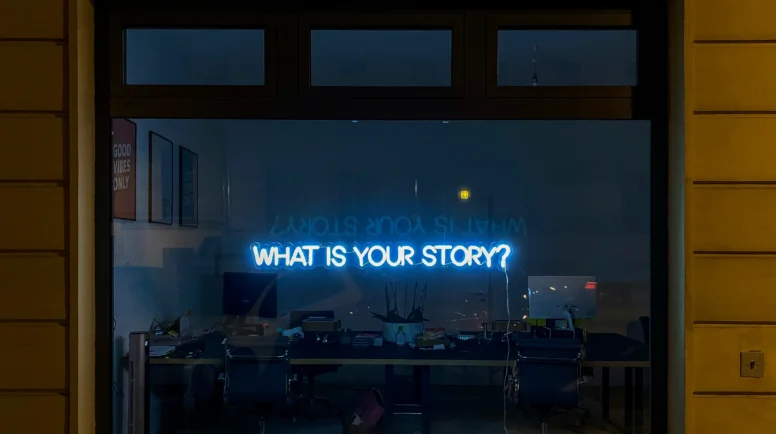
Each of us has a story, and in the telling, we transform both our world and our very selves.