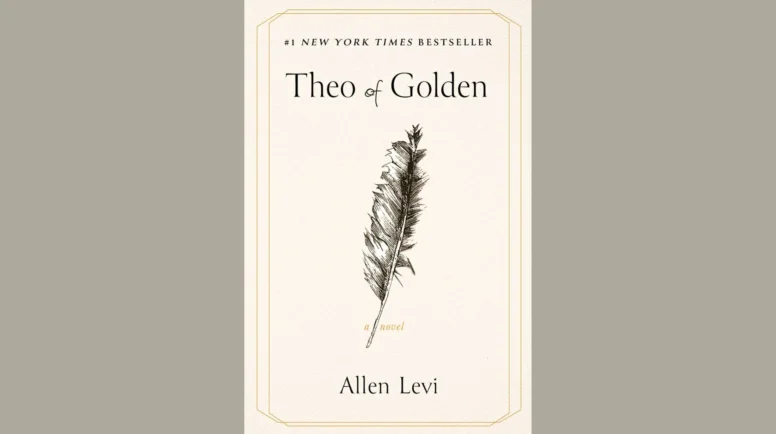
Theo of Golden
By Allen Levi
Atria, 400 pages
Published October 3, 2025
Allen Levi portrays Christianity sympathetically, including through the eloquent priest of the town church. Yet, God’s presence in this novel is provocatively characterized as the knot in an old tree in the shape of an eye — it is called God’s eye.
“Honest wear” is a phrase that an antique dealer would use to describe a piece of furniture: it is not made to look old but bears the marks of age. In turn, I think of the honest wear in my face — the white facial hair, the wrinkled brow, and the laughter lines at the corners of my eyes. Such wear is a sign of my mortality and, perhaps, even of a little wisdom.
Theo of Golden is about the story behind every face. The namesake character, Theo, is an 86-year-old man who mysteriously arrives in a charming Southern town. Theo is deeply curious; though in excellent health, he takes hours to travel a couple of downtown blocks because he stops to investigate birds, flowers, iron railings and brick steps of Golden’s historical buildings. Theo sees the divine in the beauty of creation, whether the majesty of the town’s river or the simplicity of a flower or feather.
Theo is even more inspired by people. After discovering a local coffee shop’s pencil-drawn portraits of 92 residents, Theo (who turns out to be a wealthy art collector) decides to purchase the portraits and bestow them as gifts to their subjects. The “owners,” as Theo calls them, are often initially suspicious and bewildered by the unusual generosity, yet Theo wins them over with his warmth.
Theo “bestows” much more than just portraits, assisting individuals such as a single father with his daughter’s medical bills or an unsheltered woman starting her business, always remaining anonymous. What motivates such selfless generosity? Readers receive the backstory of a tragedy in Theo’s life, and the ways his experience of suffering taught him empathy. Theo knows that, as part of the honest wear in life, there is sadness in every face. If we look closely, we discover Christ among us, especially in the least of these.
Allen Levi portrays Christianity sympathetically, including through the eloquent priest of the town church. Yet God’s presence in this novel is provocatively characterized as the knot in an old tree in the shape of an eye that is called “God’s eye.” Old-timers claim that the knot weeps for the world, as God watches and grieves injustice but is seemingly unwilling or unable to prevent violence wrought by greedy or drunken individuals or by systemic flaws, such as a racist judicial system and the cruel machinations of war.
Even Theo’s abundant generosity cannot solve these societal ills. However, his true mission is to show people their own grace and to tell them they are capable of saintliness. With humility, Theo reports, “I simply help people sit still long enough to see what is already there.” On the boulevard of Golden, like the road to Emmaus, many characters discover that their hearts burn within them while talking to this mysterious man. “I learned something from Mr. Theo,” reports a friend. “God gave us faces so we can see each other better.”
Though fiction, Theo of Golden offers glimpses of the love of God in the worn, flawed and divinely created faces of others and ourselves.
Presbyterian Outlook supports local bookstores. Join us! Click on the link below to purchase Theo of Golden from BookShop, an online bookstore with a mission to financially support local, independent bookstores. As an affiliate, Outlook will also earn a commission from your purchase.
Sign up for Page Turners, our monthly email newsletter, to receive book-related content in your inbox once a month.