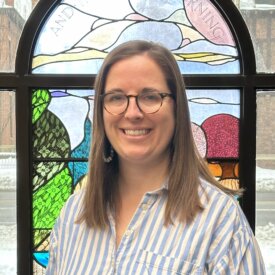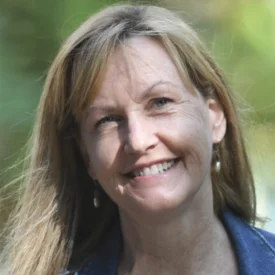
Our friendship was forged over cheese quesadillas on Christy’s couch after Wednesday night programs. Though we served at different churches, we ended our Wednesday nights the same way: with Brittany walking across the street and collapsing onto the sofa while Christy made the cheesiest quesadillas. Together, we processed our evening’s programs, traded stories about church and life and dreamed about what ministry could be and how we might find our place within it. The two of us – one a veteran, and the other a novice to full-time ministry – could not have enjoyed a more collegial relationship. Despite our 21-year age gap, we bonded over the joys and challenges of educational ministry and our shared belief that the church was still relevant, hopeful and life-giving.
What began as two friends processing the joys and frustrations of a shared calling has become, for both of us, a deeper conviction: The church cannot afford to lose the people it is currently failing to support.
When Brittany decided to pursue a Master of Arts in Practical Theology at Columbia Seminary, Christy cheered her on. When Christy later completed a Doctor of Educational Ministry, conversations became filled with a shared understanding that more formal training would deepen our ministries and sustain us for long-term vocations within the church.
Though we have both experienced genuine joy in living out our calling, we have also watched the landscape shift dramatically for nonordained church professionals. Our differing responses to these changes, offered here, represent the dilemma facing educators and youth workers in the Presbyterian Church (U.S.A.).
Christy: When I graduated from the Presbyterian School of Christian Education in 1988, my classmates and I were encouraged to live out our calling as full-time Christian educators. Our odds of receiving a call to a church were terrific — six jobs for every graduate. Take your pick. Like the other graduates in my class, I could imagine building a career in congregations that offered livable salaries, healthcare, benefits and meaningful collegial relationships. The church held seemingly endless possibilities for service and ministry for a nonordained church professional. The idea of attending seminary to become ordained, when that wasn’t my calling, seemed disingenuous or even frivolous. I believed I could faithfully serve the church with integrity as a nonordained Christian educator or youth worker.
Brittany: When I graduated from Presbyterian College in 2008 with a degree in religion, I never questioned whether educational ministry could be both a calling and a career. As part of Presbyterian College’s program for Christian educators, I was surrounded by mentors and peers who understood church education as a respected profession within the life of the church. Job opportunities were abundant, and I felt confident pursuing certification as a Christian educator. That confidence followed me to Columbia Theological Seminary, where I earned a Master of Arts in Practical Theology with a focus on educational ministry. When I graduated in 2013 and completed my certification the following year, I again found a church eager to hire trained educators. The future felt wide open.
Christy: For 34 years, I served as a full-time, nonordained Christian educator/youth worker in the PC(USA). But I question this as a viable option for my younger colleagues. As the current administrator for the Presbyterian Youth Workers Association (PYWA), I see the tide turning sharply for those who choose the path of nonordained church professionals. The job descriptions that cross my desk – from churches seeking youth directors or educators – are by and large part-time at 25 or 30 hours a week, with few or no benefits, making a second job both necessary and nearly impossible to manage. Reading these job descriptions, it becomes clear that churches want a full-time employee but are unwilling to invest in a staff person who isn’t ordained. Presbyteries set salary guidelines and benefit standards for ordained staff, and those same governing bodies offer pastors formal channels for grievance and support. But for those who answer a call to ministry in a non-ordained role, few standards or safeguards exist.
So, where does that leave those with a focus in faith formation? As full-time positions become harder to afford, and as church and presbytery budgets for children’s and youth ministry continue to shrink, how does a nonordained person sustain a calling that the institution increasingly struggles to fund?
Brittany: As I settled into ministry, I began to notice the landscape around me changing. The full-time educational ministry positions that had once seemed plentiful were becoming harder to find. Churches were combining roles, reducing hours or replacing professional educators with part-time staff and volunteers. I still felt deeply called to educational ministry, and I still do.
At the same time, my own ministry was expanding. Within a few years of serving at Broad Street Presbyterian Church, I was increasingly invited into worship leadership, pastoral care, preaching and broader congregational leadership. Members began to see me as one of their pastors, and I began to see myself that way, too.
Ordination was not a departure from educational ministry but an expansion of it.
As I discerned what this meant, I wrestled with two realities. The path for full-time educational ministry was narrowing, while God seemed to be widening my call. As I looked ahead to another 25 years of work, I realized I was facing a choice I never expected to make. I could pursue ordination and continue answering my call within the church, or I could leave professional ministry altogether. While educational ministry remained my passion, the number of full-time positions with livable salaries and benefits had shrunk dramatically since I entered the field.
The church’s changing landscape prompted me to look more closely at my future, but what I found was a genuine call to ordained ministry. Through years of service, affirmation from my congregation and conversations with trusted companions, I came to believe God was calling me to become a minister of Word and Sacrament. Ordination was not a departure from educational ministry but an expansion of it. The same call that first drew me into ministry was still present.
Christy: My calling has not been stagnant. And as I continue my work as a nonordained church professional, I believe I am still answering God’s call to serve. I am also at a different place in my life and career. Without the encouragement of colleagues and an influx of creative ideas from events, I would have given up long ago. Early in my career, I took for granted the gift of continuing education. Over time, I’ve come to understand that practicing Sabbath, challenging myself and gaining new perspectives are what sustain a calling for the long haul. My work with PYWA has reinforced this — our free monthly virtual gatherings, cohorts, trainings and annual in-person conference can be transformational for those who attend, but especially for youth workers with limited continuing education budgets or time.
Those who are called to the work of faith formation need support, training and community. They need a church that invests in them and in their programs. Nonordained staff often face a particular set of struggles: trepidation about self-advocacy with pastors and personnel committees; despair when expectations prove impossible to meet; loneliness from working outside a supported network; and burnout from too many hours and too little Sabbath. Without organizations like PYWA and the other members of The Collective – APCE, POAMN, PCCCA and UKirk – I would be adrift. These communities inspire, connect and sustain those in non-ordained and ordained ministry.

We are still talking. The quesadilla consumption may be less frequent, but the conversation hasn’t stopped because the challenges are still present. What began as two friends processing the joys and frustrations of a shared calling has become, for both of us, a deeper conviction: The church cannot afford to lose the people it is currently failing to support.
The landscape has changed. The job postings tell the story plainly. But so do the church educators and youth workers who show up to a PYWA gathering exhausted and leave reminded that they are not alone — that their calling is real, that their work matters and that a community is walking the road with them.
We don’t have a tidy solution to offer. What we have is this: each other, the organizations that refuse to let both ordained and non-ordained ministers go unsupported, and a stubborn belief that the ministry of faith formation is not a budget line to be trimmed but a vocation to be honored. The church was built, in no small part, by people like us — and it will need people like us to help build what comes next.
The quesadillas are on us.