How did religion figure in the midterm Democratic tsunami that just swept over the Republican Party?
By the numbers, religious communities changed their voting behavior in distinctly different ways. From the 2024 and 2026 exit polls, here are the most salient changes:
- Catholics went from backing the GOP 59%-39% in 2024 to voting Democratic 50%-49% in 2026, a 21-point shift that was doubtless led by Latino Catholics, given that Latinos of all religious persuasions voted 51%-46% in favor of Democrats in 2024 and 64%-34% in 2026. (A Pew survey released in October showed Hispanic Catholics favoring Democrats 59%-19%.) Democrats owe a good deal of their success nationwide to this shift.
- While 82% of white evangelicals voted Republican in both elections, their percentage of the national vote declined by more than a quarter, from 23% to 17%. The decline helps explain notable Democratic victories across the South.
- Jews went from voting nearly 4-1 Democratic in 2024 to not much over 2-1 in 2026 — presumably a reflection of worries about the party’s declining support for Israel. The shift may well have kept several close House races on Long Island and in South Florida in the Republican fold.
Morally, the religious message that seemed to resonate with the electorate came from what sociologist Nancy Ammerman has termed “Golden Rule Christianity.” Criticizing a negative assessment of liberal Christians for being weak on orthodox belief and “just a paler reflection of evangelical fervor,” Ammerman suggests they are best defined “not by ideology, but by practices. Their own measure of Christianity is right living more than right believing.”
In a series of interviews with members of a range of Christian congregations, she found their understanding of the Christian life was that “people should seek to do good, to make the world a better place, to live by the Golden Rule” (as articulated by Jesus in Matthew 7:12: “So in everything, do to others what you would have them do to you, for this sums up the Law and the Prophets”).
Ammerman points out that this understanding is to be found among Catholics but is particularly strong among mainline Protestants. Here, we might take note of seven battleground House districts held by Republicans and identified by sociologist Ryan Burge as heavily mainline. On Tuesday, all seven — three in Iowa, two in Pennsylvania and one each in Minnesota and Wisconsin — flipped to a Democrat.
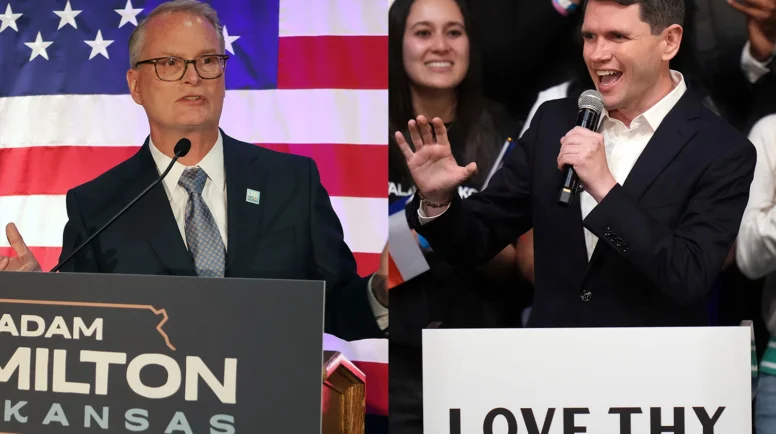
To witness Golden Rule Christianity on display, you only had to listen to the homiletic victory speeches of the two most prominent liberal Christians running in the election, Kansas Senator-elect Adam Hamilton, the Methodist pastor, and Texas Senator-elect James Talarico, the Presbyterian seminarian.
Hamilton actually asked attendees to join him in reciting the Golden Rule: “What does decency look like? I think about Matthew 7:12. I want you to finish this for me. You learned it from your grandma.” The punchline: “What does it look like in Washington if they actually did that?”
For his part, Talarico, standing in front of a podium emblazoned with “Love Thy Neighbor,” spoke of how his grandfather, a Baptist preacher, had told him that “we follow a barefoot rabbi who gave us two commandments: Love God and love neighbor. Because there is no love of God without love of neighbor.”
That the evangelical accusations of heresy leveled at Hamilton, Talarico and several other Democratic clergy candidates gained little traction during the campaign shows the continuing strength of Golden Rule Christianity in America. At a time when the Republican powers-that-be seem so at odds with it — in their treatment of immigrants, in their slashing of social programs, in their invective against those they disagree with — it’s little wonder that the “love thy neighbor” tocsin sounded so loudly on Tuesday.
By Mark Silk, Religion News Service