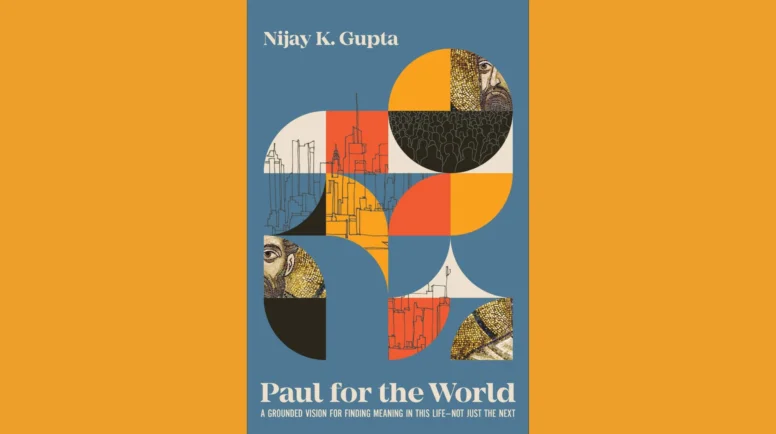
Paul for the World: A Grounded Vision for Finding Meaning in this Life — Not Just the Next
By Nijay K. Gupta
Brazos Press, 256 pages
Published May 12, 2026
Nijay Gupta’s ability to offer fresh insight into the Apostle Paul seems to know no limits. Last year’s The Affections of Christ Jesus focused on the virtue of love in Paul’s writing; now, Gupta returns to establish Paul’s ability to change lives here and now, rather than to guide us to the afterlife. As in his previous work, Gupta offers a deeper sense of who Paul was and an understanding of his first-century world.
Paul for the World brings Paul into conversation with Gupta’s theological influences, namely Dietrich Bonhoeffer, as well as figures such as Jürgen Moltmann and Beyers Naudé. Gupta draws on Greek and Roman philosophers as foils to Paul’s own thinking on matters as broad as sports and ethnic identity. The bridge between biblical scholarship and modern Christian life can be difficult, but Gupta is an able guide, and his personable writing style makes it easy for pastors or small-group leaders to take a leisurely stroll through challenging material.
Despite the current crises of the church and the historical gap separating us from the apostle Paul, Gupta knows there is wisdom to be found in Paul’s writings, and he makes it a bit more accessible.
If this book suffers, it is from its ambition. Gupta tackles a wide variety of issues (economics, justice, art, sports, and more), going deep in some areas while lightly scratching the surface in others. For example, “Here and Now Athletics” highlights Paul’s imagery for the Christian life — a helpful metaphor for the perseverance required of Christians but not necessarily intended as an endorsement of Christian participation in modern sports, which can be all-consuming. This is in stark contrast to his chapter on racism, where both the United States and South Africa are viewed through the lens of Paul’s ministry of reconciliation; here, the exigency is clear. Although Gupta tries to ground this analysis within the idea of an embodied eschaton, the varied nature and quality of the chapters seem to disrupt that throughline.
A second concern is that the problem Gupta seeks to remedy might not be the pressing issue it once was. He opens by reflecting on the mass suicide of Heaven’s Gate cult members; this was clearly a formative moment for Gupta, then a high school student, raising concerns about a religiosity that ditches the physical for the spiritual. But nearly three decades later, it is possible that Christians have become too worldly. Church leaders of various stripes (from Russian Orthodox patriarchs to American Reformed splinter groups) have tied themselves to political movements and leaders with alarming results. Gupta’s reading of Paul would not be kind to these political projects, but this might be where the theologian must pick up where the biblical scholar has left off, appropriating Paul’s thought for an entirely different context (with Bonhoeffer’s help). These sections could have been developed more fully to better address the points of friction modern readers encounter in Scripture.
Despite the current crises facing the church and the historical gap separating us from the apostle Paul, Gupta knows there is wisdom to be found in Paul’s writings, and he makes it a bit more accessible. Perhaps at its best, Paul for the World invites curious readers to explore multiple pathways into deeper theological reflection.
Presbyterian Outlook supports local bookstores. Join us! Click on the link below to purchase Paul for the World from BookShop, an online bookstore with a mission to financially support local, independent bookstores. As an affiliate, Outlook will also earn a commission from your purchase.
Sign up for Page Turners, our monthly email newsletter, to receive book-related content in your inbox once a month.