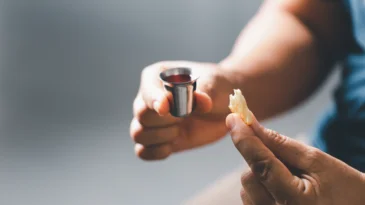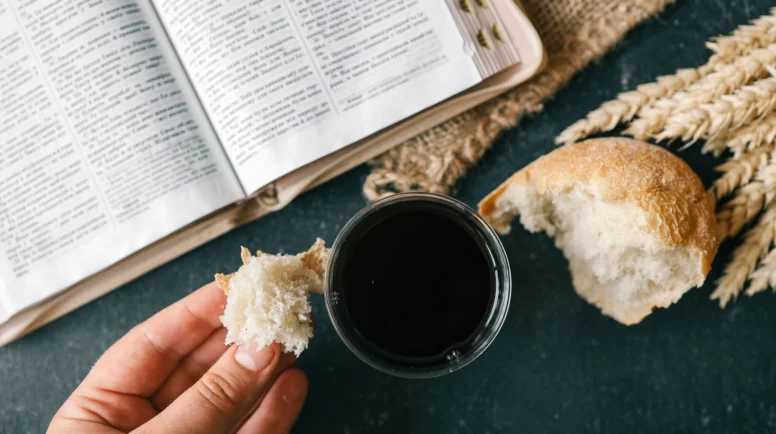
“The body of Christ, broken for you,” declared the ruling elder with a slight warble as they stood at the Communion Table and broke the loaf of bread. Afterward, our presbytery’s stated clerk told me that when she heard the elder’s voice quaver on “body,” she knew God’s Spirit was powerfully present.
This demonstration was a part of a two-hour training I led on behalf of the Presbytery of Wabash Valley’s Commission on Ministry (COM) in an effort to train ruling elders to preside at the Lord’s Supper in the absence of a pastor.
Like many presbyteries, we have struggled to ensure our smaller and transitional congregations can celebrate the Lord’s Supper regularly until a task force convened by our COM to address the issue noticed a phrase tucked away in the Book of Order. According to the PC(USA)’s constitution, “The presbytery has responsibility and power to … provide that the Sacraments may be rightly administered and received … authorizing and training specific ruling elders to administer or preside at the Lord’s Supper” (G-3.0301b).
How the PC(USA) allows ruling elders to preside at Communion
Although many presbyteries may be aware of this provision, we couldn’t find many that had developed structured training to put it into practice. For congregations navigating pastoral vacancies, supply preaching arrangements or the particular rhythms of rural or small-church ministry, identifying a minister of Word and Sacrament to preside at font or table can require significant effort. And if one is unavailable, how can the presbytery live into its calling to “provide that the Sacraments may be rightly administered and received”? A congregation should not have to choose between faithfulness to our polity and faithfulness to God’s call in its life together.
Of course, all things must be done decently and in order. We cannot thrust ruling elders into administering the sacrament without offering training. Our training, modeled on resources shared by the Presbytery of Greater Atlanta, covers several areas: the theology of the sacraments and specifically the Lord’s Supper; the Reformed understanding of two sacraments rather than seven; questions of who may serve and receive; and the liturgical pieces of the Great Thanksgiving. Finally, we arrive at the place where all that theology becomes tangible: practice.
While there are deep theological waters to explore, there is something especially meaningful about the practice of speaking the words of institution, breaking bread and pouring juice — imitating our Savior Jesus, who kept his friends front of mind on the night of his arrest. There is something sacred even in the logistics, from not “wiping off God’s grace” after getting breadcrumbs on one’s hands to making sure the goblet is large enough to hold all the juice.
As each elder walked to the table, holding tightly to the printed words of institution, I found myself surprisingly moved. Here were faithful leaders of the church, people who had given their time, talent and treasure over decades, being invited to become, in a very real sense, “stewards of God’s mysteries” (1 Corinthians 4:1). They were making the grace of God incarnate.
The practice of presiding at the Lord’s Table was more meaningful than all the theologizing we did beforehand — not only to me, but also to the elders. In the same way, inviting congregations to embody leadership through the ordained ministry of ruling elders can be immensely meaningful and sustaining for congregations without an installed minister.
When authorized by the presbytery to celebrate the Lord’s Supper, a ruling elder stands at the table with the full weight of the church’s blessing behind them. They embody the presbytery’s love for the congregation, the leadership already present among its members and the grace offered by our incarnate Lord.
Ruling elders can strengthen congregations without installed pastors
In our COM’s work, we have encountered concerns about a nationwide shortage of pastoral leadership, particularly in the PC(USA). In 2024, 59% of PC(USA) congregations did not have installed pastoral leadership, including 70% of congregations with 150 or fewer members. Yet amid these challenges, the ministry and calling of ruling elders can shine all the brighter.
We might wonder whether training ruling elders to preside at the Lord’s Supper is a concession, something lamentable that points to a failure on the part of the church. I don’t think it is. Rather, this is a coherent expression of our Reformed faith. It invites us to remember that there isn’t a sliding scale of holiness among the different ordinations of our church.
What might it look like truly to share the practice of ministry? What might the church accomplish if we took seriously God’s calling of ordained congregational leaders — homegrown leaders with knowledge of and love for the local church?
Perhaps this is a moment for us clergy, like Peter in Acts 10, not to call unclean – or unqualified – what God has called clean. Perhaps ministers of Word and Sacrament can celebrate God’s Spirit poured out upon the local church, trusting in the leadership gifts of ruling elders. These congregations still have the Spirit of God in their midst, and by the power of this same Spirit, their leaders can embody God’s grace and love for one another.
Our stated clerk was right: God’s Spirit was present. God’s Spirit is always present when God’s people gather around the Table of Grace. In Wabash Valley, more ruling elders are now equipped to lead us in celebrating this sacrament. The elder whose voice quavered over the word “body” will tell you the same.