Despite the common adage not to bring up faith and politics at family gatherings, several Presbyterians are not only talking about faith in their political platforms but also relying on it as the center of the values they convey in the public sphere.
A 2024 pre-election study by the Pew Research Center showed 71% of voters “believe that religion should be kept separate from government policies.” This average showed that 56% of those who support President Donald Trump affirmed the separation, while 85% of voters who backed President Joe Biden believed the government should not support religious values and beliefs.
Yet religious and faith-based language continues to play an important role in politicians’ messaging. From those who issue calls for justice and welcome for the stranger, to those who employ religion as a rallying cry for national unity, faith continues to be an influential factor in the language of persuasion and policy.
For Presbyterians, whose synthesis of civic leadership and faith values hearken back to John Calvin’s Geneva and the Ecclesiastical Ordinances of 1541, this has often been a delicate dance between earthly power and church authority.
Profiled here are two Presbyterian Church (U.S.A.) politicians engaged in this work, attempting to bring the best of the faith values they have acquired and integrate them into the work they do on behalf of the communities they serve.
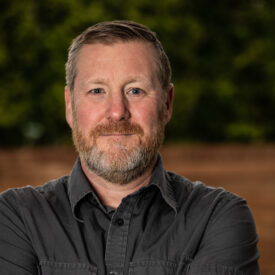
Mike Johnston: Mayor of Denver, Colorado
To speak with Mayor Mike Johnston is to encounter someone profoundly at ease with who they have become. Raised Catholic in Vail, Colorado, he’s a fourth-generation school teacher who, after graduating from Yale College in 1997, spent two years in Mississippi with Teach For America before pursuing further schooling.
Service to the community was instilled in him by his parents, especially his father, an Army veteran and business leader in Vail.
“Some of my earliest memories of my parents are my dad bringing me down to soup kitchens here in Denver, which are now the very same soup kitchens in the same blocks where we run homeless service programs,” he said. “And I think all of those were part of what shaped my belief about how I wanted to try to add value to the world.”
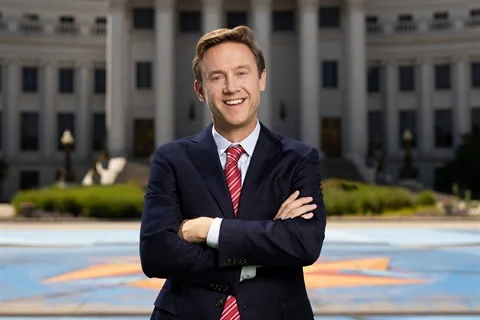
After completing his education and working as an educational advisor in Washington, D.C., Johnston returned to Colorado in 2003 to serve as principal of a Denver school and later of a juvenile detention center, while also teaching law. A Democrat, he also served in the Colorado State Senate from 2009 to 2017.
Johnston and his wife, Courtney, married in 2004, and he says his family “found a home” at Montview Presbyterian Church, adding the congregation’s advocacy for equity, access, civil rights and faith was an irresistible draw.
“The first time we came to visit the church, and the singing started, I just wept,” Johnston remembers. “I felt suddenly at home in a way when you’ve been away for a long time, and it feels good to be home, and you feel like you’re with your people.”
Elected Denver’s mayor in 2023, Johnston quickly formed a coalition of faith leaders that meets quarterly and as needed to address community concerns. Johnston says these faith leaders came together to help find housing for approximately 42,000 migrants who arrived in Denver from late 2022 to early 2024. And this coalition is helping in other ways.
“In the last two years, we’ve delivered the largest reduction in street homelessness of any city at any time in American history. We’ve also delivered the largest drop in crime of any of the top cities in the last year,” he said. “There is a real sense that those acts driven by faith can deliver results. And the more of those results you deliver, the more you see that people turn to each other and not on each other.”
Johnston acknowledges faith can sometimes be a dividing factor in communities but is hopeful that it will ultimately be a cause for unification.
“There are many times when the world pushes you to fight back. And I think my instinct, which I think is a deeply Christian instinct, is always trying to love back, because obviously hate can’t drive out hate,” he said.
“Only love can do that.”
Matt Schultz: Congressional candidate, Alaska
Matt Schultz is the pastor of First Presbyterian Church in Anchorage, Alaska, the husband of Presbytery of Yukon’s executive presbyter, Elizabeth Schultz, and the father of three children. And he’s also running for the only U.S. Congressional seat in Alaska in the 2026 mid-term elections.
A native of rural New York, Schultz moved to Alaska in 1997 to serve as a youth pastor at First Presbyterian. He left to attend Princeton Theological Seminary and returned in 2013, and has served as the congregation’s solo pastor since then.
Schultz says his understanding of calling has developed in ways that extend beyond what is considered prescribed pastoral duties, the first among them being to work to change unethical policies that harm his congregants. Citing the Parable of the Good Samaritan, he believes that when injury is inflicted on individuals or a community, there are no innocent bystanders.
“It became clear in 2024 that there was a great cruelty being inflicted on my neighbors and my congregants by the Trump administration,” he explained. “As a pastor, my place is to stand with the abusers and the abused.”
Schultz has been a vocal advocate for fair economic policies and low-income housing. He spoke earlier this year at Anchorage’s “No Kings” rally. Although a registered Democrat, he eschews political labels, saying they aren’t helpful.
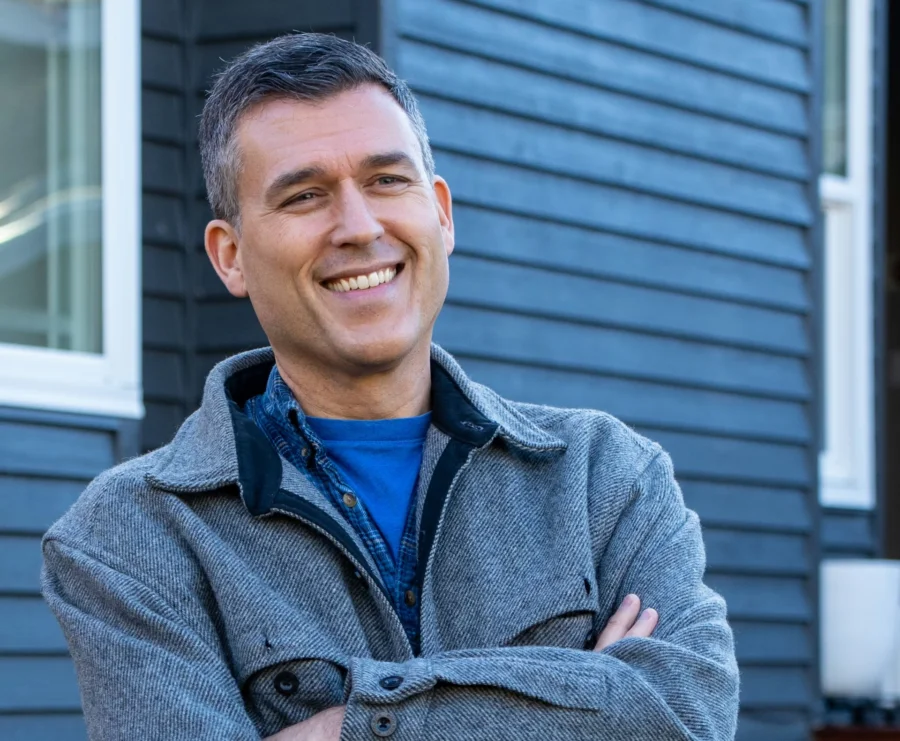
He describes Alaska as “a highly free-thinking state,” defying categories of conservative or liberal, red or blue, with a majority of voters registered as nonpartisan or undeclared.
“That’s really where the rubber hits the road up here,” said Schultz. “Many of the same values and ethics that made people choose their vote in the past, those values and ethics have been betrayed by the people currently in office. And I would be better suited to serve those values and ethics.”
And these values and ethics are the positions from which Schultz leads. It’s even in his main campaign slogan: “Guided by Faith. Grounded in Alaska.”
The biggest issues facing Alaskans, he says, are the “two-headed monster” of cost-of-living increases and accessibility to and the cost of health care. His faith, he believes, informs a political solution in which public policy options are available that serve everyone with fairness and dignity, not because they are Christian policies, but because they are “sound policies for all people.”
Part of that, he believes, means undoing policies that exempt corporations and billionaires from taxes and enacting policies that shift the burden to them rather than to working families.
One of Schultz’s greatest goals would be to find common ground and an end to divisive partisan politics. Noting that most people have many of the same hopes for their families, their state and their country, he believes politicians have recently not come together to build something but to “destroy” the other side.
“They’ve spent so long treating government as a war zone that they’ve forgotten that it’s supposed to be a construction zone,” he said.
Editor’s Note: Four sitting members of the U.S. Congress hold membership in PC(USA) congregations and were contacted for interviews, including Sen. Chris Coons (D-Delaware), Sen. Shelley Moore Capito (R-West Virginia), Sen. John Barrasso (R-Wyoming) and Sen. Rand Paul (R-Kentucky). Unfortunately, they were either unavailable at this time or declined our interview requests. James Talarico, a student at Austin Presbyterian Theological Seminary and a Democratic Texas State Representative, did not respond to an interview request.