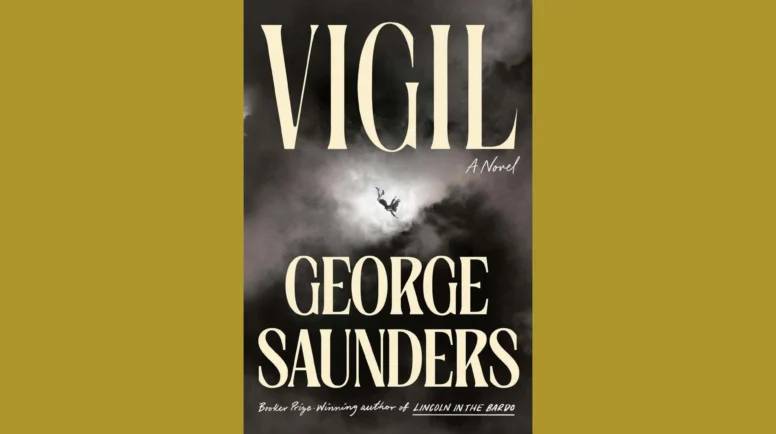
Vigil
George Saunders
Random House, 177 pages
January 27, 2026
George Saunders’s latest novel was criticized in the New York Times as “a hot-water bottle in print form,” characterizing the book as soft, shallow and saccharine. I read Vigil in a different light. It is not a feel-good story but displays a haunting theological imagination.
Like his Booker Prize-winning Lincoln in the Bardo, Saunders sets his story in the afterlife of this world. After death, some spirits achieve “elevation” and are never seen again; others stick around the planet for a variety of reasons. For a novella, Vigil has a huge cast of spirits, but the story is told from one perspective.
Jill “Doll” Blaine is introduced as a type of deathbed angel who brings comfort to those with only a few hours left to live. Initially, Blaine’s character reminded me of the Buddhist idea of a bodhisattva, an enlightened being who voluntarily forsakes nirvana to guide the living, or perhaps as one possible translation of Paraclete as Comforter (John 14:16).
However, Blaine is bad at her job! Though neither cruel nor vengeful, the comfort she offers the dying is meant to cause them to forget their ego and discover “elevation” into the benevolent unknown, but Blaine cannot practice what she preaches. She is pulled into memories and longs for her former life, which was cut tragically short. She cannot let go for a peace that surpasses understanding. I find her to be very human in that struggle.
In Blaine’s defense, the dying person whom she is sent to comfort is the type of person anyone would love to hate. K.J. Boone made a fortune as an oil tycoon. He was directly involved in the conspiracy to deny climate change. On his deathbed, Boone is unrepentant and self-righteous. Through Blaine, who has access to his thoughts, readers discover how he rationalizes his deception and blames the victims. He is morally abhorrent; even Blaine is repulsed by him. And yet, as we hear his private thoughts and personal history, Boone becomes more human—perhaps not a sympathetic character, but a tragic one.
Complicating this story is yet another ghost, a Frenchman who is the foil to Blaine. Instead of offering comfort, he seeks to convict Boone, causing a deathbed repentance of his crimes against humanity and the planet. To convict is yet another possible description of the Holy Spirit’s role (1 Corinthians 1:30). Unlike Blaine, the Frenchman remains dedicated to his mission, even as the strength of Boone’s pride blunts his confession of sin.
Saunders engages in a New Testament paradox: the Paraclete comforts us in our sorrow yet also convicts of sin (John 16:6–8). The novel also wrestles with the tension between free will and determination. How much of Boone’s despicable actions were informed by his upbringing? How much choice did he really have, given how he was created and the experiences forced upon him? How much influence can one person have in the tide of history? In Blaine’s words, are our actions in life an “inevitable occurrence?”
For me, the measure of a novel is that, after I finish reading, a small part of me remains in that fictional world. Vigil wrestles with paradoxes of life and faith, and rather than attempting to answer them, invites the reader to wonder in both comforting and convicting ways. Hardly a hot-water bottle, Vigil is more like a cattle prod!
Presbyterian Outlook supports local bookstores. Join us! Click on the link below to purchase Vigil from BookShop, an online bookstore with a mission to financially support local, independent bookstores. As an affiliate, Outlook will also earn a commission from your purchase.
Sign up for Page Turners, our monthly email newsletter, to receive book-related content in your inbox once a month.