This article appears on Presbyterian Outlook with the permission of the Presbyterian News Service. The Outlook has a paywall to help fund our independent journalism. If our paywall prevents you from reading the full story, you can read it freely at pcusa.org/news.
As August rolls into September and the weather turns, water cooler conversations among people of all ages will undoubtedly address the question: “What did you do this summer?” For 16 young adult Presbyterians, the answer will be, “We helped the United Nations work toward healing the world.”
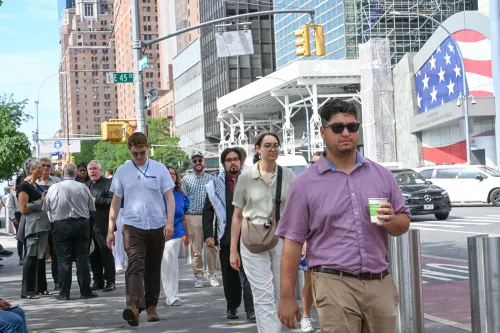
In 2015, the UN established its 2030 Agenda, a 15-year plan consisting of 17 distinct but connected sustainable development goals, addressing an array of issues including hunger, poverty, racism, gender inequality, clean water access, ocean care, environmental care and more. Each July, representatives from governments and organizations convene in New York City at an event called the High Level Political Forum to discuss progress on a handful for the established Sustainable Development Goals, or SDGs.
This year, the young adults, mostly between the ages of 18 and 26, made up the second PC(USA) HLPF delegation organized by the denomination’s ministry at the UN. Last year, 13 young adults attended.
Since 1998, the PC(USA) has held special accreditation status with the UN’s Economic and Social Council (ECOSOC) which allows the denomination to engage in global advocacy efforts, submit statements to the UN, and send delegations to various UN meetings and events. For years, the PC(USA) has had a significant presence at the UN’s annual Commission on the Status of Women, which is organized in part by the denomination’s UN office. That event allows Presbyterians from across the country to see the church’s work with the United Nations and take what they experience back to their own congregations and mid councils.
Clare Balsan, the advocacy associate in the PC(USA)’s UN ministry, said that a couple of years ago she and Sue Rheem, the PC(USA)’s representative to the UN, saw an opportunity to give young adult Presbyterians a similar opportunity with the High Level Political Forum. Like the church, the UN has identified young adults as a key demographic to engage in its work toward a sustainable future. The Presbyterian Ministry at the United Nations sent its first young adult delegation to the HLPF in July 2025.
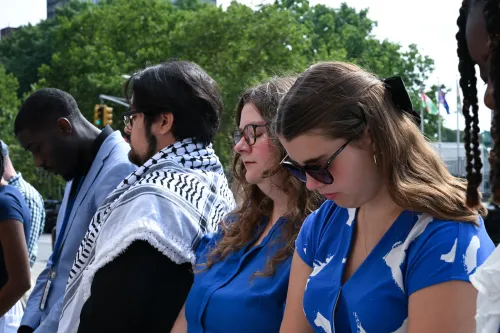
This year’s delegation was made up of young adults from all over the country, including California, New Mexico, Kentucky and the Carolinas. Some were college students, others seminarians. Some were pursuing environmental justice as a career, and others policy work more broadly. Several members of the delegation were part of the summer fellows program with PMUN or the Office of Public Witness within Presbyterian Life & Witness. Many of them were encouraged to apply by pastors and other church leaders who knew them.
In a video captured by the Communications Ministry of PL&W, delegate Anwi Fomukong said she was inspired to attend because of both the unique access to the United Nations and because of the event’s relevance to her own Environmental Science degree, which she is currently pursuing at the University of New Mexico.
“We have a few classes on the SDGs, so it would be super cool, I thought, to see how these SDGs are actually getting implemented around the world,” Fomukong said.
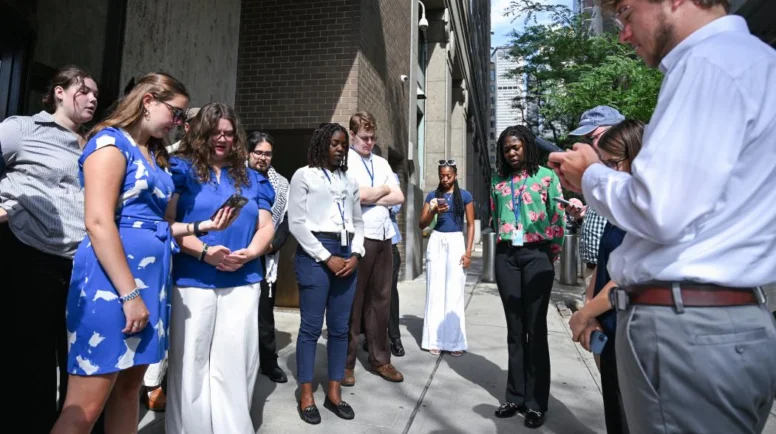
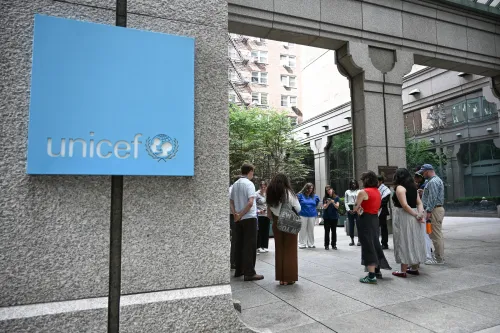
Over the course of the week, delegates were able to attend various meetings among UN representatives as they discussed specifical SDGs around water and sanitation, affordable clean energy, industry and infrastructure, sustainable cities and communities, and others. However, the delegates’ week wasn’t just about attending meetings. They also joined ecumenical and civil society partners from the Church Center for the United Nations in a silent vigil for Gaza outside the United States Mission to the UN. On the final day of their week, they held a prayer walk, stopping at various locations around the UN, including the Church Center for the UN, UNICEF, the U.S. Permanent Mission, and the UN Development Programme.
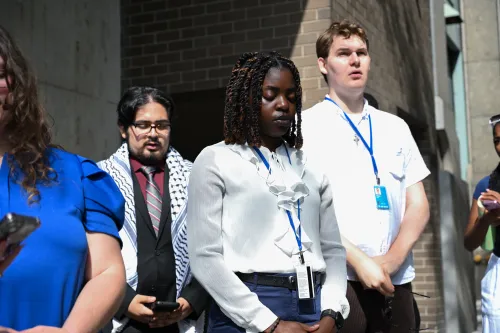
During daily devotions, meal-times, and debriefing sessions, they had the chance to connect with one another. Several participants said this opportunity to get to know other young adults who shared their values and commitments was a highlight of their experience.
“Being part of the HLPF delegation meant a lot to me, as I was able to meet other young people of faith that were so interested in social justice,” said Bella McKenzie of Grace Presbytery. “It really cemented my faith in the church, PC(USA), and our generation!”
Fomukong described meeting other young Presbyterians with so much motivation and interest as “refreshing.”
Delegates also had the chance to reflect on their own vocational discernment and how their faith informs their advocacy in conversation with the Rev. Chris Palmer, pastor for young adults and membership at Fifth Avenue Presbyterian Church and Katherine Ellis, a doctoral candidate in religion (theology & ethics) at Baylor University. They also attended a workshop organized by the Committee on Voluntary Service and Action about bringing the 2030 SDGs back to their communities.
Caroline Brucken said that the experience helped her understand the complexity of turning talks into action with a body as large as the UN, which has 193 member states. Brianna Pennington, who attended HLPF as part of her experience as a summer fellow with the Office of Public Witness, said that on one level, her own role felt “miniscule” compared to the diplomats representing member states at the UN. But ultimately, she was able to see how pivotal the church and faith leaders such as herself can be.
“My biggest takeaway from HLPF is the impact that the church, non-governmental organizations, and individual volunteers have in implementing the sustainable development goals,” Pennington said, adding that she left the experience “feeling inspired and energized to bring what I learned back to my community.”
Balsan said that sort of inspiration to share with their communities back home is exactly with they hoped the program would spark. Rheem agreed, emphasizing the need for congregations and individuals to understand how global advocacy is connected to what’s happening in their own local communities.
“It’s all interconnected and what happens in your local community impacts what happens globally,” Rheem said. She added that delegates seemed to appreciate that this work cannot be done alone or in isolation.
She said the value of and need for collaboration was evident even in how the HLPF delegation program itself came together, relying on the combined efforts of various churches, mid councils, and even ecumenical partners. Local congregations in New York City provided some financial support and housed delegates during their time at HLPF. Congregations, presbyteries, and synods helped promote the opportunity and supported delegates — both spiritually and financially—so they could attend. And Presbyterian Women, which has its own accreditation with the UN, and several other ecumenical organizations shared their access passes so all the delegates could have access to the UN during their time.
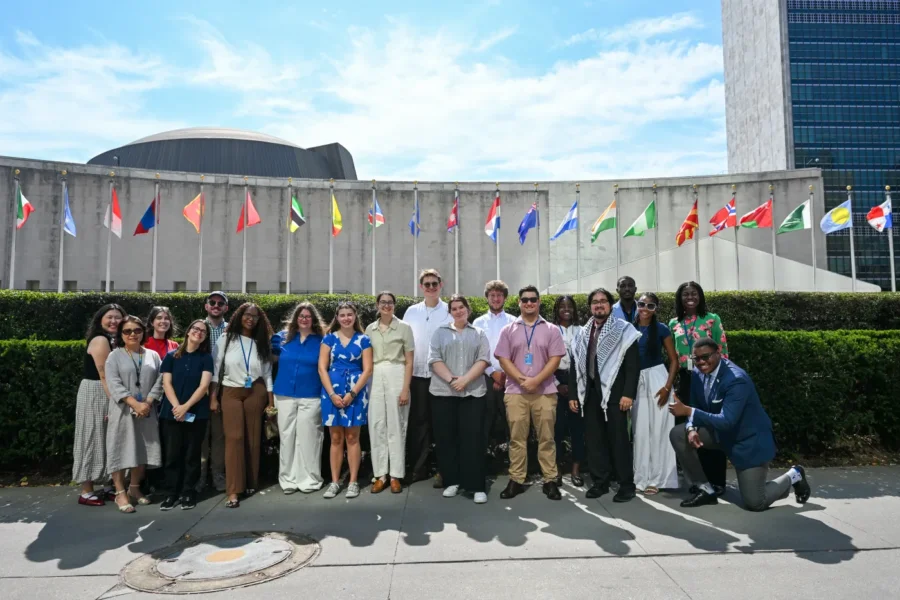
The result of these efforts was a powerful week that left participants and UN ministry staff alike full of energy and encouragement.
“It was really great to have the young people here who are really committed and wanted to do something.” Rheem said. “That sense of volunteerism was really palpable.”
Tucker Samuelian, a summer fellow in the Office of Public Witness and a member of the HLPF delegation, said the experience instilled in him a hope for the future because it showed “the young adults of the world are thinking critically, discussing problems, and providing solutions.”
“It is my wish that the governments of the world … take seriously the ideas and voices of young adults and provide a platform for those facing injustices to share their stories with the world.” Samuelian said. “We may all become better for it.”