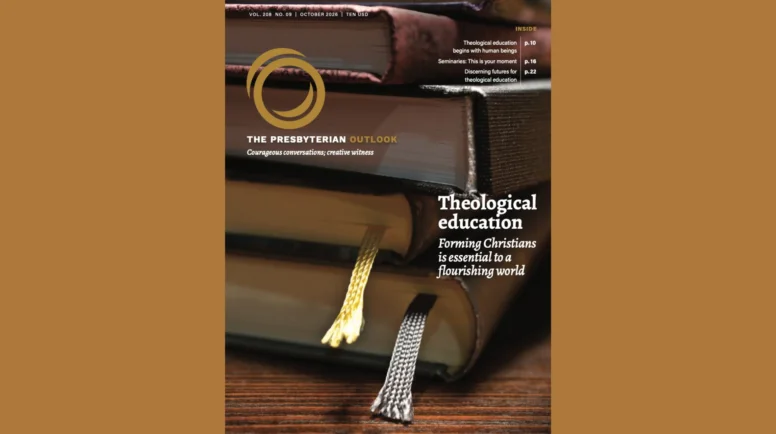
Walk into almost any contested public space and religion is already there — in the candidate’s closing argument, the school board member’s objection, the comment thread, the bill moving through committee. What we believe or don’t believe about God shapes what we think about ourselves, our neighbors and our obligations to each other.
The question is not whether religion will have a hand in shaping our shared life; it will, and it does. The question is whether we are equipped to examine the theology presented to us, to ask how these beliefs are shaping our lives and communities, and to discern whether this religion is oriented toward love, justice and human flourishing.
This is why theological education matters.
Christian nationalism offers a particularly urgent example. This political ideology, which seeks to merge the Christian faith and America’s constitutional democracy, distorts both. Christian nationalism can be difficult to recognize because it often looks and sounds familiar, with images of Bibles and crosses, and with Christian hymns to sing. Its adherents speak of loving God and loving country.
What, we might reasonably ask, is wrong with loving Jesus and loving your country?
Nothing. The problem comes when those loves are fused: when God ’n Country collapse into a singular phrase, and the country inherits the divine authority of God; when Christianity becomes a litmus test for who counts as a real American; when political power is recast as something Christians are not merely permitted but destined to hold.
Historian Jemar Tisby names the danger well: “The subtler threat of Christian nationalism is a kind of ubiquity that leads to invisibility. For so many white Christians, Christian nationalism isn’t Christian nationalism. Rather, it’s just Christianity. People don’t even see it and that’s the deadliest threat.”
This is precisely the work of theological education: helping us see.
At times, Christian nationalism is connected to other theological claims that require careful scrutiny. Dominionism teaches that Christians are chosen by God to exercise control over society and its institutions. White supremacy attaches divine favor to Whiteness, White culture and White Christian identity. Nationalism makes the nation itself an idol that cannot be critiqued.
Each of these ideologies can be wrapped in Christian language. Each can quote Scripture. Each can appeal to deeply held religious convictions. But Christian language does not make an idea faithful to Christ.
At the 227th General Assembly this summer, commissioners overwhelmingly approved “Standing Against White Christian Nationalism,” a policy statement from the Advisory Committee on Social Witness Policy. The statement distinguishes patriotism – appreciation for one’s country and commitment to its ideals – from nationalism that grants the nation divine status or supremacy. It rejects White Christian nationalism as contrary to Reformed theology and urges Presbyterians to study it, preach and teach about its dangers and speak against it.
When we consider the future of theological education, we are not merely talking about the future of seminaries, enrollment numbers, degree programs or the changing shape of ministry. We are talking about whether Christians will have the intellectual, spiritual and moral formation necessary to recognize theologies that deform the gospel. That formation cannot remain behind seminary walls.
The future of theological education must include pastors who continue learning long after graduation, congregations that take adult Christian formation seriously, colleges that help students examine religion critically, publications that bring theological scholarship into public conversation and churches willing to wrestle with difficult faith questions.
Theological education teaches us to ask: What does this belief say about God? What does it say about our neighbor? Who benefits from this belief? Who is harmed by it? Does it lead us toward Christ’s all-encompassing love or toward exclusion and the accumulation of power? Does it widen our circle of concern or shrink it?
Those are not abstract academic questions. They are discipleship questions. They are also questions on which the health of our church and our democracy depend.
We need theological education because religion is powerful. Our faith can inspire courage, compassion, justice and liberation. It can also sanctify hierarchy, exclusion, violence and domination.
Our call is to learn the difference.