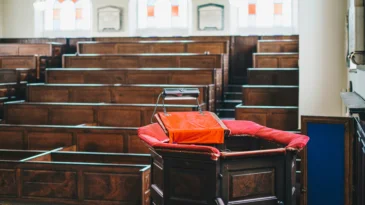
Shannon Webster, pastor of First Presbyterian Church in Birmingham, figured out quickly that his historic building – the oldest church in the city – had been spared when the April 27 tornado took another path, skipping over that chunk of downtown Birmingham. But that didn’t lessen his anxiety for the church’s members.
People come to this 450-member church from a wide geographic area – some walk a few blocks, some drive 40 minutes. Webster knew that some of them lived straight in the storm’s path.
So he and the associate pastor, Michelle Freeman Owens, divided up the church directory and began calling church members, working into the night on Wednesday. They reached as many as they could and heard that some people were missing. Starting Thursday morning, “I got in my car and went looking for the rest,” Webster said.
It wasn’t easy going – in some places the roads were blocked, so he got out and walked into the neighborhoods. It took two and a half days, but by Saturday “we found all of them, and they are all alive,” he said. “We are feeling spared and blessed.”
The physical destruction, however, was immense. The tornado touched down west of Tuscaloosa and stayed on the ground.
“This one didn’t hop,” as tornadoes often do, Webster said. “It just dug a scar in the ground in a straight line from Tuscaloosa to Birmingham and kept on going.” In that mile-wide swath, “it’s like it’s been blown up and bulldozed.”
And other, smaller tornadoes bounced around central and northeastern Alabama as well. While no one from First Presbyterian had a home destroyed, “we have people whose homes were damaged,” he said. One staff member’s home sits on a street where most of the homes were destroyed, but “her home is still standing, without a porch and carport and windows.”
Now, the staff is beginning to minister to people’s emotional needs.
“There’s stress,” as the destruction has “caused emotions to be right on the sleeve,” Webster said. “There are lots of tears. There’s laughter as well, but it has an edge.”
The community is close enough – and the death toll of at least 350 across the southeastern U.S. was high enough – that nearly everyone knows someone who knows someone who died.
Church leaders are reminding the congregation “that we are all in this together,” Webster said. “We have each other.”
A representative of Presbyterian Disaster Assistance was at the church for Sunday morning worship, and “we talked to the children about whether or not they were afraid, and what it sounded like” when the tornado passed through, Webster said. They told the children “we have friends who come from far away to help. Here is the face of a friend” – introducing them to the emergency responder from Presbyterian Disaster Assistance.
The congregation also talked about theological questions – “Why does this happen? And do we doubt the presence of God in this time?”
Owens preached from the lectionary – appropriately citing the story of Doubting Thomas, who would believe in the resurrection only when he had placed his finger in the wound in Jesus’ side.
Owens started off by describing a bit of what she had planned to preach. “And then, Wednesday came,” she said – and everything changed.
“I’m finding it difficult to comprehend the level of destruction that has happened,” Owens said in her sermon.
“It’s too much for the brain to wrap around. How can entire neighborhoods be gone? How can so many be dead, or injured? How can we know that the news will get worse before it gets better? Homes, businesses, infrastructure, are all gone. Family photos, the baptism gown passed down for three generations, a child’s lunchbox with their favorite cartoon character, the back porch where family would gather on cool spring evenings, birth certificates, tax documents, deeds, the whole neighborhood, and your neighbor, our neighbors, all gone. Gone.
“Bewilderment, grief, pain, shock, anger, quickly replace the relief folks have at just being alive. Whether you have seen the faces come across your television screen or have been out to survey the damage, I’m sure that many of us can’t help but feel those same emotions ourselves. And overwhelmingly we need to understand why this happened, and we need to do something about it.”
She spoke a bit about how Presbyterian Disaster Assistance will help with the long-term recovery needs.
“But it’s the intangible needs we have that are more difficult to meet: our need for answers, for how to deal with the overwhelming devastation we see, to comprehend the trauma and grief and pain of it all,” Owens said. “Why did this happen? Where was God on Wednesday? Where is God now? Why would God ‘allow’ such enormous pain and suffering to occur? These are questions to which there are, finally, no answers that are fully satisfying.”
She did, however, offer some reflections:
* God does not cause natural disasters to occur to punish sinners, as “we are all sinners.”
* God was with the people of Alabama as the tornado blasted through, with those huddled in their homes, with those crying out, with those who died.
* God is present in the community’s healing response. As she said in closing: “Together we will bring Christ’s peace to those who need it most.”
After worship was over, the congregation gathered for lunch and a meeting to form a Tornado Task Force. That 16-member group will work with an ecumenical faith-based community group called Birmingham Faith in Action to make sure that “dollars and efforts are used well, and the poor are not neglected,” Webster said.
He also participated in a conference call with pastors from Baton Rouge, La., and New Orleans, the veterans of a series of hurricanes, “asking them, `What do you know that we need to know?’ They were very helpful,” with some offering to come to Alabama to assist. Another consultation is planned for this week with federal disaster response officials.
“Right now, everybody’s running to take care of immediate needs,” Webster said. In the weeks to come, however, developing a long-term needs assessment will be crucial.
“If someone’s drowning,” he said, “it doesn’t help to rush to the shore and throw them a hammer.”