
I do not understand my own actions. For I do not do what I want, but I do the very thing I hate. (Romans 7:15)
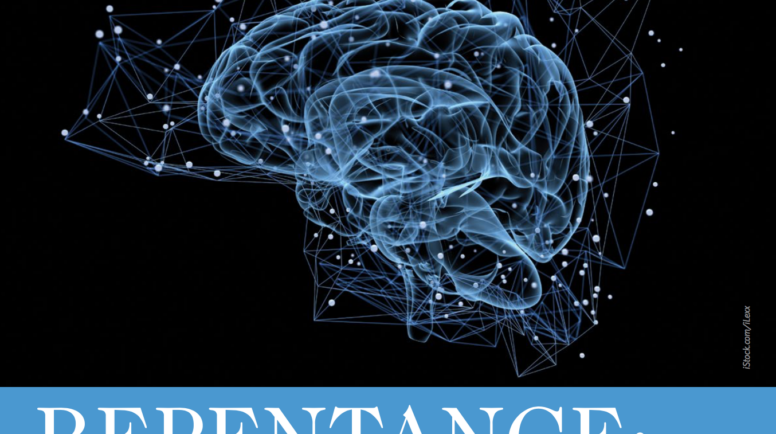
The apostle Paul may not have known 2,000 years ago the reasons he did the things that he did not want to do and not the things that he wanted to do, but today we do have some idea of how that happens. The billions of neural connections in our brain – shaped by our genetic heritage, our evolutionary past, our early development and the experiences we’ve had – send signals to our lips and tongue to lash out with hurtful words and to the muscles in our legs to walk away from the stranger who needs our help. Likewise, the emotional centers in our brain – shaped by thousands of years of evolution – recognize anger or anxiety in the eyes of someone we love and that move us to apologize, embrace and reassure.
The eminent scientist and theologian John Polkinghorne lays out the challenge in “Belief in God in an Age of Science” that our understanding of the brain presents today saying, “There has been a considerable amount of thought and speculation among those concerned with the interface between science and theology, concerning the extent to which it is possible to speak with integrity about the notion of God’s acts in the world, whilst at the same time accepting with necessary seriousness what science says about the world’s regular processes.” Is our sinful behavior (really our sinful nature) tied back to original sin and the fall of Adam, or is it the output of the regular process of neural activity? Is our ability to change our behavior and move toward wholeness in our relationships with others and God because of God’s action on our behalf, or is it the output of the regular process of neural activity? How do we reconcile regular processes of neural activity with God’s activity? Is the situation a both/and rather than either/or?
Although church doctrine is often thought to be stagnant, it does change over time. The Reformed tradition in particular regards our understanding as always being re-formed. In “Bodies and Souls, or Spirited Bodies?” Nancey Murphy notes that the Christian understanding of human nature has changed throughout history though interactions with the Greek world, through the revival of Aristotle in the late Middle Ages and following the development of historical-critical methodology in the modern period. In addition, there are three times in “Western history where science has called for a re-appraisal of theories of human nature. The first was the replacement of Aristotelian physics by modern physics in the seventeenth century. … The second major scientific change was the Darwinian revolution in biology. … The third major scientific impact is taking place right now due to the influences of contemporary neuroscience. It is becoming increasingly obvious to many that the functions and attributes once attributed to the soul or mind are better understood as functions of the brain.” For Murphy this reappraisal does not diminish our understanding of God, but expands it. Like Murphy, I see neuroscience a way to have a deeper understanding of God’s activity in the world.
Calvin to the rescue
“Departing from ourselves, we turn to God, and having taken off our former mind, we put on a new.” – John Calvin
In the Reformed tradition, we have John Calvin to thank for deepening our understanding of repentance. For Calvin, repentance has two faces: death of a corrupt sinful nature and new life in the Spirit of God. Calvin refers to these processes as mortification of the flesh and vivification of the spirit. They are a consequence of faith and conferred on us by Christ with the Holy Spirit as the author. Calvin explains repentance saying, “departing from ourselves, we turn to God, and having taken off our former mind, we put on a new. … It is the true turning of our life to God, a turning that arises from a pure and earnest fear of him, and it consists in the mortification of our flesh and of the old man, and in the vivification of the Spirit.” The fallen creature that we abhor and is displeasing to us is the flesh that must die. Then in us will be a “new zeal to seek God” and we will be regenerated into what we were initially created to be: the image of God.
For Calvin, both knowledge and grace are required. Repentance requires knowledge of the law and knowledge of our redemption through Christ. The law shows us our wretchedness, that which must be mortified. Christ bridges the gulf between humans and God. We receive grace through Christ’s merit, not by our own. Christ’s death on the cross and descent into hell correspond to the mortification of our flesh and his resurrection to the renewal of life. Vivification is not a “happiness” that arises from the relief that one is not condemned, but “rather, the desire to live in a holy and devoted manner, a desire arising from rebirth; as if it were said that man dies to himself that he may begin to live to God.” Repentance is the conversion by which our old sinful self dies and a new life arises.
Reshaping the brain
Synaptic or neural plasticity is the dominant schema for understanding brain development and function in contemporary neuroscience. Its roots lie in the work of mid-20th century neuroscientist Donald Hebb. Attributed to Hebb is the following explanation: When an axon of cell A is near enough to excite cell B and repeatedly or persistently takes part in firing it, some growth process or metabolic change takes place in one or both cells such that A‘s efficiency, as one of the cells firing B, is increased. Hebb’s Law is often paraphrased as “Neurons that fire together wire together.”
 In the 1970s, researchers confirmed Hebb’s model using electrical stimulation of individual synapses in slices of rat brain tissue. This procedure, known as long-term potentiation, has been used to study the plasticity that underlies short-term and long-term memory, as well as other processes where brain remodeling occurs including addiction, response to stressful stimuli, pain and depression. Changes in brain function (behavior) result from biochemical changes at the level of the synapse, which induce transduction pathways that signal intracellular changes such as alterations in protein structure and induction or repression of gene expression. In addition (and important for long-term behavioral changes), remodeling of brain architecture occurs through modifications to the neural cells via insertion of new receptors, additions of synaptic contact points and restructuring of the region where synaptic transmission occurs. These biochemical and cellular architecture changes are rapid, happening within minutes of stimulation. There is also a corresponding process that weakens synaptic contacts, remodeling the brain to diminish connectivity. This process is known as long-term depression and it allows the brain to remove connections that are no longer relevant. Thus, synaptic plasticity provides a mechanism for long-term changes in brain structure function – with old connections dying off and new connections made. Old behaviors can thus be mortified and new behaviors vivified. Calvin was on to something: We actually do take off our former mind and put on a new mind.
The changeable nature of our brains leads to a changeable nature of the individual. Now we add God to the picture. Here the theologian Kathryn Tanner is helpful. In her book “Christ the Key,” Tanner uses the counterargument that the changeable nature of humans allows humans to be transformed. Via attachment to God, we become reworked beings because plasticity is part of our human nature. She says, “What is of interest about human nature is its plasticity, its susceptibility to being shaped or molded by outside influences. … Humans seem to have an exaggerated capacity for this that opens them to a radical reformation from without in the divine image.” Because humans are like soft wax, we have “reflexive capacities of self-formation [which means] humans can try to reshape in a self-critical fashion even desires they cannot help having by nature.” Thus, Tanner eloquently voices the output of synaptic plasticity, a re-formed and always re-forming nature that is arching forward toward the image of God.
Being recreated in the image of God requires loss and death of the earthly and sinful ways we have lived. I’m thinking Calvin might be delighted by modern neuroscience, which has shown us the mechanisms by which we rid ourselves of old habits and old ways, of unhelpful and harmful pathways and the way we create connections that can lead to wholeness. At the level of the neural tissue, this is both a destructive and a constructive process. Our brain is ever being shaped. It is in a dynamic state rather than a static state.
 From a spiritual perspective, reshaping of our very being can be disruptive, maybe even painful, as we pull away from the comfortable and stretch ourselves toward the vision God has for our lives. As Tanner argues, “Sinful through our hardening to divine influence, we must be re-spun or refashioned, in a way that brings us back to the fundamental plasticity of our nature, broken down in order to become ourselves anew.” When we turn to God, when we attach to God, we allow Hebbian Law to reign supreme. The neurons that fire together, wire together. Our knowledge of our separation and our turning to God to breach that separation are connected. Our recognition of the harm we have done is connected with our desire to make amends. We are simultaneously saints and sinners as connections are refashioned.
Both/and science and faith
Rather than seeing neuroscience and religion as opposing forces, we can see repentance as an example of where neuroscience enhances our understanding of an essential tenet of our faith. Yes, we can repent. It is possible because our brains can be restructured. We truly can turn from our sinful ways and turn to God. We recognize that we are created in the image of God and that we have distorted this image through sin, through separation from God and others. This leads to a desire to be restored. A Reformed understanding of justification emphasizes that we are not made free of sin by our own doing, but rather by grace through faith. However, our understanding of sanctification does promote our responsibility for our actions. Thus, the plasticity of our brain permits us to recognize our sinfulness and find ways to change through our own actions – asking for forgiveness, making amends and reparations, seeking paths of reconciliation and developing the gifts of the Spirit like self-control and kindness.
 Lisa Schrott is the associate pastor for pastoral care at First Presbyterian Church in Hilton Head Island, South Carolina. She previously served as associate professor of pharmacology, toxicology and neuroscience at Louisiana State University Health Sciences Center in Shreveport.