
“For some of us, books are as important as almost anything else on earth. What a miracle it is that out of these small, flat, rigid squares of paper unfolds world after world after world, worlds that sing to you, comfort and quiet or excite you. Books help us understand who we are and how we are to behave. They show us what community and friendship mean; they show us how to live and die.” — Anne Lamott (in “Bird by Bird: Some Instructions on Writing and Life”)
My grandmother was trained as a librarian. She loved to read. Her genre of choice was mostly literature, but as a Presbyterian to the core, she dabbled in a bit of theology. As a young woman, she left her family in Charleston, South Carolina, to strike out as a high school librarian in the small town of Greer, South Carolina. She used to tell me how she remembered one particular student spending all of his free time in the school library, immersed in history books. That same young man would never complete his degree. Instead, he would drop out of school to sign up for the Navy in the midst of World War II. Their paths would cross again years later, when their children began dating one another in high school.
My four grandparents were very different from one another. One set was formally educated, and the other never completed high school, but all four valued the gift of learning. A love for books has been in my blood from the beginning. I can remember the smell of old books in the public library I loved to visit. I thumbed through the history books on my grandfather’s bookshelves, marveling at all he knew with no formal education beyond a GED. I loved reading the nameplate on the inside cover of all my Nana’s books that bore a quote by Ernest Morgan: “I enjoy sharing my books as I do my friends, asking only that you treat them well and see them safely home.”
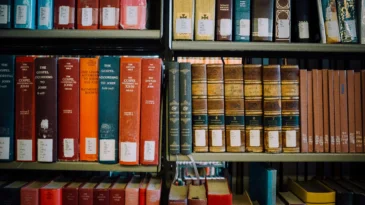
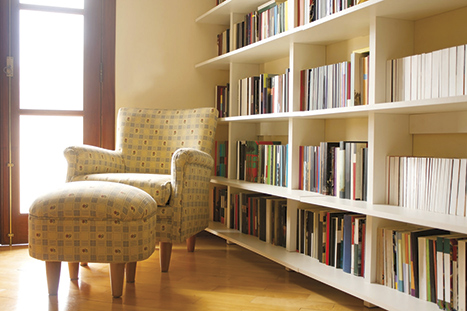
I am sure it sounds old fashioned, but I love the feel and weight of text. I use digital versions and listen to audiobooks as much as anyone, but it is hard for me to imagine a world without weighty hardbacks and dog-eared novels. I am a visual learner. There is something to be said for reading the words on a page, holding and smelling the aging paper, and jotting my notes in the margins. I believe the old adage is true: You can learn a lot about a person by the books on her bookshelf.
Today, with information at our fingertips, we take much of it for granted. In the 15th century, Gutenberg’s printing press made the Bible more available to European Christians than the book had ever been. Its publication helped fuel what we would later know as the Reformation. When Martin Luther nailed his 95 theses to the Church at Wittenberg decades later, could he have had any idea that his words would go “viral”? The explosion of book production between the 15th and 16th centuries was incredible. What would follow is a revolution of communication. Our theological forefather John Calvin would learn of Reformers like Martin Luther and Philip Melanchthon first through the work of written word. It was Calvin who would put the codified theology together that is so familiar to us Presbyterians today: “The Institutes of Christian Religion.”
The written word is a miraculous thing. It allows us to communicate across time and distance. In 2008, I traveled with my seminary to historical and theological sites in the Middle East. While in Alexandria, Egypt, I imagined the role the ancient Great Library, a public library first opened around 300 B.C., must have played. Libraries were extraordinarily expensive and difficult to compile. Most libraries in ancient times were private, and only the wealthiest and most educated had the resources they could painstakingly afford and acquire. Today, I Google “Great Library, Alexandria” and a host of images and articles appear on the library’s history, supposed contents and its ultimate destruction.
I have often heard Presbyterians described as a people of the book. What I assume we mean by such a depiction is that we are a people of the Word, like many other faithful traditions. But perhaps a unique distinguishing factor of ours is the emphasis we place on lifelong learning. As pastors, educators and people of faith, we each ought to strive to be a seeker among seekers. Some of my favorite people happen to be retired pastors and Christian educators. They “get” the life of parish ministry, but more than that, they get the importance of learning. I am fortunate enough to serve a congregation that has many retired pastors. I have been the beneficiary of some of their books and commentaries over the years. And I have appreciated, more than I can say, the open and honest conversations they have about their own questions and struggles with faith.
The Reformed tradition is known for its depth of theology and learning. Our rich tradition allows us the opportunity to mine the Scriptures for their weight, to question and constantly seek new understandings and to use our minds to diligently search for the intersection of life and faith. We have a proud history of insisting on educated ministers and supporting institutions of higher education.
So much of my personal and professional library is thanks to my own institutions of higher learning. My college and seminary professors introduced me to new worlds of thought and helped me explore and question my own theology. When I go back to my earliest days of books, it is plain to see how what I have read has helped shaped my thoughts and my character.
As a young girl, my mother and I took turns reading before bed each night, and Anne Frank spoke to me through the pages of her diary. A hidden door in the back of closet in an English manor house ushered in a whole new world called Narnia. It was L.M. Montgomery who transported my imagination to a small island village where I learned that I wanted to be a strong and independent young woman through the lens of an orphan girl named Anne. The Brontë sisters taught my adolescent heart about deep, brooding things. The mystery and darkness lurking between each line sparked my love for language and helped grow more comfortable with the unexplainable things of life. Jane Austen’s wit and humor helped me laugh at the folly of human nature. She taught me that from time to time, we all behave badly and judge when we should not.
Literature continues to teach me a great deal about myself and the world. I look forward to my monthly book club, and have enjoyed reading books I would have never chosen on my own. But it is the soul-bearing truth of theologians who give me the words when I cannot find them on my own that I cherish the most. When I was a student at Presbyterian College, I registered for an elective philosophy course. I needed the additional credits, and this particular course happened to suit my schedule. I had never heard of Søren Kierkegaard before that first day. In his writings, I was introduced to a theologian who helped me explore the depth and doubt of my own faith. His words challenged me to take my faith as seriously as my own life, and to see my own faults and shortcomings with clear eyes. That same semester, I was also introduced to Dietrich Bonhoeffer. I was humbled by the life he led and the courage he described in what it means to take up one’s cross daily. It was through classes like these that I learned that when Jesus calls disciples, he asks for their very lives.
Truly, I miss required reading lists. The books my professors had me read in history, philosophy and religion classes were so good for my soul that I even miss the assignments and the late nights of reading and writing.
When I became a minister, I thought I would get to spend countless hours reading in my study. (That’s what a pastor’s office is supposed to be called, right? “The pastor’s study”?) As a girl, I pictured our minister pulling book after book off of his walls of shelves to read what some historian or theologian had to say on a passage of Scripture. I imagined that he must have spent his days reading and writing, only springing to action when the phone rang and a hospital visit or church member death called him away. Having served as a pastor for nearly nine years in a large program church, I can hardly think of a day when I spent hour after hour poring over texts. Perhaps I should be embarrassed to admit this (particularly here), but as an associate pastor, I preach so infrequently that getting back into the swing of research and writing feels a little what I imagine it’s like for our lawnmower each spring. It is no easy task to turn the motor over smoothly after it has been sitting idle during the months of cold weather.
A recent visit with our pastor emeritus reminded me that I need to reconsider how I manage my time. Bill Klein is kind enough to consider me a friend, and he shared with me a list he has compiled of the writers and books that have meant the most to him during his lifetime. We share a few favorites like Dietrich Bonhoeffer, C.S. Lewis, Richard Rohr, Paul Tillich and N.T. Wright. But his list has shared with me many other names of theologians and novelists I have not yet read, and even a few I’ve never even been exposed to: Jacques Ellul, John Macquarrie and Helmut Thielicke.
On his list, Klein wrote: “The list of my significant books includes authors from a former generation now deceased, as well as new writers. I have discovered in my later years that these new writers give fresh insights into my reading of older books, insights of which I was incapable in earlier readings. So I go back to some of the old books. If a book is worth reading, it’s worth reading again and maybe still again.” What I find on his bookshelves tells me that he is a lifelong seeker, a model for us all.
I am grateful for this exchange. The longer I am out of school, the more I realize I desperately need this kind of stretching and stimulation. Each fall, I remind our Sunday school volunteers that our participation in Christian education into adulthood helps teach our children that education is not a childish pursuit. As a pastor, I ought to do the same to show to my congregation that I am still learning and growing in my faith.
My annual preaching group helps me to stretch my research and writing wings a bit, but what I really need is to exercise my book allowance and get into the practice of making time to read. Who is to say? The most valuable book on my bookshelf this year may be the work of some tried and true theologian, or even some brand new voice I’ve yet to discover. It might also be a novel that stirs my soul, or poetry that speaks to the depth of human joy and suffering. Regardless, despite my growing dependence on electronic communication, my bookshelf grows and I am grateful for the voices which speak to me from the pages.
You are welcome to borrow a copy. Just be sure “you treat them well and see them safely home.”
 Elizabeth N.H. Link is the associate pastor for Christian education at Second Presbyterian Church in Roanoke, Virginia. Elizabeth is married to Chris and the two enjoy spending time in the Blue Ridge Mountains.