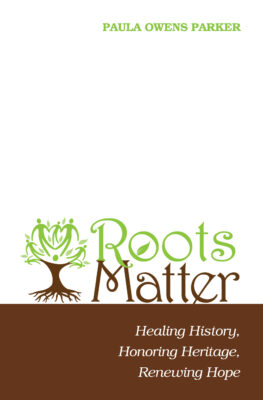
 Paula Owens Parker
Pickwick Publications, 224 pages
Reviewed by Karen Branan
Why did my mother get so upset when I asked simple questions about race? Why did I grow up feeling as if I had committed some horrible crime? Why did my father die believing erroneously that he’d killed a black girl?
These questions haunted me for many years and in my search for answers, I discovered family systems therapy, the genogram and trauma theory. I wandered from one discipline and method to the other, weaving in historical study, Jungian art and dreamwork, yoga, prayer, meditation, genealogy and regularly walking a labyrinth at Westminster Presbyterian in Washington, D.C. — a 25-year journey that would result in a book and a sense of wholeness long hungered for, but unimagined, in my youth and middle years.
Therefore, I am fascinated and delighted to discover “Roots Matter,” a fertile course of which blends genealogy, theology, psychology and history in order to heal generational trauma.
Designed as a six-week, 12-hour class for African-Americans by Paula Owens Parker, adjunct assistant professor of spiritual formation at Union Presbyterian Seminary and senior program developer for Roots Matter (rootsmatterllc.com), she has found it adapts well for a wide variety of people. She has used it with people in recovery from substance abuse, as well as with predominately white advocacy groups, women’s groups and conferences. The program uses trauma theory and the genogram, developed by Murray Bowen as part of his family systems therapy, to help participants begin to understand the inherited positive and negative patterns in themselves, their families and communities through several generations and the importance of differentiation of self. By identifying both trauma and triumph, individuals open up to forgiveness, reconciliation, healing and hope. Parker’s work was guided by the writings of four theologians dealing with trauma: Dominic Robinson, Matthew V. Johnson, Shelly Rambo and Flora Keshgegian. She describes their work in this book and discusses scriptural references to genealogy and generational transference.
The first half of “Roots Matter” concisely explains, based on scientific studies, the roots of trauma to African-Americans, Jews, Native Americans and Armenians and the ways that trauma may manifest in their lives today. Activities include reading slave narratives, free writing, researching family history, creating family genograms and designing healing prayers and services.
One woman in the pilot course described her experience this way: “You seldom get a chance to use a stretch of time to ponder, to reflect and to experience transformation in your everyday life. I felt that the service was very much a process of closure and an opening of the spirit to embrace a new beginning of life experiences. I find myself very emotional and compassionate to concerns that surround me after class.”
The back cover of the book adds this impetus: “‘Roots Matter’ prunes the family tree of trauma, the silent, secret, and severed stories that stunt the growth of the family, and tends to family roots, fertilizing them with the recognition of the resilience, achievement, gifts, and talents of the ancestors, thus creating a healthier environment for future generations to flourish.”
Karen Branan is the author of “The Family Tree.” She lives in Washington, D.C.