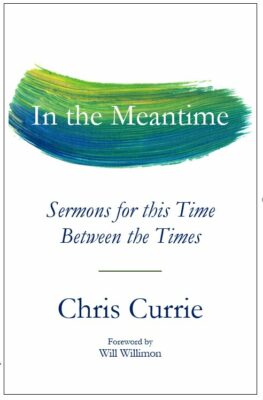
 Chris Currie
Parson’s Porch, 152 pages
Every Sunday, all across the world, preachers stand to proclaim a “word from the Lord” to a particular people, in a particular place, at a particular time. It’s an incredibly inefficient process, and one that various technologies and ecclesiologies may continue to challenge. But “in the meantime,” this kind of face-to-face communication is the primary means by which Christ becomes present to local congregations, week in and week out.
Chris Currie is well aware that compiling a written artifact of such particular proclamations is problematic at best. It risks “removing them from the intimacy of the congregation in which they are preached” and “ripping them from the struggles a community may be facing.” A “prayerful imagination” (Eugene Petersen’s term) will be required for these printed words to come alive for the reader. Nevertheless, I think this works in this particular case.
First, the congregation of First Presbyterian Church in Shreveport, Louisiana, comes alive in these sermons. We meet the rest of the ministers by name: “Seth and Holly and Rhodes and Lynace.” Particular ministries provide the closers in certain sermons, like the bus picking up homeless children from Caddo parish. First Presbyterian provides much of the grist and the grace for these sermons, as did other congregations for sermons before.
Second, and related, these sermons are rooted in a persistent ecclesiology, which holds up both the absurdity and the necessity of proclamation in the midst of real-life congregations. In a sermon on the calling of the disciples titled “Outliers,” Currie first stresses the foolishness of Jesus’ mission strategy: Jesus “can redeem humanity without [calling disciples]. … We are trouble. Our lives are messy. Our abilities are sketchy. We have baggage.” Nevertheless, Currie is clear that Jesus will not work without us. “So let us continue to thrive and be a community of faith, hope, and love, a refuge from social isolation, a place full of interesting happenings and interesting people, and most of all, an interesting God.” Good preaching gives birth to a flawed, yet faithful congregation who hears and responds.
Third, and most important, these sermons consistently point toward an “interesting God.” While the source material in these sermons covers a wide range (from Tom Petty and Willie Nelson and “The Muppet Movie,” to quotes from Richard Neuhaus and Reinhold Niebuhr and The Christian Century), the focus of these sermons is consistently the “God who shows up in the least likely places, the Lord who becomes a servant, the God who comes to us in what looks like foolishness and debasement and yet turns our world upside down and invades our lives with his disruptive grace.”
No, reading a sermon will always be second best to hearing sermons in community with the congregation to whom they are preached. But with a little prayerful imagination, these sermons have the power to make that event come alive or, better, reveal the God who is always alive within and through them. Read them — for far more than pleasure.
 RICHARD BOYCE is the dean of the Charlotte campus of Union Presbyterian Seminary, and associate professor of preaching and pastoral leadership.