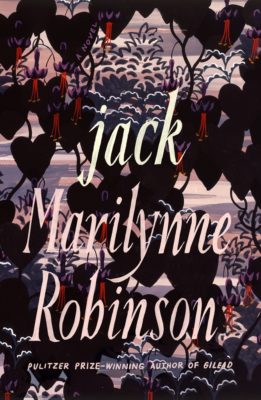
 Marilynne Robinson
Farrar, Straus and Giroux, 320 pages
Reviewed by Sarah Kiewitz
Young couples sometimes slip into cemeteries at night to have dramatic conversation, like an early scene in Marilynne Robinson’s “Jack,” but here the drama is adult, fraught. Jack, a middle-aged, self-proclaimed bum is mourning his toddler daughter, whom he abandoned and never met. She is buried in a modest cemetery in Gilead, Iowa, the home of his unconditionally loving family — family he hasn’t visited in 20 years. But Jack, a charming thief, compulsive liar and alcoholic, receives grace in the form of Miss Della Miles, a Black high school English teacher, soon to be his wife, with as much ceremony as 1950s miscegenation laws allowed.
On this cemetery evening, the couple’s third stolen moment, the romantic deal is sealed with chivalric behavior and conversation about predestination, cherubs and “Hamlet.” Della – kind, bookish, determined – was locked in the cemetery while writing poetry. Walking out in the morning with Jack may yield an arrest — or worse, the loss of her job. On their tumultuous second date Della had chided Jack for giving up his privilege, yet she abandons her hard-earned, Talented Tenth prestige for poetry and unrelenting love. Even when Jack manages briefly to become the man he could be, the societal sin of racism defeats their hopes.
To say “Jack” isn’t Robinson’s best work is as true as it is beside the point, because it stands tall in an oeuvre of Titans. Fans yearning to see threads, beautifully woven in Robinson’s novels “Gilead,” “Home” and “Lila,” originate in prequel scenes will not be disappointed. In those works, Robinson breathes life into Lila, a neglected, itinerant child who grows to be a contemplative convert, a halting new reader, a loving mother. Robinson even more effortlessly inhabits Lila’s humane, lonely husband, Reverend John Ames, a man like Robinson in restraint and intellectual temperament.
But the more flawed characters – Jack and Glory in “Home” (and Lucille in “Housekeeping”) – though fully realized, seem not fully forgiven. This causes an identification crisis, not because we can’t see ourselves in them, but because we can. In “Jack,” this crisis creates a feeling that the book may be flawed, when perhaps we are. “Jack” only intensifies the impression of a character needlessly self-orphaned, utterly compelled to sin, yet who remains lovable, beloved even, and is thereby poised to receive unmerited grace. This masterful Calvinist nuance is counter to convention because such pained characters are often transformed in order to be fully realized, like Sydney Carton in “A Tale of Two Cities” or the Whiskey Priest in Graham Greene’s “The Power and the Glory.” No, Jack remains a fallen Adam, apple thief, sick with perpetual temptation, just outside the garden that would contain he and his wife whole and unashamed. Yet even east of Eden, the grace of Della’s love gives Jack a temporary reprieve from his lack of ease in his own skin.
Those who read “Jack” first would miss the full resonance of a handful of passages, but all the missing moments might ache like a phantom limb. Robinson addresses this in an exchange about the lost stories that must underlie “Hamlet.” But Jack is Ophelia and Hamlet both — his depth plumbed only when all the acts are performed together yet remaining ever not quite. Jack’s shame, helplessness and pride tempt him to (or predestine him for) the outer darkness, a distinction Robinson doesn’t settle. Her thoughtful, generous prose continues to occupy the space between compassion and judgment, the space of truth.
Sarah Kiewitz is a professor of English at Sinclair Community College in Dayton, Ohio.