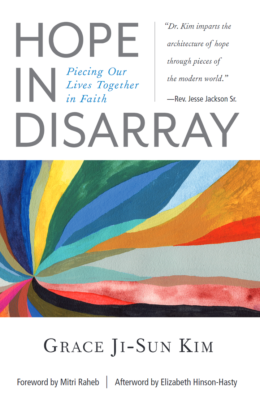
 Grace Ji-Sun Kim
The Pilgrim Press, 160 pages
Reviewed by Eunjin Jeon
Grace Ji-Sun Kim, an ordained Presbyterian minister and a professor of theology at Earlham School of Religion in Indiana, is a Korean American theologian who examines social and religious experience combined with intersectional theology. In “Hope in Disarray,” Kim asks: “Why do we hope?” and “How can we better understand hope and its preservation in our lives?” She found that we are living in limbo between hope and doom; however, we go on to abound in hope anchored in the very presence of God, living with hope to uphold expectations for goodness and the ultimate revelation of the Son of God. The hope we aspire to is not individual work, but involves collective effort to achieve it through reframing, rebuilding and reacting to social injustice and conflict.
This remarkable book has resonated with my personal journey to find abiding hope in a troubling world. As a female Asian pastor and a non-citizen living in the United States for the past three years, I have experienced anti-Asian hate crimes – intentional and unintentional – and feel that in the Atlanta spa shootings, the victims were killed because they were Asian and were women. Reading this book has encouraged me to find the abiding presence of God and use it to overcome social anxiety and fear in the midst of the struggling world, hence speaking out and taking action on behalf of marginalized individuals who are engaged in ongoing struggles and helping them to find hope anchored to the presence of God.
“Hope in Disarray” relies on the author’s personal narratives and spiritual reflections, contextualized in terms of her background as a woman, a mother, a wife, a theologian, an immigrant and an Asian American. This book contains three sections that pertain to the church, culture and relationship. Each chapter begins with a biblical passage and ends with discussion questions designed to stimulate further reflection and conversation regarding how faith and hope will work in readers’ lives and how they can steer toward hope and cope with fear. Overall, she draws the focus to the empowerment of minority groups and oppressed groups that are devoid of economic, political and social power.
The first section, living in the church, invites readers to reflect on their spiritual journey during their churchgoing years through the framework of intersectional theology, contributing to reframing the profundity of Christianity in a changing world. In the second section, living in the culture, she urges taking action and taking responsibility through cultural reimagination amid the disarray of racism, sexism, gun violence and the environmental crisis. In the last section, she encourages readers to engage in the all-encompassing issue of living through collective efforts as well as finding hope that is anchored to the presence of God.
I highly recommend this book to ministers and educators who seek a contextual perspective on theology in North America. This book will greatly inspire those who are planning group discussions and those engaging person reflection and devotional journaling. The author’s unique perspective will guide open-minded readers with theological, ecclesiastical and practical information. Reading this book in immigrant churches and multiracial settings will enable congregations to have transformative experiences with taking responsibility and taking action to achieve hope in a troubled world.
Eunjin Jeon is a pastor in the Presbyterian Church of Korea and an administrative assistant of the Institute for Youth Ministry at Princeton Theological Seminary in New Jersey.