

(RNS) Advocacy groups say plans of cable television companies to offer family-friendly programming packages are flawed and designed to thwart consumers from getting what they really want: a la carte sales, in which subscribers pick and choose their channels.
The marketing model traditionally used by cable companies and the two leading satellite TV services requires consumers to subscribe to channels in various pre-packaged "tiers." "Right now, to get the good channels, you have to buy the raunchy channels," complained Jim Metrock, head of the Birmingham, Ala.-based child advocacy organization Obligation Inc.
Portions of the cable industry -- under pressure from the federal government -- have come forward with a new willingness to package family-friendly channels into a special programming tier to help parents
For some, the question they'd most like to ask about the Presbyterian Church (U.S.A.)'s big fundraising campaign is: Is it working? Will they reach the $40 million goal?
But another question that seems to be growing organically from the campaign itself is: What's being learned? What is this campaign teaching folks about how Presbyterians think?
Because in the two and a half years since The Mission Initiative: Joining Hearts & Hands campaign started, it's seen a few extreme makeovers. What started as a "deep pockets" fundraising effort, targeting wealthy Presbyterians with the ability to make substantial gifts, has shifted to a much more diversified approach, with considerable involvement from presbyteries and individual congregations.
Jan Opdyke, the campaign's director, asked what's changed since the campaign's beginning, told a group of Presbyterian communicators that it's gone "about 180 degrees in the opposite direction" of where it started.
But she added that, about halfway through the five-year effort, more than half the $40 million has been pledged -- about three-fourths of it through partnerships with presbyteries. As of September 30, the campaign had reported more than $22.5 million in pledges, and had collected more than $1.3 million of them, with some of that money already being used to put mission co-workers out in the field
(RNS) Half of Americans have had a spiritual transformation experience, and 35 percent of those are not born-again Christians, according to newly-released research from the University of Chicago.
Most "changers" were part of a religious community when they had the experience and reported an increased commitment to God that has lasted for many years, the study found. Many transformations occurred early in life and at a turbulent time -- during an illness or after an accident or a relationship breakup.
Tom W. Smith, the study's author, was surprised by the reported endurance of the behavioral changes. Thirteen years, on average, have passed since most respondents' experiences.
The question was posed to 1,328 adults in 2004 as the religion component of the General Social Survey by the university's National Opinion Research Center.
Fundamentalist and evangelical Christians reported the highest percentage of changers (72 percent). These groups are more poised for a change experience because their language encourages it, Smith said.
Out in Presbyterian-land, the calendars for January and February are full of presbytery meetings at which overtures will be discussed and voted on -- perhaps giving as good a sense as any of what the mood of the church might be.
It doesn't seem particularly settled. Some early-arriving overtures have the General Assembly revisiting a controversial decision from 2004 involving divestment and Israel. Others want the assembly to take stands on gay marriage and on ordaining homosexuals.
Debates on controversial matters seem inevitable in the Presbyterian Church (U.S.A.) in the months to come.
But some are hoping that the Theological Task Force on the Peace, Unity and Purity of the PC(USA) may have nurtured a climate within the denomination in which the differences can be talked about with less rancor, with more civility and open-mindedness.
"If these people can work it out and come to a unanimous agreement, it seems the church ought to be able to do that too," said Bill Gannaway, a retired minister from Topeka who works part-time for the Fund for Theological Excellence, trying to raise money for seminaries. "That's the hope I have."
In October, Gannaway helped lead a question-and-answer session in Northern Kansas presbytery, featuring Task Force Co-moderator Gary Demarest of California. Demarest and the task force's other 19 members have been answering invitations all fall, speaking at presbytery meetings and before other interested groups, trying to explain what the task force is recommending as the culmination of its four years of work.
The task force will meet in Atlanta Jan. 11-13 to assess how the report it made public last August is being received and to decide how most effectively to work toward approval of it from next summer's General Assembly.
Friends,
On the night of my election as Moderator of the General Assembly, I asked Presbyterians several questions. "Are you ready to 'get in the boat with Jesus?'" "Is the Assembly ready to imitate the disciples as they took the huge risk of leaving behind all they knew to be both comfortable and sacred, and follow Jesus to 'the other side,' to the land of the Gentiles, the unclean, and the community with whom Jewish law expressly forbid them to have contact?" I invited Presbyterians to make a leap of faith - to believe that if we let go of our fear and step boldly into the world - God will do remarkable things both in and through the Presbyterian Church (U.S.A.)
Many Presbyterians have responded to the image of getting in the boat with Jesus. They are excited to share their own stories of "getting in the boat." I've seen clear indications that many of our congregations are tired of "business as usual," and they're looking for opportunities to "cross over to the other side."
As I've traveled, I have tried to listen carefully. I have prayed for discernment -- for the insight to see "the signs of the times" and the work of God's spirit in our present life. I've asked Presbyterians what they need from our denomination in order to live their faith with courage and conviction.
After eighteen months of an intimate look into the heart of our church, I am convinced that God is calling all of us to become something new. This is our moment to let go and strike out for the other side.
In 1905, just one hundred years ago, the Henry J. Heinz Company was incorporated in Pittsburgh, Pa., and Henry Heinz became America's chief processor and producer of foods that still nourish us and that we still enjoy. But that is just part of the story.
Henry Heinz was born in Pittsburgh's Birmington section, the oldest of eight children, to a Henry and Margaretha Heinz. He spent his childhood years growing up in Sharpsburg, Pa. After business school, he became a bookkeeper in his father's brickyard and became a partner. He carried on his concern for bricks and brick laying for the rest of his life. However, during this time he also began a lifelong love of gardening and peddling produce from the family's garden. The business expanded -- its horseradish product selling especially well. he public enjoyed its taste. After early financial troubles, he and relatives started the H.J. Heinz Company, inventing the "fifty-seven varieties" slogan by which the company has been identified ever since.
Heinz married Sarah Young in 1869 and the couple had five children along the way. As Germans, the Heinzes started out in the Lutheran denomination. After other temporary choices, they finally ended up in the Presbyterian family with an ecumenical attitude. During this pilgrimage, Heinz considered studying for the ministry as his career. However, given his gardening interests, he settled on a calling of providing people healthy food -- along with the Gospel, of course. More of that later.
(PNS) The trustees of Columbia Theological Seminary have approved a proposal from the Committee on the Office of the General Assembly (COGA) of the Presbyterian Church (U.S.A.) to create a program for the study of Presbyterian and Reformed history and theology.
Under the terms of the agreement, most of the collection of the Montreat, N.C. branch of the Presbyterian Historical Society will be moved to Columbia's John Bulow Campbell Library when the Montreat facility closes in December 2006.
During a Dec. 5 trustees meeting, the board authorized CTS President Laura Mendenhall, and a committee she appointed, to work with COGA on the details.
It's an uncomfortable question but one, some Presbyterians think, it's imperative to ask: What is the U.S. government position these days on torture? What's the policy, what's really happening and what should people of faith do about it?
On Jan. 6-7, Rick Ufford-Chase, moderator of the 216th General Assembly, is inviting Presbyterians concerned about torture to come to Miami for a time of prayer, spiritual reflection and public witness. He wants at this conference, https://no2torture.org/ come/miami06.shtml, to generate some thinking on "how we might encourage a grass-roots movement of Presbyterians to stand unequivocally against the use of torture by our government and to name the ideals that might lead us to authentic security," Ufford-Chase has written in his blog.
That's not all.
George Hunsinger, a professor of systematic theology at Princeton Theological Seminary, is helping to convene a group of academics and religious leaders Jan. 13-15 for an event called Theology, International Law and Torture: A Conference on Human Rights and Religious Conviction.
Genesis 1:16 The moon, sun's lesser princeling, rules the dark. Good-citizen stars slip into their arcs. They hum the hours..
LOUISVILLE -- "How do we understand our little tribe of God's folks?" asked Eileen Lindner, a Presbyterian minister who works gathering and analyzing statistics for the National Council of Churches in Christ.
In other words, what do the numbers say about the health of the Presbyterian Church (U.S.A.) and the challenges it faces?
First, and perhaps most obvious, is the continuing decline in membership for the PC(USA) and other mainline Protestant denominations -- a combined loss of millions of members in recent decades. But that's in part due to demographics. "We were big winners in the post-World War II sweepstakes," the baby boom, and now that high birth rate has leveled off, Lindner told a national gathering of presbytery and synod moderators, convened in Louisville on Nov. 11 by Rick Ufford-Chase, moderator of the 216th General Assembly.
The membership losses the mainline denominations are experiencing should have been expected, projecting ahead the death rates based on those birth patterns, said Lindner, who edits the annual Yearbook of American and Canadian Churches.
"It's not so much what we did wrong," to cause people to leave, "as what we didn't initiate" to bring people in once high birthrates stopped driving growth, Lindner said.

Getting to Bethlehem this year has been rough. Immediately after last year's trek came the massive Indian Ocean tsunami. Since then we have endured the most active hurricane season ever on record, including the still mind-numbing devastation wrought by Hurricane Katrina. October brought the earthquake in Pakistan that killed a staggering 75,000 people. Meanwhile, fresh accounts of political corruption continue to fill newspapers, heating bills are up, and national morale is down.
How do we get to Bethlehem this year? A minimum wage worker must work almost a full day to fill his car's gas tank. Airlines are struggling in bankruptcy. Amtrak is plagued by equipment breakdowns. How do we get to Bethlehem? How do we get past the 150,000 service men and women who are in Iraq, separated from family and festivities, and for some, separated from new babies they have fathered but never seen? Amid suicide bombers and improvised explosive devices, their safety is anything but assured; their length of stay is up in the air.
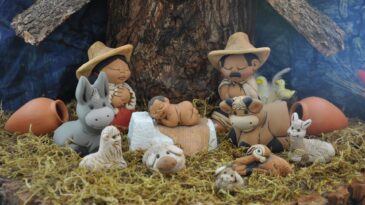
The National Cathedral in Washington, D.C. has a crèche collection gathered from all over the world. Various hands sculpted these figures from every conceivable material: stone, wool, glass, and even cow dung. The tropical regions portray Jesus under palm trees with very little cloth swaddling him, while cold climates show the holy family wrapped tightly, huddled and surrounded by snow. They remind us that we interpret this beautiful story in our own contexts; we pick up what the gospel writers leave out as we imagine the earthy smell of the hay, the rough texture of the feeding trough and the gentle sounds of the animals. These miniature mangers capture that crucial period after a baby is born, when the bonds of relationships strengthen as an infant is introduced to a family with care and attention. It is a time for welcoming, healing and wholeness.
In our culture, family leave policies enable this opportunity, yet within our church, that time off is often seen as an unnecessary benefit. Although sick leave after major surgery is expected, congregations can be unclear about the fair expectations of parents when a child enters their family. When I look at the adoring Mary and Joseph, a startling love bubbles up as I recall the birth of my own child. I also remember the confusion in our churches and Presbytery.
Login to see an overview of movies playing this 2005 holiday season.
Simplicity.
That's a cut-against-the-grain word in this season of so much everything -- so many parties and too many cookies, herds of lit-up reindeer marching across the lawns, lines of frantic shoppers hunting Xbox game systems or one more package of anything to put on the mound.
We do it, but in many hearts there's also a whisper -- maybe even a shout -- of "too much," a longing for a sacred silent night.
And so some people are deliberately, consciously, intentionally choosing less. Less Christmas shopping. Fewer decorations to put up and then haul back down, fewer plastic bins into which to cram it all.
Those who cultivate simplicity say they want more time, more peace, more care for the world -- not just at Christmas, but for the rest of the year as well, as a deliberate statement of their faith in God. Some are asking hard questions. How do the choices we make -- what we buy, what we eat, what we drive, what we invest in -- affect the world? What impact do our choices have on the earth and those who produce the goods we buy?
The simple-living movement is about more than saying "too much" to a consumer-driven Christmas, however. It ties together elements of environmental stewardship, of global economics, of socially-responsible investing, of caring for the least in a world in which many Americans have so much while the vast majority of the world's people live in poverty.
In the October 3, 2005 issue of The Presbyterian Outlook, the question "How Do We Change the Book of Order?" was answered by reviewing steps and deadlines that must be followed to change our constitution.

My big brother Chris is 47 years old. His best friend Fritz died of cancer when they were both 43. When our family moved to Minnesota, Chris and Fritz met in school, and they stayed friends through high school, college, and beyond. They played basketball in high school together, and they wrote a sports column for our school newspaper with one other friend each week entitled "The Blonde Bombers." Fritz hung out at our house a lot, and by the time he and Chris were in senior high, my junior high friends and I started to develop crushes on their group of friends; I, of course, developed a crush on Fritz, who was tall, blonde, and blue-eyed. Unfortunately, the crush was never mutual. I was too much like a "little sister."
Though he was over six feet tall, everyone in our small town called Fritz "little Fritz" because his dad was "big Fritz," the large-bellied owner of the German bakery in town. My mom was always glad to see Fritz at our house at night because he would bring some of the day's leftover bakery goods, all of which we readily consumed. Fritz's mom was a dear soul and still spoke like the true German she was.
When Fritz was first diagnosed with cancer a number of years ago, my brother kept us all connected with him through weekly and sometimes daily e-mails. He sent updates of Fritz's treatment, from the first radiation to the last experimental chemotherapy, and then to his worsening physical condition at home. But there was a wonderful side to these e-mails. Chris told of the strong faith in God and deep love for each other Fritz and his wife, Lynn, had; of what I would call Fritz's deep joy in life. It sounds odd, of course, to speak of joy in the midst of the situation. But joy it is what I heard through these e-mails, even joy amid pain, suffering, sadness, and questions.
Scripture text: Psalm 89
Finding Psalm 89 among the texts for Advent 4 begs this question: Should Advent be a season of emotional de-crescendo and rest, as the church approaches with certainty the time of God with us; and/or should it be a time of emotional crescendo and dismay as we fly through yet another year of "how long, O Lord" (Psalm 89:46) with no certainty of the Messiah's imminent return?
Appearing elsewhere in the lectionary cycle at the end of Lent, on Maundy Thursday, Psalm 89 speaks to a time of crisis, as hope in the Lord appears betrayed and headed toward certain death. Therefore, the appearance of Psalm 89 again, here, leads me to this conclusion: Although the church tends to advocate emotional de-crescendo as Advent progresses, "but now" (v. 38), the church should be entertaining an emotional crescendo of lament that the Lord has NOT come as promised; that the disconnect between promise and reality is almost unbearable yet again. Only then is the joy of Christmas a true expression of God's in-breaking hope in the midst of seeming impossibility and dismay.
Concluding Book III of the Psalter, Psalm 89 is a royal psalm, swinging the faith of Israel between assertive confidence in God's steadfast love, faithfulness, and promise to all generations (v. 1-4), and at the other extreme, Israel's protest and disappointment in God's apparent breach of covenant in abandoning the anointed one during the exile (v. 38-51).
Editor's note: This is the fourth in a series of stories entitled: "What is a Presbyterian Elder?" (link to 'For Church Officers' articles)
The word "elder" in the Greek New Testament is presbuteros (for the biblical background see Part 1 in the April 25, 2005 issue). And the question is this: How many different kinds of presbyters are there in the PC(USA)?
The answer "one" is correct from an initial perspective. All elders are called by Jesus Christ and are united in one Lord, one faith, and one baptism. They serve one worldwide church. What is more, anyone who is ordained an elder remains so for life unless he or she requests release from office by the session (G-14.0211), joins another denomination, or is temporarily or permanently removed from office for an offense (D-12.0000).
In another sense there are two different kinds because there are elders in every congregation who serve various functions. Elders who are currently on the session are what used to be called "ruling" elders, but all other ordained elders in the congregation are still able to serve the Lord's Supper, and be commissioners, committee members, or officers of higher governing bodies (G-10.0102 p; 14.0203).
ORLANDO -- The Presbyterian Coalition, not content to wait, started months before a major task force report was due out to prepare its own statement of where it thinks the Presbyterian Church (U.S.A.) ought to be going -- a paper that is not shy of proclaiming theological truth.
The paper -- "Given and Sent in One Love: The True Church of Jesus Christ" -- concludes in an afterward that the church should reject the report of the Theological Task Force on the Peace, Unity and Purity of the Presbyterian Church (U.S.A.). Two pastors wrote "Given and Sent in One Love" -- Gerrit S. Dawson of Baton Rouge, La. and Mark R. Patterson of Ventura, Calif. -- and it was published as a book with help from the Presbyterian Lay Committee, Dawson said.
The Coalition released the paper, based on the prayer that Jesus prays in the 17th chapter of John, on Nov. 7 at the start of its national gathering at First Church in Orlando.
ORLANDO -- How much do many evangelicals dislike the report of the Theological Task Force on the Peace, Unity and Purity of the Presbyterian Church (U.S.A.)?
Listen to some of what's been said at the national gathering of the Presbyterian Coalition, held Nov. 7-9 at First Church in Orlando.
Jim Berkley, interim director of Presbyterian Action for Faith and Freedom, the Presbyterian arm of the Institute on Religion and Democracy, called the task force report "an indigestible sausage" that "would permit behavior that would have scandalized Jesus himself."
Michael Walker, executive director of Presbyterians for Renewal, has praised some sections of the task force report. But he described the task force's fifth recommendation as 'damaging to the church,' and said it could with one General Assembly vote 'effectively do an end run around three decades of discernment by the whole church.'
John "Mike" Loudon, an evangelical pastor from Lakeland, Fla., who's one of the 20 task force members, was invited to answer questions about the report. But Berkley, not Loudon, got to describe and analyze what the task force had done -- and the first question Loudon was asked was about what tradeoffs the task force had made to achieve a unanimous vote.
Loudon was gracious, saying he sees the report as a way for the PC(USA) to stay together, keeping its national ordination standards but allowing them to be applied locally. "Nowhere does it say to remove those national standards," Loudon said. "In fact, I fought long and hard to maintain those national standards."
ORLANDO -- The preachers talked a lot about trust in a sovereign God, even in difficult times, even when surrounded by "slippery theology," as pastor David Swanson put it. Don't lose hope. Don't give up. Don't lose sight of the truth.
But the political discussions at the Presbyterian Coalition's national meeting Nov. 7-9 were mostly about how to keep bad things from happening at next summer's General Assembly -- and what to do if something terrible does happen, such as (from the Coalition's point of view) the assembly approving the report of the Theological Task Force on the Peace, Unity and Purity of the Presbyterian Church (U.S.A.).
If that does happen, some contended, certain evangelical churches will be ready to leave the PC(USA).
There was also another theme subtly drifting through the conversations at the Coalition meeting, held at First Church in Orlando. Don't just look at what's wrong with the other side, evangelicals were told -- take a look at yourselves too.
Andrew Purves, professor of pastoral theology at Pittsburgh Theological Seminary, preached during closing worship about the need for both truth and love -- saying that a church with "shining orthodoxy" but without love "is no longer the church."
Swanson, senior pastor of First Presbyterian in Orlando, did not stint on criticism of the PC(USA)'s misguided directions during his opening sermon, citing examples such as a declining number of missionaries, a Washington office that supports political causes, sessions or presbyteries that ordain lesbians and gays.
Book suggestions for :

Scripture lesson: Mark 1: 1-8
Without sounding as melodramatic as Daniel did about his inner life, I recently had a dream. It went like this: We came home, opened the front door of the house, and discovered to our surprise that it was as empty as a gourd.
I do not mean just somewhat empty. When you are preparing to move and you are packing everything up you can say that it is empty when it is still half full of stuff. But this time I mean spic and span--astonishingly clean. If Hemingway had been there he would have said that it was the original clean well lighted place. It was apocalyptically bare.
Dreams are big these days. There is open season on them by both novelists and psychotherapists. Nevertheless, I am not so sure that the experts would do much with this one. It could be beyond the grasp of even that newly evolved profession, life coach/mentor. Sigmund Freud and Carl Jung could have met at Seattle's Best over it, flipped for paying the bill, and left shaking their heads.
Thomas W. Currie Jr. died at Charlton Methodist Hospital in Dallas, Texas on November 7. A memorial service was held at North Park Church of Dallas on November 10 with the Rev. Stephen W. Plunkett officiating.
Born in Austin, Texas, he was educated in the public schools there as well as the Choate School in Wallingford, Conn. He was a graduate of the University of Texas at Austin and subsequently received a B.D. from Union Theological Seminary of New York and degrees from Austin Presbyterian Theological Seminary (M.Th.) and Union Theological Seminary of Virginia (Th.D.).
MEMPHIS -- Spiritual practices -- such things as showing hospitality and forgiveness, giving and receiving, reading Scripture, praying, healing, discernment of God's will -- often are messy, full of ambiguity and even conflict.
They aren't spiritual merit badges -- do this as a sign of how good or godly you are.
They aren't private, transcendent spiritual experiences that no one else can share.
They are instead "an attempt to catch up with and respond to God's merciful and transforming presence in the world," said Amy Plantinga Pauw during the opening session of the 2005 national meeting of the Covenant Network of Presbyterians.
She said such practices "are like holding out our hand to receive the bread of life at communion," an act of faith and at the same time "a concrete acknowledgement that we are not whole, that we are not at peace, that we need healing and nourishment that we cannot provide for ourselves."
Pauw, the Henry P. Mobley professor of Doctrinal Theology at Louisville Presbyterian Theological Seminary, was speaking on "Graceful Practices." And the theme of this Covenant Network gathering, held Nov. 3-5 at Idlewild Church in Memphis, is "Disciples in Community," an exploration in part of how to be faithful in a church with so many opinions of what is right and what is sinful.
© Copyright 2026 The Presbyterian Outlook. All Rights Reserved. Privacy Statement. Website by Web Publisher PRO
