There is power – and then, there is power.
There is the power that comes with military supremacy and another kind of power that comes from sacrificial love.
There is the power that comes with possessing great wealth and there is the power that comes with being free from its grip. There is the power that comes with the authority to pass judgment on others and there is the power that comes with granting forgiveness. There is the power that comes with terrorizing people and there is the power that comes with inspiring people to strive for peace.
The author of the Gospel of Luke tells the story of the birth of Jesus by contrasting different powers: the power of the Roman Emperor, who controls a vast empire, and the power of an infant in whom the Spirit of God dwells.
When Jesus was born, Caesar Augustus was the most powerful person in the Western world. He ruled over the vast Roman Empire and declared himself to be a son of God. Moreover, he boldly asserted that he had brought peace to the whole world. Never mind that what he meant by peace was possessing such political clout and military might that he could keep people in check. His idea of peace had nothing to do with a just society but rather the absence of dissent.
Luke could have told the story of the birth of Jesus without ever alluding to the Roman Emperor, but he intentionally begins his birth narrative by mentioning Emperor Augustus and the decree he issued. In fact, scholars cannot find a record of such a registration under Augustus and Roman law did not require citizens to return to their place of birth or family origin.[1] Neither was Luke’s purpose to provide a date for Jesus’ birth. (The dates don’t mesh because King Herod’s reign ended before Quirinius became governor.) Luke had something else up his sleeve. He wanted to highlight the stark differences between the rule of the mightiest earthly king and the rule of the King of kings.
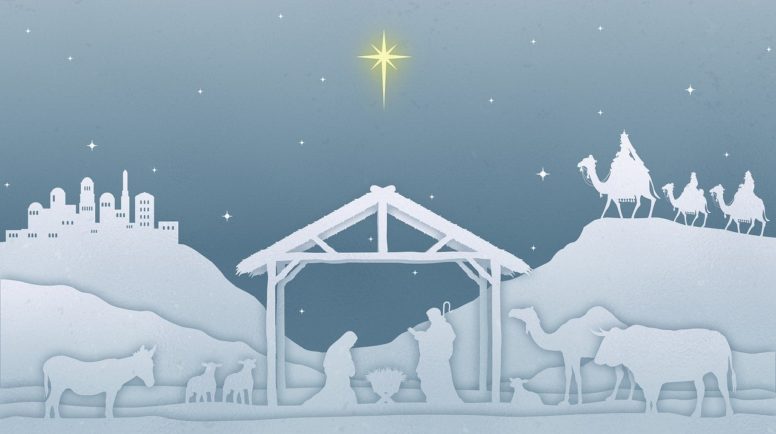
So, he began his narration of the nativity by reminding his hearers of the impressive power that Caesar Augustus possessed and how he was the epitome of what people expected in a king. He had armies at his command, enjoyed extravagant wealth and ruled over an immense territory. And, notably, it was during the height of his rule that a poor Jewish couple gave birth to a child and named him Jesus. This birth took place in a small town far from the seats of power, in the humblest of settings. Because the inn where they were hoping to stay had already displayed its “No Vacancy” sign, the child’s mother laid him in a feeding trough for animals. The contrast between a royal birth in a palace and the birth of Jesus could not be greater.
This contrast continues with the announcement of the birth. The initial declaration is made neither to political rulers nor religious leaders, but rather to lowly shepherds. Lowly shepherds? Doesn’t the mention of shepherds prompt us to conjure up positive pastoral images? After all, before David became Israel’s greatest king, he was a shepherd. And who can forget that the 23rd Psalm announces that the Lord is our shepherd or that the Gospel of John names Jesus the good shepherd? All of that notwithstanding, in first-century Palestine, shepherds were not only poor, but were basically shunned as dishonest people who grazed their flocks on land that belonged to others. In other words, they were not only poor, but they were also outcasts.
Luke’s description of Jesus’ birth underscored his belief that this event marked a pivotal point in history. Jesus was the long-awaited Messiah who would initiate a new world order based not on power and privilege, but rather on justice and love. Throughout his life, Jesus would move among the poor and all who had been pushed to the margins of society while challenging the wealthy and those who held earthly positions of power. Why? God loves the people of earth. The divine love is not reserved exclusively for any single group of people. Indeed, God so loved the world that God sent God’s Son. And through his teachings and his way of living, Jesus demonstrated that God’s love naturally gives rise to justice.
For centuries, God communicated the divine desire for justice through the prophets of Israel who called on the people to care for the poor and the outcast. The message was received with mixed results so God’s Son was born among the poor and the angels delivered the birth announcement to those on the fringe of society. Then, when this infant became an adult, he called for a new world order in which the poor would be blessed, the oppressed would be liberated and the last would be first. He called on his followers to pray for this new order to come and to help make it a present reality by changing their way of living.
Our celebration of Christmas is our opportunity to remember that God loves all of us and seeks to lead us to a new world order founded on a love that necessitates justice for all. In this new order the hungry will be fed, the homeless will be housed and the government will not balance its books on the backs of the poor. The new order will see the blind having 20/20 vision, the lame competing in Ironman triathlons and cancer, ALS and AIDS vanishing. In this place God’s creation will once again be a delight for everyone because the air will be clean, the water pure, the soil rich and the harvests abundant. It will be a place in which violence and abuse will have disappeared, terrorism will be nonexistent, and where swords will be beaten into plowshares and spears into pruning hooks and nations will not lift up laser-guided weapons of destruction and war will not even be considered.
However, this new world order is not simply a fantastic realm that will be established sometime in the future. We catch glimpses of it even now when justice and mercy flourish. And this vision of what the world will one day become, inspires us to live justly and mercifully today.
1 Leander E. Keck, editor, The New Interpreter’s Bible, Volume IX: Luke and John, (Nashville: Abingdon Press, 1995), p. 62.
GREGORY KNOX JONES is pastor of Westminster Church, Wilmington, Del. and author of Play the Ball Where the Monkey Drops It: Why We Suffer and How We Can Hope.