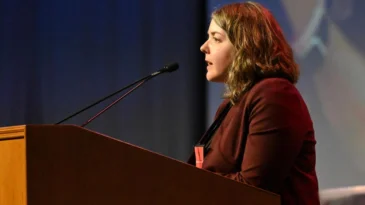
Charlotte, N.C. (PNS) As people of God and as a church, we are called to do good. With the power of the Holy Spirit, we preach and testify, said the Rev. Elizabeth Conde-Frazier, speaking April 28 at the National Multicultural Conference here.
“But our message would not make sense if we did not ground it in the moment – if we did not make it relevant,” she added.
If we are to cast out our enemy, as the Bible says, we must understand the context. Why are there injustices like the killing of Trayvon Martin and the immigration system? Conde-Frazier asked.
“How does the church cast out this devil?” she asked. “How do we heal people from such oppression?”
And how can we heal our own church, which doesn’t always act in congruence with the inclusive ideals of the multicultural conference? Conde-Frazier continued.
The reason many of us are here today relates to a long history of imperialism, she said. Current demographic trends have deep roots and the practice of subjugating peoples for our own gain enhances injustice, she said.
“How do we unravel these practices is what this conference is about,” Conde-Frazier said. “How do we unravel them in ourselves?”
Scripture teaches the humanity of all, but the Christian tradition has helped support inequalities. Manifest destiny was seen as a divine calling to move across the United States, establishing a “moral dignity” while pushing out Native Americans, Conde-Frazier said. And in current-day seminaries, the theologies of racial-ethnic people are relegated to the margins. Myths of superiority and inferiority bind us, she said.
But in God’s story, we can think of ourselves with sober judgment and change the balance of power, she said. The Holy Spirit brings us together, as it did with Cornelius and Peter in Acts 10: 34-43. In those verses, the Holy Spirit acts as a “matchmaker,” bringing together Cornelius, a colonizer, and Peter, a colonized Jew.
The Holy Spirit is wild and transforms our perspective, Conde-Frazier said. Peter thinks he knows what God wants and is preaching it when the Holy Spirit comes in and disrupts his message — “with no permission or committee approval.
“The moment is so abrupt,” Conde-Frazier said.
We don’t know where the Holy Spirit is going to go, so we’re a few steps behind, she said. What do we do with the incongruence of our tradition and the movement of the Holy Spirit? We must stand open and humble, asking God to open our hearts so that we can hear and know differently than before.
“Are we open to the Spirit tonight?” Conde-Frazier asked. “Move beyond the prejudices. Move beyond ourselves.
“Let us open ourselves to the Spirit’s movement. Let us open ourselves to allow a moment of transforming conviction.”
Being open to the Spirit means we must also be open to conflict and messiness — but we can’t leave, Conde-Frazier said. We must stay together in order to make a fabric that is strong and can stand up to being pulled. Just as we have faith in God, God has faith in us and entrusts us to create a space for the Holy Spirit.
“God’s door is open. Let us be light unto all the nations,” Conde-Frazier said, as the crowd rose to its feet, cheering. “We are open to the Spirit of God.”