Think classic country church — beloved, significant, its membership aging. With so few members, the congregation can’t afford to call a full-time pastor — and unless something changes, it may never be able to do so again. A common solution is to hire a part-time pastor on a temporary basis.
Now swirling through the Presbyterian Church (U.S.A.) are the questions: How common is that arrangement? And what are the implications?
Early this year, as outrage surged over the Board of Pensions’ proposal (now being revised) to change the dues structure for its medical plan, some of the dismay focused on salaries and job prospects for young pastors with families. And part of the refrain went something like this:
Young seminary graduates have a hard time finding jobs with churches. In some cases, jobs they might hope for are being taken by retired pastors, hired by congregations as stated supply or on some kind of temporary basis. Retirees can see their pensions grow if they continue to work and don’t draw full pensions until they are 70.
“Over half of our congregations cannot afford a full-time pastor, and many associate pastor positions were cut during the recent economic downturn,” pastor and author Carol Howard Merritt wrote on the Christian Century website. “These are churches where seminary graduates would normally be heading, so what are the congregations doing instead? Many of them are hiring retired ministers or retired laypeople to serve these churches, while our younger pastors remain unemployed.”
The Committee on Theological Education of the Presbyterian Church (U.S.A.) has begun to explore the question of what seminaries are saying to prospective students about the job market.
“It began as kind of an ethical question,” said Kathy Wolf Reed, who chairs the committee. “There has been this big push to get young adults into ministry,” through initiatives such as the Fund for Theological Education and the Young Adult Volunteers program, “and the question came up: ‘Is it ethical for PC(USA) seminaries to be heavily recruiting young adults, knowing that there may not be a full-time call waiting for them when they are done?’ ”
Aware of that financial reality, “seminaries are beginning to communicate that you may have to be willing to work part-time, you may have to be willing to take small, struggling churches,” Reed said. In many cases, “You’re not going to be able to walk into an associate pastor position in a large church the way that seminary graduates used to … . You need to think outside the box.”
The numbers tell part of the story. More than half of the 11,000 congregations in the Presbyterian Church (U.S.A.) have fewer than 100 members, and many have fewer than 50 members.
The number of ministers serving in temporary positions (excluding those in interim pastorates) rose from 535 in 2003 to 710 in 2011, the last year for which statistics are available. To put that in perspective, the PC(USA) in 2011 had 21,064 ministers overall, including 7,952 who were retired (38 percent) and 710 (3 percent) serving as stated supply or temporary supply.
The exact terminology can vary. The new Form of Government did away with the old terms “temporary supply” and “stated supply,” leaving it up to mid councils to determine how to characterize these temporary situations. What those arrangements look like can vary as well.
“As our churches have shrunk in size, we’ve had more and more need for part-time positions,” said Marcia Clark Myers, who just retired as director of the PC(USA)’s Office of Vocation. “Most stated supplies would be part-time. They might be Presbyterian, or they might be something else.”
Often these arrangements spring up through local connections — forged by a congregation hungry for consistent leadership and able to mine its local relationships to find someone to fill the pulpit. The idea is “to provide some stability for a congregation so they have the same face every week, and somebody to go to in times of pastoral need,” Myers said.
Often, she said, these relationships are forged little or no input from the presbytery.
“A lot of times a small church is looking for leadership, and somebody has an Uncle Harry who has been preaching for a lot of years for the Assembly of God. He looks like a pastor. He tells great jokes in his sermons. We fall in love with Uncle Harry. Before the presbytery is aware of it, he is entrenched.”
In central Illinois, “we have about 100 congregations now, and just a little over half of our congregations are not served by a full-time pastor,” said Sue Krummel, general presbyter and stated clerk for the Presbytery of Great Rivers.
Some are served by commissioned ruling elders (what used to be called commissioned lay pastors), but others by “what we sometimes call ‘the friendly pastor down the road,’” Krummel said. “Oftentimes we have churches who find somebody on their own. … In several cases, that is somebody who does not have any qualifications as a PC(USA) minister,” so the presbytery tries to provide support by providing someone to moderate the session meeting or serve communion. “It’s really kind of a quilt thing we have going on here, trying to help our churches to have some kind of pastoral leadership,” Krummel said.
While these arrangements may solve a pressing question for the congregation — who will preach on Sunday? — they often do not provide an energetic vision for the future, she said.
With a temporary, part-time arrangement, “Often, it really is just preparing the sermon, leading the worship and saying, ‘I’ll see you next Sunday,’ ” Krummel said. The supply pastor may perform funerals and visit people in the hospital. But “in many cases there isn’t this sense of ‘What is God calling this church to do, and how can we move forward?’” to a more vibrant future.
Technically, the longest a contract for temporary service can run is one year. But it’s not uncommon for contracts to be renewed year after year. “The idea of stated supply was pastoral supply for a stated period,” Myers said. “That’s where the ‘stated’ word comes from. For this stated period, this will be our pastor.”
Some are raising the prospect that temporary supply positions could provide possible job openings for new seminary graduates or younger ministers, many of whom are having trouble finding pastoral work. But economically, that may be difficult to pull off.
Many seminary graduates, carrying educational debt, can’t afford to take a part-time job, particularly in a rural area where a spouse or partner may not be able to find work either, Reed said.
There’s little job security. And these part-time positions often are in small towns or rural areas, making it difficult for the minister to find a tentmaking job to pair with the pastoral work.
Aware of these realities, the PC(USA) is encouraging new possibilities to meet both the pastoral and financial needs — including the initiative to start 1,001 new worshipping communities and the “For Such a Time as This” program, which provides support and mentoring so small congregations can call recent seminary graduates into two-year, designated pastor positions.
The Committee on Theological Education is encouraging congregations, presbyteries and seminaries to think creatively and pool resources so that small congregations can call younger pastors and support tentmaking.
Surrounding inexperienced young pastors with mentors “gives them a better chance of success,” Myers said. Too many small, aging, faithful congregations, she said, lack pastoral leadership and see themselves as “in a maintenance situation and probably a trajectory of decline.”
Sharing financial and mentoring resources and providing support for tentmaking can “turn them in a different direction,” she said. “It can open up the opportunity for transformation.”
When pastoral needs align: A brief case study
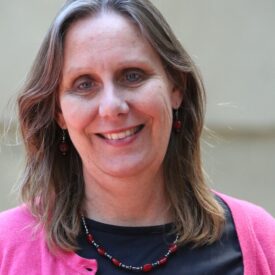
Sometimes, having a temporary supply pastor can work well — when the needs of the congregation and the pastor align. That’s been the case for Deb Uchtman, serving as the half-time pastor of Bethel Murdoch Presbyterian Church in Loveland, Ohio since Oct. 2011.
Bethel Murdoch, a country church of just under 90 people, can’t afford a full-time pastor now. But Uchtman doesn’t need full-time employment.
“I feel very blessed because my husband has a full-time job,” she said. “That gives me a flexibility not a lot of my colleagues have the opportunity to consider.”
Bethel Murdoch hopes in the future to afford a full-time called-and-installed pastor, as the area transitions from more rural to more developed.
“It’s a very exciting time in ministry,” with a congregation willing to assess its strengths, weaknesses and opportunities for outreach, Uchtman said. “They’re not a ‘We have no hope’ congregation … They’re open to the spirit.”