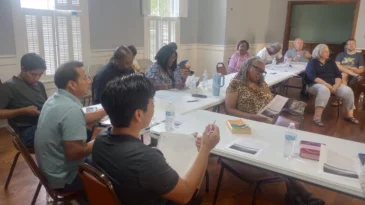
Neal Presa, moderator of the 2012 General Assembly, has convened a Colloquium on Ecclesiology this week at Austin Presbyterian Theological Seminary – the first of three such gatherings he intends to organize to discuss the purpose of the church.
The discussions, from April 23-25, center around seven papers that were written in advance and posted online. The format for the discussions is this: For each paper, the author presents a 20-minute summary; comments are then offered by members of the Austin seminary community and the event planning team; then in a question-and-answer session from those attending in Austin and submitted online by people watching the live-stream
For each session, the Outlook will provide a snapshot of the paper and a few memorable points of the discussion.Colloquium on Ecclesiology III — Worship and Witness
 Session 3: Worship and Witness
Written and presented by: Allen Permar Smith, pastor, Kenilworth Presbyterian Church, Asheville, N.C.
In the gospels and in the Six Great Ends of the Church listed in the Presbyterian Church (U.S.A.) constitution, the church is called to both worship and witness. Worship is transformational – the real presence of Jesus Christ is made known in Word and sacrament. What is the meaning of witness in a world in which at least some forms of institutional church are in decline? How do Christians translate the gospel to this world? At Kenilworth Church in Asheville, congregants have reconsidered how they take the offering – and through a focus on renewal, the question of “what does it mean to be vital again?”
They, in fact, chose to take up the weekly offering not by passing baskets in the service but by receiving it in the narthex from those departing the service, as a way of being more welcoming to those who might not have funds to give, and to make it clear the collection is intended to help those in greatest need, not just to support the institutional church. The results have been modest but good. The membership has bumped up from 35 to 55. The church budget is balanced and benevolences increased from 5 to 15 percent. The numbers are encouraging. However, the true success of the church is not measured in this way. “It would appear that the true success of Kenilworth Presbyterian Church is the belief that the members have nothing to lose and everything to gain,” said Smith.
One member of the congregation proclaimed: “I would rather fail by doing the right thing than be successful while doing it wrong.
“It is clear that the grace of Jesus Christ is moving the community into an exciting future, he said.
Ideas from responses:
-
Convergence: Worship and witness are intertwined. They are not identical but they are inseparable. The convergence is well expressed in the two great commandments: You shall love the lord your God; you shall love your neighbor as yourself, said David Johnson, Professor of Church History and Spirituality at Austin Presbyterian Theological Seminary. “They are not identical. But the one loses reality if the other is abandoned.”
-
The Power of Change: Changing something like pouring the water in the baptismal font or how an offering is received can bring attention to something not otherwise noticed. Moving the offering to the narthex “changes the threshold between the worship of God and the service to the world,” said David Gambrel of the PC(USA)’s Office of Theology and Worship.
-
Minimizing? Marney Wasserman, pastor of Trinity Church, Tucson, Ariz., asked if the practice of receiving the offerings in the narthex following worship “gives the implicit message that giving is optional?” Allen responded: “We are now talking” all the more about “what it means to present an offering; the most important offering we give is what we present as we walk out the door to give ourselves to the world.” He then added, “At present, what we are doing has really struck a chord.”