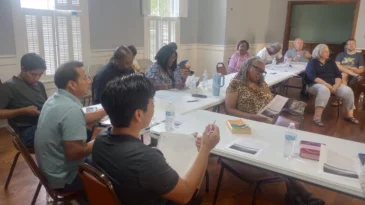
Neal Presa, moderator of the 2012 General Assembly, has convened a Colloquium on Ecclesiology this week at Austin Presbyterian Theological Seminary – the first of three such gatherings he intends to organize to discuss the purpose of the church.
The discussions, from April 23-25, center around seven papers that were written in advance and posted online. The format for the discussions is this: For each paper, the author presents a 20-minute summary; comments are then offered by members of the Austin seminary community and the event planning team; then in a question-and-answer session from those attending in Austin and submitted online by people watching the live-stream
For each session, the Outlook will provide a snapshot of the paper and a few memorable points of the discussion.
 Presentation 7: Worship as the Missional Church’s Whence and Whither: A Liturgical Missional Ecclesiology
Written and presented by: Teresa Stricklen, associate for worship in the
Presbyterian Church (U.S.A.)’s Office of Theology, Worship and Education.
What seems to be a crumbling church – losing members and relevancy for many – also draws on the powerful wisdom of the Judeo-Christian tradition. Ecclesial images from the Bible – the body of Christ; the liberated, exodus people; and more – can provide both traditional images and new ways of looking at this question: What is God’s future to which the church is called? Worship is the space in time, the thin place which catches us up in God’s future. Orthodoxy means “right praise,” not “right belief,” and humility as we gather in worship, as we pay attention to how worship calls us to live, can be invaluable in a time of “witnessing a great tearing of the fabric of ecclesial life.” We are sent from the table to continue worship in service to the world as Christ’s body.
According to Clark Cowden, executive presbyter of the Presbytery of San Diego, the church is the airport terminal that helps people to get to the place where God is building the kingdom. One doesn’t want to stay in the terminal for long periods of time, but goes there to be launched into the places where we engage that kingdom work. “I would like to suggest that it’s not the institution of the church but the church’s worship that is the airport terminal,” Stricklen writes.
Ideas from responses:
-
Utilitarianism: What of Sabbath as an end in and of itself? Does worship have just a utilitarian purpose of preparing to be sent? Or are we not also called to worship to stay right there? “Maybe it takes both – the here and the there – to be a participator in the missional community,” said Kristen Saldine, professor of homiletics at Austin seminary. “Too often missional preaching becomes little more than moralistic promotion of program recruitment, arm-wrestling the people of God to get to work.”
-
Membership: Our language of church membership seems to carry with it “the notion of entitlement. We too often speak of membership as associated with rights and privileges,” suggested Paul Hooker, the seminary’s director of ministerial formation and advanced studies. “We need to recover the thinking of (the apostle) Paul who speaks of membership as being a part of a body – where each one has a particular part” that serves in organic unity with the whole. “Membership is not a matter of status, but of functionality.”
-
Halftime: Perhaps we might think of worship as halftime. “We come in from the mission field a bit beat up to get some rest, some nourishment, some instructions from the coach, some conversation with the teammates,” and then we get sent back out to the field to continue the missional task, offered Tom Trinidad, a Colorado pastor and vice-moderator of the 2012 assembly.