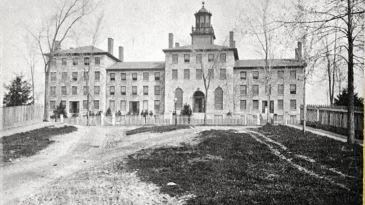
A decade ago, when I was between jobs, a pastor friend asked me to archive her church’s session minutes and digitize them. Job accepted, I began the task of transcribing handwritten session minutes from the 1870s. Meeting minutes in that day were succinct: three or four lines indicating those present, notice of an opening and closing prayer, and business matters. For the most part, business matters dealt with baptisms, transfers of membership (in and out), and matters related to the church building.
Fast-forward to the 1950s. Handwritten minutes gave way to pages of typewritten session minutes in outline form. Onionskin paper. And committee reports. Among the more prominent reports was that from the Sunday school. The full-time, paid Christian educator’s report included mention of all the accoutrement of a professional public school: lists of teachers; assigned classrooms; annotated curriculum descriptions for children, youth and adults; supplies and budget issues; special events calendars; and announcements of continuing education opportunities provided by the presbytery.
In less than 70 years, this session had become a “board of directors” with a hired staff. Programs became increasingly important for the expression of the church’s mission; programs required managers.
By the mid-20th century, in many large and mid-size churches, the professional church educator had grown into a program manager whose scope of responsibility exceeded the Sunday school. The educator was considered a professional, a term traditionally reserved for doctors and lawyers. Hiring a professional Christian educator, trained in theology, pedagogy, human development and group dynamics, signaled to the community that the congregation valued education, children, youth, families, and so on. Salary and benefits rounded out the professional nature of the church educator’s role.
Smaller churches conducted their Sunday schools without paid staff, relying on the untrained volunteer teacher who loved God and loved God’s church. However, many small churches tapped the trained educators’ skills by using denominational curricula and teacher training materials.
Professional educational ministry was a boon for the church. To a church predominantly guided by the lecture presentation model of education, it introduced numerous models, educational theories, developmental theories, age-appropriate methodologies, multiple intelligences, group dynamics, the art of asking questions, and so on.
Then again, the professionalism of education did weaken some educational programs. Instead of seeking the best educators to lead classes, teacher recruitment just aimed to fill slots. Curriculum became the “expert without skin” and the teacher’s job was to cover the lesson, not to nurture faith, devotion or service. The emphasis on program management pulled the Christian educator, the only theologically and pedagogically trained teacher in many mid-size to larger churches, out of the classroom.
Fast-forward to 2013. At its annual conference, the Association of Presbyterian Church Educators received a survey report from its leadership on the current state of Christian educators in the church. The preliminary result: over 50 percent of respondents believe that church educators are home-grown leaders who have little or no formal theological training. (To be clear, the survey measured only respondents’ perception of the state of Christian educators; still, perceptions have their place.)
After a hundred years, the church is entering a post-professional period in relation to its educational ministries. Fewer seminaries provide support for the church educator; fewer presbyteries have the staff or budget to do so. Denominational staff and funds dedicated to educational ministry have been cut. In the growing number of churches that employ part-time pastors or commissioned lay pastors, a professional educator is certainly out of the question. Sadly, friends and colleagues have lost and will continue to lose their jobs, their incomes and perhaps their place in their respective communities.
Large churches, with large budgets and staff, will probably continue as they have been, offering programs developed in-house, with little need for connection to the broader church’s resources. Smaller churches, with limited budgets and staff, will feel forsaken by their presbyteries and their denominational curriculum that addresses the needs of the middle-size church. Mid-size churches are becoming small churches, if not in number, then at least in staffing models. They will flounder, looking for ways to honor their baptismal promises to nurture the baptized in the faith, but without the benefit of trained educators.
How can the church honor the call and claim of God on those who profess educational ministry as vocation, as calling, whether or not there are programs, money, benefits or even classrooms? How can the church nurture and empower those homegrown practitioners of Christian education to embrace the good things professional educational ministry brought to the church? What can the church learn from the smaller churches? And how can the presbytery, seminary and denomination encourage and assist the mid-size and smaller churches in their educational ministries?
To play on words, maybe the present moment is calling church education and educators from profession to professing. In the current state of disequilibrium, there are signs of hope. I envision a promising future for educational ministry even as its professional trappings subside.
More and more sessions are professing commitment to the church by asking good questions about education, such as: “What is education in the church for?”; “What’s the best way to do education in and for the church?”; “What are the differences between education and spiritual formation?”; and “What’s the benefit to our children, youth, and adults’ faith to use denominational curriculum?”
More churches are professing smallness as a way to recover the essentials of educational ministry: relationship and holy conversations. Groups are meeting in coffee shops and corner pubs to know God and one another. Mentors lead children and young people in the ways of faith and ministry in Christ’s name. Parents are hosting faith formation groups for their children’s friends.
I hear of professional educators professing a concern for the next generation of educators. They’re seeking ways to train them up and prepare them for a bivocational or purely volunteer ministry. I imagine more and more professional educators volunteering in retirement to provide assistance to the church as it adapts to new realities.
I see the Presbyterian Church (U.S.A.)’s certification council professing commitment to the volunteer teacher by providing a streamlined option. And seminaries are producing adult educational resources on DVD as a way to bridge the gap between seminary and church.
I see pastors claiming the office of teaching elder and professing a commitment to making the church a school for disciples. Some, sensing their need for further preparation, seek certification as Christian educators through our denominational processes.
I can imagine the teaching elder leading a confirmation-like course for those volunteers called to serve as teachers in the church. This would be a perfect context for modeling education as relationship and conversation.
It will not serve the church to try to recover a glorious past in which educators and education were prominent in the church. Instead, our God calls us to the future with the call to teach intact. We give thanks for the glorious past, learn from it, and step into the mystery of what God has in store.
“We have different gifts that are consistent with God’s grace that has been given to us … If your gift is teaching, devote yourself to teaching.”
— Romans 12:6, 7; Common English Bible
MARK D. HINDS is general editor for curriculum development, Congregational Ministries Publishing, PC(USA).