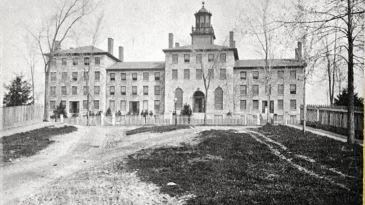
In 1893, the General Assembly of the Presbyterian Church convicted Charles Briggs of heresy on an appeal of his acquittal by the Presbytery of New York City. The presbytery had found him not guilty of heresy for holding historical-critical beliefs about Scripture. When he was defrocked by the General Assembly, Union Seminary in New York stood with him and disaffiliated from the Presbyterian Church. It was an important event in the “fundamentalist-modernist controversy” that troubled the Presbyterian Church in those days. After two other related heresy cases in the years following, there were no further heresy trials in the Presbyterian Church.
The fundamentalist-modernist controversy essentially faded when the General Assembly approved the report of the Swearingen Commission in 1927. The Presbytery of New York City had wanted to receive American Baptist Harry Emerson Fosdick, who had preached the now-famous sermon, “Shall the Fundamentalists Win?” but the General Assembly balked. Before making its decision, however, it formed the Swearingen Commission and asked for an opinion on the matter.
The commission reported that the General Assembly did not have the authority to block an ordination, reasoning that since the presbyteries that had originally created the General Assembly did not give it ordination authority, presbyteries and sessions had complete discretion about whom they could ordain. The effect of Swearingen was that there is no way to ensure a session or presbytery does not ordain someone who might be considered heretic.
The issue has since been litigated in church courts and decided in favor of the Swearingen position. Most recently in the 1981 case Rankin v. National Capital Union Presbytery, the General Assembly Permanent Judicial Commission ruled that a presbytery could not be prohibited from receiving someone who held beliefs that many considered heresy.
The same issue has been recently litigated, and the decision has predictably been the same. For years the Presbyterian Church (U.S.A.) held a standard for ordination that prohibited ordaining or installing anyone who refused to repent of sins named in the Confessions — the former “fidelity and chastity” provision, G-6.0106b. The only times this provision has been cited in judicial cases has been in those involving the ordination of gays or lesbians. In two recent cases, Session of Caledonia Presbyterian Church et al v. John Knox Presbytery (2011) and Eric Parnall et al v. the Presbytery of San Francisco (2012), the General Assembly Permanent Judicial Commission found that since G-6.0106b had been rescinded (in favor of G-2.0104b), a person could not be prohibited from ordination on that basis. In both, the cases were dismissed as moot. In Parnall, however, the complaining party had made oral arguments based on Scripture and the Confessions, so the Permanent Judicial Commission directed the parties to submit briefs on those issues. The case was argued on April 27, and published on May 1, 2012.
In Parnall, the commission reduced the issues to these: “(1) doctrinal error by errant interpretation of Scripture and Confessions, and (2) the authority of the Presbytery in the examination of the Candidate for ordination.” Essentially, the case was decided on whether the General Assembly had the authority to decide if a presbytery had allowed heresy. Given the Swearingen Report and the cases interpreting it since, the commission could only decide the way it did.
One wonders, however, why the General Assembly Permanent Judicial Commission ignored one of the pleadings: Specification 5 claimed that the synod had “failed to apply and enforce the interpretation of Scripture found in the Confessions (G-2.0105) with regard to sexual conduct.” Part of the problem certainly rises from the history of the matter, for the ordination of noncelibate gays and lesbians has virtually always been pled as a matter of doctrine, not as a matter of conduct. A major part of the problem was and continues to be this serious error in how the matter has been pursued. Error in pleading notwithstanding, the commission declined to address the matter of conduct, deciding the case solely as a matter of theology and doctrine. Once accepted as a doctrinal dispute rather than a matter of conduct, the commission could have done no other than what it did.
The outcome perhaps could have been different had the opponents of ordination adopted a different legal strategy. In 1975, the General Assembly Permanent Judicial Commission considered whether it was proper for Pittsburgh Presbytery to ordain Walter Kenyon. When examined, Mr. Kenyon said that he did not believe it was proper to ordain women, and he gave as his reason those passages in the New Testament that speak against the activity and authority of women in the church. He was very clear to say that he would work with ordained women; he just would not participate in the ordination of a woman. Pittsburgh Presbytery approved his ordination, and the matter was appealed in the case Maxwell v. Presbytery of Pittsburgh. The General Assembly Permanent Judicial Commission ruled that while ordination could not be prohibited on the basis of what Mr. Kenyon believed, it could be prohibited under the distinction between belief and conduct. Walter Kenyon was denied ordination because of his declared refusal to participate in the ordination of women. The mere declaration of a future behavior was sufficient cause to prohibit his ordination.
The simple truth, however, is that in the history of the conflict over the ordination of noncelibate gays and lesbians, conduct has not been a significant factor. The matter has been argued time and again as a matter of doctrine, a question of heresy. We have prohibited heresy as a bar to ordination by Swearingen and its cases. And the specter of Charles Briggs haunts us still. Convicting him of heresy was such a painful event that we have been reluctant to repeat it over the last hundred years. And given this history, pleading the matter of homosexuality as an issue of doctrine rather than conduct was doomed from the beginning.

EDWARD KOSTER is the stated clerk of the Presbytery of Detroit. He is a retired attorney.