cairo – Wageeh Mikhail, interim director of the brand-new Center for Middle Eastern Christianity, predicts the center will help counter a popular truism of its region: that Middle Eastern culture is naturally Islamic.
The center, based at a venerable Christian seminary, “will overturn this idea,” Mikhail said, “by highlighting the central role played by Arab Christians in building Arabic civilization in the Middle Ages.”
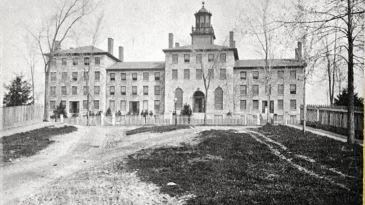
The center opened in April on the top floor of the Evangelical Theological Seminary in Cairo (ETSC), which was founded in 1863 by Presbyterian missionaries. The keynote theme during opening ceremonies was the Arab proverb, “Dig deep and you will find a pot of gold under your feet” — meaning Middle Eastern Christianity has much theological treasure buried in its 2,000-year history.
Mikhail said the center will be a place to advance the scholarship of Middle Eastern Christianity. It will do this through the study of biblical texts in Arabic, Coptic, and Syriac. The center will also promote research in the areas of Arabic Christian theology, Coptic history and theology, and inter-religious dialogue.
The center “will be important to Protestant Christians,” Mikhail said, “in that it will show us our roots in the ancient history of the region.”
The idea for the Center for Middle Eastern Christianity came from Atef Gendy, the president of ETSC. Gendy’s doctoral dissertation led him to a study of the Gospels from a Middle Eastern perspective.
In 2003 he met with visitors from Eastminster Church in Milwaukee. As they discussed the seminary, it became clear to Atef that ETSC would never be in a position to compete with major American and European seminaries in terms of library size, student scholarships, endowments,and other assets that these institutions had developed over decades or even centuries.
The seminary could, however, contribute through providing a Middle Eastern interpretation of Christianity with which the world was not generally familiar.
This idea was confirmed in further discussions that Gendy had in 2003 with Kenneth Bailey when Gendy was visiting Pittsburgh. Bailey’s books, which include “Jesus Through Middle Eastern Eyes: Cultural Studies in the Gospels” (2008) and “Paul Through Mediterranean Eyes: Cultural Studies in 1 Corinthians” (2011), reflect the vision that Gendy had for the seminary. In 2005 when construction was begun, Bailey gave the inaugural address.
Having served as a PC(USA) missionary for 40 years in several countries in the Middle East, including Egypt, Bailey was an ideal choice to give the first talk at the grand opening in April. Using a question/answer format with Gendy, Bailey recalled his early research into the New Testament, especially the story of the Samaritan woman at the well (John 4:1-42) and the parable of the Prodigal Son (Luke 15:11-32). In both cases, he gained key insights into the stories by considering the Middle Eastern cultural context. Some of these insights, he explained, came from reading medieval Arabic Christian texts.
Bailey maintains that Middle Eastern Christians often feel inferior to Westerners when it comes to interpreting Scripture. Yet the Scriptures are generally composed of stories, parables and proverbs, while Western scholarship is largely based on logic, philosophy and abstract ideas.
Much of the meaning of Scripture, therefore, is especially amenable to interpretation by the Arabic church because it is perfectly at home in the literary genres of the Bible. Present-day listeners in rural congregations, he averred, can contribute firsthand insights into the text. Moreover, the Arabic church has emerged from the very cradle of civilization that produced the Bible.
During opening ceremonies in April, Samir Khalil — who, like Bailey, will serve as a distinguished visiting professor at the seminary — fleshed out Bailey’s ideas with concrete examples from Arabic literature. A professor at the Political Oriental Institute in Rome, Khalil observed that while Western Christians often concentrate on issues of doctrine, Middle Eastern Christians instinctively put flesh and blood on the dry bones of dogma by telling stories that involve the mind, heart and body. Their tales also appeal to the senses of taste, smell and sight, which, he argued, present the faith in a tangible and compelling manner.
Another speaker at the ceremonies, Mark Swanson, lamented the loss of much of the history of Middle Eastern Christianity. Swanson, a professor of Christian Muslim Studies and Interfaith Relations and Associate Director of the Center of Christian-Muslim Engagement for Peace and Justice at the Lutheran School of Theology in Chicago, said he hoped the center would excel in four areas: the history of Coptic Egypt; all the genres of literature employed in Coptic Christianity (history, lives of the saints and martyrs, apologetics, theology, sermons, and others); the cultural aspects of Arabic Christianity, such as music and architecture; and the comparative study of Arabic Christianity, showing its distinctiveness as well as those areas in which it reflects the common Christian heritage.
Mikhail, who was awarded his Ph.D. in theology just a week earlier from the University of Birmingham, said the Center will promote research in Middle Eastern Christianity by making its resources available to independent researchers; and it will also appoint professional researchers to produce and publish Arabic Christian materials. He plans to hire a researcher as early as this September, and he hopes to hire at least two more as funds become available. The center will also conduct seminars, conferences and study programs, all of which will be open to the public.
Mikhail’s most ambitious plans may be in the area of publication. The center currently has a monograph series, “Studies on the Christian Heritage in the Middle East,” that will publish articles on Middle Eastern Christianity. The center will also translate and publish books on the Middle East from English into Arabic. Books currently planned for publication include Sidney Griffith’s “The Church in the Shadow of the Mosque,” Thomas Oden’s “Early Libyan Christianity” and David Thomas’s “Arab Christianity.”
In the early centuries of church history, the ancient School of Alexandria in Egypt re-interpreted the Bible and Christian theology in the light of Hellenistic culture, so that they could be appreciated in the Greco-Roman culture of the Mediterranean world. In the process, the school produced brilliant original thinkers such as Clement of Alexandria, Origen, and Athanasius, whose insights shaped Christian thought. The Center for Middle Eastern Christianity is intended to play a similar role in our time.
“Instead of translating Jewish religious thought into Greek cultural terms and ideas,” remarks Mikhail, the center “will be probing the meaning of Middle Eastern cultural nuances and motifs in the Bible so that the modern world will be able to appreciate them.” Perhaps, like its ancient counterpart in Alexandria, the Center for Middle Eastern Christianity will in time also produce insights of timeless value.
MICHAEL PARKER is a PC(USA) mission co-worker serving as a professor of church history at ETSC in Egypt.