What’s next for mid councils in the Presbyterian Church (U.S.A.)?
That’s still to be determined, as the decisions the 2014 General Assembly made start to trickle down to the local level.
One change that’s imminent: the assembly voted to reduce the number of synods in the denomination from the current 16 to no more than 10 to 12. Exactly how that will be accomplished is not yet clear — although some hope the reconfiguration will emerge through grassroots approaches to mission and ministry. The assembly approved language stating that “a new configuration of synod boundaries be established based on an emerging sense of purpose, partnership, context and call through a collaborative process between the synods and presbyteries.”
The synods are to report back to the 2016 General Assembly in Portland.
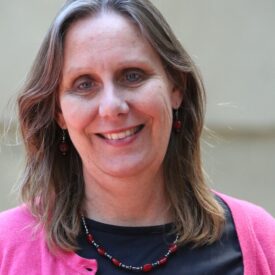
Susan Davis Krummel, who served for more than a decade as the executive/general presbyter and stated clerk for Great Rivers Presbytery in Illinois, in June started work as the PC(USA)’s associate for Mid Council Relations — replacing Jill Hudson, who retired at the end of 2013. In an interview, Krummel — asked what will happen next with synods — replied that “the short answer is to stay tuned.”
The action the assembly approved, part of its response to the recommendations of the Mid Council Commission II, says the number of synods should be reduced but “does not have any language about how this should happen,” Krummel said. “There’s no procedural language going forth. That was intentional on their part, to allow presbyteries and synods to create their own process going forward.”
The mid councils also are to be involved at efforts at reconciliation regarding the assembly’s decision to allow PC(USA) ministers to perform same-sex marriages. Knowing there was likely to be a strong reaction, and that presbyteries will be voting over the next year on a proposal to change the definition of Christian marriage in the denomination’s constitution, the assembly called for a reconciliation process — although it left out the details.
The assembly directed the Presbyterian Mission Agency Board and the Committee on the Office of the General Assembly to work together with churches “in the task of reconciliation, starting with visiting each presbytery … .”
But that directive did not include any funding for visiting the presbyteries, Krummel said. So she and other top denominational officials will discuss ways to respond to the mandate “in a way that accomplishes what it intends within those parameters.”
The proposed constitutional revision is to say that Christian marriage involves “two people, traditionally a man and a woman,” instead of the current wording in the PC(USA) constitution stating that Christian marriage is between “a man and a woman.” To take effect, that revision would need approval from a majority of the 172 presbyteries. The assembly also approved an authoritative interpretation allowing PC(USA) ministers to immediately begin performing same-sex marriages in places where those marriages are legal.
All these conversations will take place in an environment of sea change for most of the denomination’s presbyteries. Many face significant financial pressures — with funding dependent on congregations often growing smaller and older, or closing their doors, or from churches leaving for other more conservative denominations.
One theme of the ongoing discussion about the future of mid councils: they are entities created in a much different time in the life of the PC(USA). Seeing the current structure as not sustainable, the Mid Council Commission II recommended creating no more than eight regional synods — and the first Mid Council Commission wanted to eliminate synods as ecclesiastical bodies altogether.
In its report, Mid Council Commission II wrote that “the PC(USA) has a denominational structure that no longer fits the church of today. The current synod structure was established when we were a significantly larger church, when denominational loyalty to the mission decisions of higher councils was significantly deeper, and when geographic distance was an obstacle to efficient administration. Today our size, our understanding of denominations, and technology help to create opportunities for new ways of being church.”
The ways in which mid councils respond to contemporary challenges vary widely, Krummel said. “There are some synods that have purposefully gone to a minimal amount of business. They’ve made the decision this is how they want to operate as a synod. They’re fulfilling the Book of Order mandates” but not conducting programming, making space for mission networks to emerge.
Other synods focus primarily on mission — the Living Waters for the World program of the Synod of the Living Waters is an example. Some stress leadership development through programs such as Theocademy — new, free online videos developed by a partnership of several mid councils to train new members and ruling elders. The Synod of Lakes and Prairies offers Synod School — with the theme this year of “Becoming God’s Next Church.”
And “there is a lot of transition among the leadership of presbyteries and synods,” Krummel said. Some mid council executives are retiring, making way for new leadership to emerge, although “there are presbyteries that are running out of money to pay professional staff” and are leaving those positions vacant — much as congregations do without having a full-time pastor. “There are presbyteries that have made a ministry decision that they don’t need someone in an executive role,” she said.
The 2014 General Assembly voted down a substitute motion — essentially an alternate vision for changing the denomination’s mid council structure. That proposal would have authorized Krummel’s office to implement a process “by which synods and presbyteries develop mutually accountable mission goals” which would be reported to each General Assembly, along with the progress made in achieving those goals. The office, in consultation with presbyteries and synods, would have proposed structural and constitutional changes to the 2016 assembly “to repurpose synods as missional councils.”
That substitute motion also would have created a General Assembly Standing Committee on Mid Councils. And the debate over that proposal reflected some of the tension surrounding how to achieve the changes at the mid council level that many agree the PC(USA) really needs.
Jennifer Burns Lewis, a teaching elder from Chicago Presbytery, argued for the substitute as a collaborative process, a way forward with “natural, connectional partnerships” to develop mission.
But Jim Wilson, an attorney who served on the Mid Council Commission II, said both that commission and its predecessor collected a huge amount of data, concluding that the PC(USA) needs fewer synods — “that our existing status quo is not working.” After years of work, both commissions determined that “we need to consolidate our regional structure before we can begin to address the question of what those consolidated structures’ mission will be,” Wilson told the assembly.
“Is a structural change really the best solution to a missional problem?” asked Harold Armstrong, a teaching elder from Sierra Blanca Presbytery. “Instead of imposing a structure from the top down and hoping it will work,” he suggested “starting from the ground level.”
A thread through much of the discussion was a desire to find ways to support collaboration, innovation and networking in mid-council ministry — particularly significant at a time of diminished resources. In making structural changes to reconfigure synods, “please do not derail the work that is already being done,” urged Stephanie Anthony, a teaching elder from the Presbytery of the Twin Cities Area.