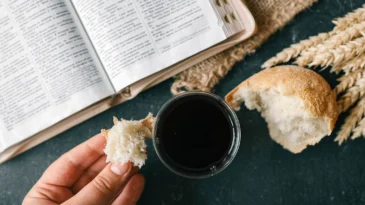
But when they measured [the manna] out, everyone had just enough. Those who gathered a lot had nothing left over, and those who gathered only a little had enough. Each family had just what it needed. But some of them didn’t listen and kept some of it until morning. But by then it was full of maggots and had a terrible smell. Moses was very angry with them. (Exodus 16:18, 20 NLT)
My daily Scripture readings brought me to Exodus this past month. Much in this Old Testament account of Israel’s release from slavery and wilderness wanderings instructs me as I re-enter pastoral work (for which I have been away seven months). Exodus 16 recounts God’s provision of manna, an unfamiliar, flaky substance that fell with the morning dew and provided food for every Israelite family wandering in the Sinai desert for 40 years.
What has stuck in my mind and heart is God’s order that each family take only enough manna for the day. They must trust that manna will also fall the next day and the days to come. Some – understandably to me – save a little manna after finishing their evening meal, maybe going a little hungry, just to ensure their children will have breakfast. Their failure to trust God’s promise of daily bread awakens them to a stinking, rotting mess of manna the next morning.
God then adds a further instruction to the manna collection: On Friday mornings, the Israelites are to collect two days worth of the flakes so that they will not be forced to work gathering manna on the Sabbath. But, true to our human capacity to trust ourselves more than God, some Israelites awaken early on Saturday morning to gather food, only to discover nothing on the ground.
To be content with “enough” from day to day requires trust. The Israelites must trust that God will do what God said, which means they need only collect enough, either for one day or two, depending on the time of week. In the vulnerability of wandering around a wilderness, this trust is the difference between full and empty stomachs.
Why, when the manna first falls, do some families save it? Perhaps they feel more secure taking control of their family’s food supply than in trusting God’s weird instructions. Taking control feels more secure than trust. But trust is necessary if we are going to discern what is “enough.”
I observe in myself a strong desire to be in control of my circumstances – my health, my finances, my work, even my relationships. I feel consistently overwhelmed by “too much” – too much to do in too little time. I have a hunch that capitalism, more than the way of Jesus shapes the value system, drives this feeling of “too much.” I store up resources and treasures in metaphorical “barns,” saving money, social capital and work accomplishments “just in case” they one day run low or run out.
Yet, every week as I pray the Lord’s Prayer, I ask God, “Give us this day our daily bread.” I know that control is an illusion; this season of ill health hammered that reality deep into my spirit. And I still hate to “waste time” and never feel like I am able to accomplish all I want to accomplish. I don’t live as if I trust that God truly provides enough.
I’m left with two questions:
- How do we, as individuals and as congregations, discern what is enough, especially when we are barraged with media and advertisements telling us we don’t have enough?
- How do we practice trust in a society that teaches that security lies in the creativity, accomplishments and control of the individual person?
What do you think?

Rachel Young is the associate pastor of spiritual formation at Clear Lake Presbyterian Church, in Houston, Texas. She is married to Josh, who also serves on staff at Clear Lake Presbyterian as the director of contemporary worship and media.