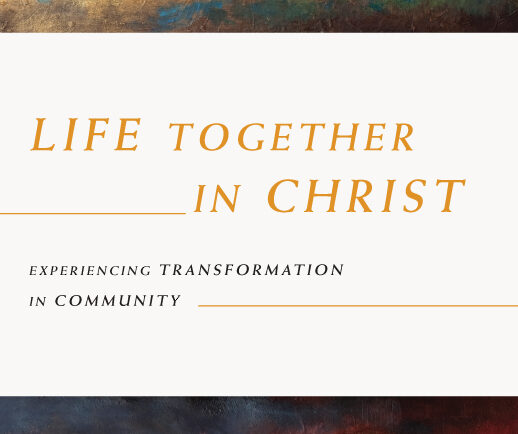
 by Ruth Haley Barton
IVP Books, Downers Grove, Ill. 192 pages
Reviewed by Sarah Scherschligt
When I picked up this book, I groaned to see yet another manual on small group life that would be the answer to what’s missing in churches. From the start, however, I was happily surprised. “Life Together in Christ” is fresh, useful, biblically smart, and rooted in sound theology.
Haley Barton begins with a challenging assertion: The two most overpromised and underdelivered aspects of church life are community and spiritual transformation. What follows is her successful attempt to deliver on that promise.
Breaking Luke’s Road to Emmaus story into nine sections, she describes an aspect of discipleship revealed in each section. For example, “And Jesus himself came near us” becomes the practice “welcoming the stranger”; “Some women in our group astounded us” becomes “men and women in community”; “And they stood still looking sad” becomes “choosing to listen rather than to fix.”
In each chapter, she exegetes Scripture, describes a practice, and gives theological and anecdotal underpinnings for how the practice, supported by life in community, can be spiritually transformative. For instance, in “welcoming the stranger” she shows how strange it would have been for the Emmaus travelers to welcome Jesus. She urges openness to the odd ducks in the group and with a personal anecdote describes how often it’s the stranger — including the person we find the most difficult to be around — who reveals a key insight into our spiritual journey.
Each chapter ends with practical ways for a group to explore the given practice. It’s here, at times, that the book gets confusing. She gives too many choices. For those with experience leading such groups, the options are helpful; but for the average person looking for a “how to” book on small groups, the options are too broad. That’s a small critique of an otherwise solid book.
One of the best aspects is her sources. She draws heavily on the wisdom of those who have preceded her including Thomas Merton, Henri Nowen, Richard Foster, Thomas Keating, St. Benedict and Dietrich Bonhoeffer. She weaves their insights into her clear, personal writing, giving a new audience access to some of the old masters.
Those on the relatively progressive side of church life have much to learn from a few of Haley Barton’s assumptions, especially regarding male/female relationships. She makes the case that men and women should be in community together; one senses that in her circles, that’s still a controversial concept. You also learn something about her context when she makes a case that Protestant churches would do well do to emphasize the experiential aspects of the liturgy and not only proclamation of the Word (interesting to this Lutheran reviewer, Lutherans and Anglicans are not included among the Protestants).
As a pastor thinking about how to use “Life Together in Christ,” I envision employing it as the basis for a sermon series on the Road to Emmaus, linked with small groups of the same theme, perhaps during the Easter season. I could also see using some of the chapters on their own for small group use. Whichever way I end up using it, I am certain that I will.
SARAH SCHERSCHLIGT is the pastor of Peace Lutheran Church in Alexandria, Virginia. She blogs at thebarefootpastor.blogspot.com.