Technically, India abolished the caste system more than 70 years ago, after achieving independence and drafting a constitution. In reality, change doesn’t happen that quickly, which means that for Dalits —people who are viewed as being untouchable or outside the caste system, the disenfranchised and dispossessed — many inequities remain.

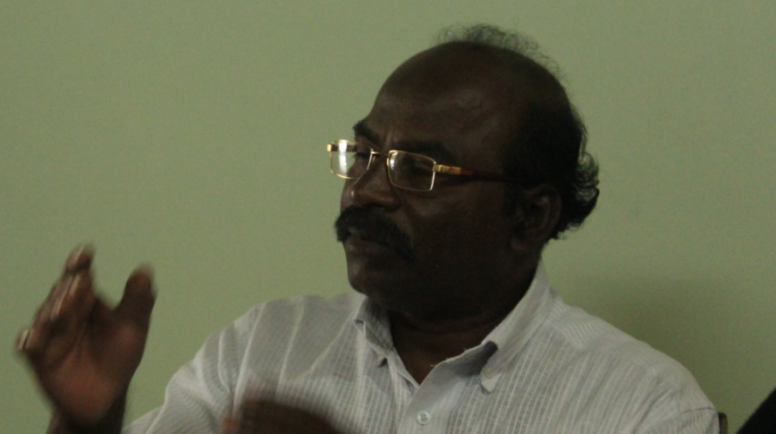
Sasi Pandippiilly is a Dalit activist in Kerala, the president of a Dalit community and someone who’s working in India’s complicated contemporary context for change.
Dalits “don’t have any land,” Pandippiilly told a group of students from Louisville, speaking through a translator, Franciscan friar Father John Pozhathuparambil. “They don’t own any land here in Kerala” — as with Native Americans in the United States, others have claimed what had historically been their land.
Through a complicated system, Dalits — whom Pandippiilly said make up about a quarter of India’s population — are supposed to have certain jobs and resources reserved for them by the government, but those in charge are high-caste people and often the rules are not enforced. “Even if the caste system is prohibited, illegal, in India, it is still there in the hearts of people,” he said.
What’s the definition of a Dalit? “Those people who are oppressed, marginalized, economically poor people — all are called Dalits … They will do all the dirty jobs,” the most difficult, physical work.
They are outside the caste system — called “untouchables.” The civil rights leader Mahatma Gandhi used the term “harijan,” meaning “children of God.”
Especially vulnerable are Dalit women — whom some have termed the “Dalits of the Dalits”— and who have been subject to rape, sexual assault and violence. “They are the most abused people here in India,” Pandippiilly said, with some men thinking that “anyone could rape them or abuse them” — that sexually attacking Dalit women was permitted. “When there is abuse or an attack against Dalit women, no journalist is interested,” he said. “But if you touch a high-caste woman, there is news everywhere.”
The legacy of the caste system also has other implications: there are internal tensions among Dalits and between Dalits and tribal people in India as well. “There is a caste system inside the caste system,” Pandippiilly said — with people with different occupations (those who fish vs. street sweepers, for example) protecting their territory and job advantages, which makes it difficult for them to join together on behalf of reform.
Dalits are inspired by the example of B. R. Ambedkar, a lawyer, economist and social reformer of the mid-20th century who earned an education, served in government and fought for the rights of Dalit people. A Dalit, K. R. Narayanan, served as India’s president from 1997 to 2002.
Churches have not always been responsive to the Dalits’ needs, Pandippiilly said, as most Dalits are not Christians, and conversions to Christianity can, under the rules, cost them access to jobs and services.
Some Christians say to Dalits, “You want help? Convert to Christianity, know Jesus, and I will help you,” Pandippiilly said. Otherwise, the answer is no.