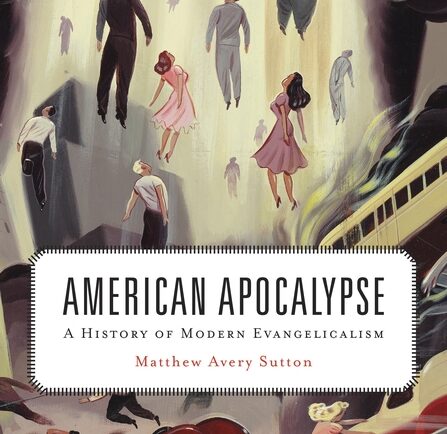
 by Matthew Avery Sutton
The Belknap Press of Harvard University Press, Cambridge, Mass. 480 pages
The story of fundamentalism-cum-evangelicalism in America is filled with colorful and eccentric characters. One of my favorites is Aimee Semple McPherson, who purportedly once dressed in a police uniform and rode a police motorcycle onto the stage of her Angelus Temple. On coming to a halt, she held up a gloved hand and shouted, “Stop! You’re speeding to Hell!”
Matthew Avery Sutton, professor of American history at Washington State University, has written a revisionist history of fundamentalism, or as he prefers “radical evangelicalism,” that traces the movement from the 1870s to 9/11. He asks a key question: What is fundamentalism’s defining doctrine? George Marsden in “Fundamentalism and American Culture” (1980) defined it as “militantly anti-modernist Protestant evangelicalism.” Sutton, however, sides with Ernest Sandeen who, in “Roots of Fundamentalism” (1970), said it was premillennialism. Their disagreement, Sutton explains, lies in Marsden’s attempt to be as inclusive as possible while Sandeen narrowed the scope of his work to those espousing the positive doctrines of the movement, which naturally put the spotlight on premillennialism.
Sutton’s book takes Sandeen’s approach. Hence, despite the advertising hype, this is not a “comprehensive history.” Yet by highlighting a single theme Sutton is able to rewrite the narrative and periodization of fundamentalism, arguing that World War I, not the 1925 Scopes “Monkey” trial, was the major turning point of the movement. The importance of biological evolution, he says, has been greatly exaggerated while WWI was the venue in which pre-millennialism and therefore fundamentalism caught fire. Sutton’s methodology, however, is ill conceived because it virtually guarantees the result that he set out to find. Consequently, he does not succeed in proving his point beyond demonstrating that pre-millennialism is a key doctrine of the fundamentalist-evangelical movement.
Nonetheless, Sutton makes some important observations along the way. His revised history of fundamentalism rejects its supposed “sectarian isolation” and withdrawal from politics. This, he argues, was a myth that was largely created by Carl F. H. Henry in “The Uneasy Conscience of Modern Fundamentalism” (1947) and followed by later historians. Actually, fundamentalists have always been political: in the ’20s supporting Prohibition, in the ’30s opposing the New Deal, in the ’40s boosting the war, and so forth. Also, while Marsden ignored issues of race and gender, Sutton is careful to fill in this gap, noting that “The color line always trumped theology” and that fundamentalists were fighting the culture wars as early as the 1920s — and the major battlefield even then was women’s bodies.
Sutton’s narrow focus also leads him astray when he asserts that fundamentalists were not conservatives because they were not trying to conserve anything; rather, they were religious innovators. Pre-millennialists and Pentecostals were certainly high-energy innovators, but the movement as a whole, rooted as it was in Reformation theology, was deeply conservative. It is this, as Marsden asserts, that accounts for its longevity. Sutton has shown the importance of pre-millennialism within the fundamentalist-evangelical movement, but he presents a distorted and partial picture because he insists on viewing the movement through a single interpretive lens.
MICHAEL PARKER is director of graduate studies and professor of church history at Evangelical Theological Seminary in Cairo, Egypt.