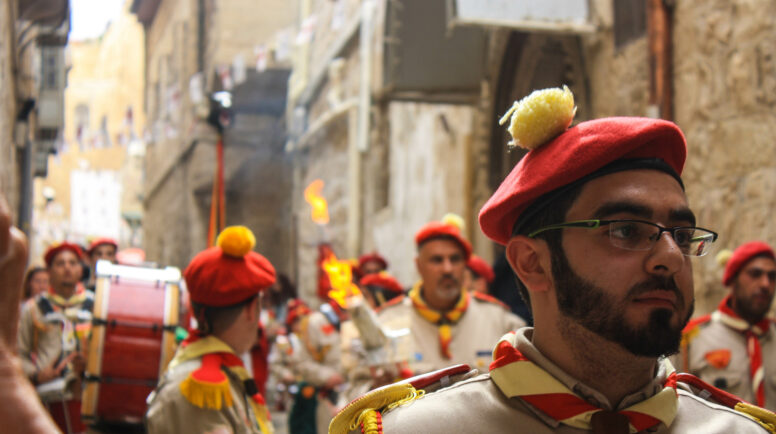
There is a common anecdote among Palestinian Christians I’ve met. They tell me that people often ask them when they converted to Christianity, assuming that they are converts from Islam. “Pentecost!” my friends respond. Their humorous response is also the truth. The Palestinian Christian church that exists today is the oldest in the world. They are the descendents of the church that was born in this very land; indigenous Christians have been here ever since.

Palestinian Christians mark the day of Pentecost in similar ways as American Christians. They read the second chapter of Acts during worship. They preach about the Holy Spirit. Yet I would argue that their very existence is a continual celebration of and testimony to the Pentecost.
While many conceive of the Israeli-Palestinian conflict as one between Jews and Muslims, Palestinian Christians are an integral part of the Palestinian people. They share the same history, culture, language and hopes as all Palestinians. They also experience the same consequences of Israel’s military occupation. Palestinian Christians are just as likely as Palestinian Muslims to have their homes demolished, to have restricted access to healthcare services and educational opportunities, to have their land and natural resources confiscated and to be denied access to their holy sites. They are just as likely to be unable to live united with their families, to have their residency rights threatened, to experience army raids and detention and to feel the impact of settlement expansion.
One consequence of this oppression is the alarming rate at which Palestinian Christians are emigrating. According to the World Council of Churches, Christians made up 18 percent of Palestinians in the Holy Land in 1948; today, they are less than 2 percent. Given the daily realities of life in the occupied territories, it is no wonder. Yet, there are many Palestinian Christians who remain in the land very intentionally as a way to resist the occupation. They embody the Palestinian value of sumud, or steadfastness.

As a mission co-worker appointed to Israel- Palestine by the World Mission agency of the Presbyterian Church (U.S.A.), it is my task and joy to be in relationship with Palestinian Christians on behalf of our church. Their sumud is a testimony to the ongoing work of the Holy Spirit in the very place where she first came to us.
One example is Nidal Abu Zuluf and all of those with the Keep Hope Alive (KHA) program in Beit Sahour, a town bordering Bethlehem. The KHA olive tree campaign brings internationals to the West Bank to help during the olive harvest and olive tree planting seasons. Internationals provide protective presence to farmers in the face of threats from settlers and the Israeli military. Yet when they leave, farmers remain vulnerable. Just this past February, 40 international volunteers, including several American Presbyterians, helped a Palestinian farmer, Anis Ayaydeh, plant 500 olive trees as part of the KHA program. Within days, news came that nearby settlers had uprooted every single tree. Sadly, this is not a unique story. Even so, Nidal, other staff at KHA and the farmers find a way to continue. KHA has decided to offer Ayaydeh help planting 50 trees a week in an attempt not to lose so many trees at once in the future.

Another example is Suhaila Tarazi, the director of Al Ahli Arab hospital in Gaza, whom I had the privilege of visiting last August during a brief ceasefire of Operation Protective Edge. She gave me a tour of the hospital and introduced me to dozens of patients. Some laid in rooms packed with their extended families, because the explosion that injured them also destroyed their home and their families had nowhere else to stay. Some patients were alone in their rooms, the only surviving members of their families. The majority of patients I met were actually children, covered in burn wrappings and casts for broken bones. As she took me from room to room, Suhaila put her hand on every patient’s arm and looked each one in the eye. She knew the story behind each person’s injury, which family members they’d lost, whether their home still stood. She told me, “We are here as an instrument in the hands of God to show the love of Jesus Christ for all people. We are proud that in all conflicts this hospital was there to eliminate the suffering of the injured, the poor and to help those in need of a compassionate heart.”
During Pentecost, we celebrate the gift of the Holy Spirit, which empowered all Christians to witness to the resurrection. Here in the land where that gift first came, the Holy Spirit is still at work, enabling Palestinian Christians to proclaim a God of life, even in the midst of violence and oppression. Alhamdulillah, thanks be to God.
 KATE TABER is a PC(USA) facilitator for peacemaking and mission partnerships in Israel-Palestine.