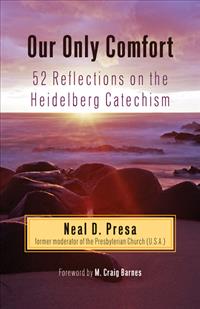
 by Neal D. Presa
Westminster John Knox, Louisville, Ky. 160 pages
The parking lots of the Dutch churches were packed every Sunday evening in the 1960s when my family and I lived in western Michigan. In the pulpit, pastors were preaching from one of the 52 Lord’s Day sections of the Heidelberg Catechism, completing it in one year. Recently, a special committee representing the PC(USA), the Reformed Church in America and the Christian Reformed Church developed an updated translation of this document that is part of our Book of Confessions.
During his tenure as moderator of the 220th General Assembly, Neal Presa used his blog to post pastoral, theological reflections on the catechism. Many remember the first question: “What is your only comfort in life and in death?” And the answer: “That I am not my own, but belong — body and soul — in life and in death — to my faithful Savior, Jesus Christ.” The purpose of the catechism, written in 1562, was an irenic one. The intention was to reconcile differences between Lutheran and Reformed, whose spheres of influence intersected geographically in Heidelberg, in the German Palatinate. The tone was meant to be pastoral rather than polemical, as exemplified in the first question and answer. The catechism is organized around three themes, titled “Of Human Misery,” “Redemption” and “Thankfulness.” It reflects on the Apostles’ Creed from Lord’s Day 9 to 22; on the Sacraments from Lord’s Day 25 to 31; and on the Ten Commandments (interestingly, under the “Thankfulness” section) from Lord’s Day 34 to 44; and concludes with the Lord’s Prayer from Lord’s Day 46 to 52. Both before and after the Reformation, parents or sponsors promised to teach baptized children the Creed, Commandments and Lord’s Prayer.
No matter how worthy, a document formulated in 1562 under circumstances very different from our own poses a challenge to the expositor. The existentially pressing issues of the 16th century have yielded to different ones. Part 1, “Of Human Misery,” was framed in an era in which people were deeply concerned with sin and salvation. The catechism thoroughly embraces Anselm’s doctrine of substitutionary atonement, which may tell the truth metaphorically, but optimally only when it is set beside other biblical metaphors, as the Confession of 1967 does. Although not addressing the dissonance directly, Presa works with the catechism’s (and Scripture’s) intention to point to the cost of God’s graciousness toward us.
Presa’s writing seems to grow in liveliness and animation in the section on the Sacraments, which clearly exhibits his commitment to worship in both Word and Sacrament every Lord’s Day. “Eucharist” (thankfulness) seems to him best to represent the tone and character of the holy meal. Faithful to the catechism, he points to the presence of the risen Christ in the Sacrament, and understands it to be not about a past event only, but certainly also the present, and an anticipation of the messianic banquet.
This book might best be read over an extended period of time, more or less in accord with its intended use. Presa ends each commentary with a prayer. The overall impression is devotional, rooted in a persistent confidence in the faithfulness of the triune God, made known in Christ by the Holy Spirit, and consistently highlights the importance of the Spirit in Reformed theology.
RONALD P. BYARS is professor emeritus of preaching and worship at Union Presbyterian Seminary in Richmond, Virginia.