The difficulties the Presbyterian Church (U.S.A.) is facing may provide opportunities for it to become a leaner, more focused denomination.
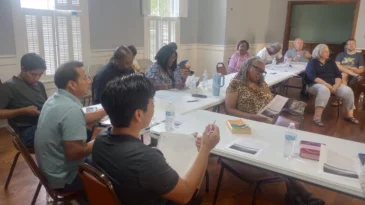
That’s part of the message that Marilyn Gamm, who is chair of the Presbyterian Mission Agency Board and the new transitional executive presbyter of the Presbytery of Riverside, brought to participants in the Pursued by Grace conference – the first national gathering organized by the PC(USA)’s 1001 New Worshiping Communities program and held August 10-13 in St. Pete Beach, Florida.

Speaking via Skype, Gamm presented her remarks on the evening of August 11. Earlier that day, conference organizers invited Pursued by Grace participants who had questions or concerns regarding the events of the past year to submit written questions to Gamm. Conference organizers said this was done not to vet the questions, but to allow for better preparation given what they described as the potentially unreliable logistics of holding meetings over Skype.
In the evening, a small group gathered to hear Gamm read a statement (the full text of which appears below). In it, Gamm addressed the decision of the Presbyterian Mission Agency Board’s Executive Committee to hire a law firm in late 2014 to conduct an independent investigation involving $100,000 in 1001 program grant money that had been sent to an unauthorized corporation set up in California. All of the money was returned, and Linda Valentine, the former executive director of the Presbyterian Mission Agency, has said none of those involved acted for personal gain. The investigation has so far cost the PC(USA) more than $1 million in legal fees.
In her August 11 statement, Gamm said “I take full responsibility for having taken the idea of doing an investigation to the Executive Committee. I stand by that decision.”
She also said her “support for the 1,001 New Worshiping Communities initiative remains strong and unshaken by any other events from the past year.” Gamm concluded by suggesting that “these challenges and crises” might be considered as opportunities to become “a leaner and more focused national church.”
Vera White, 1001 coordinator, said, “No money has been withheld from the 1001 initiative.” She shared that her team recently got approval to hire a new West Coast regional associate and said they will start the hiring process “very soon.”
White also shared these signs of hope:
- Young adults are active in the new worshipping communities that have formed.
- Many new communities involve racial/ethnic populations.
- PC(USA) research shows 78 percent have entered with no PC(USA) background, although some were involved in other denominations.
Gamm, White and Chip Hardwick, director of Theology, Formation and Evangelism for the PC(USA), answered the participants’ questions. Here’s an overview of the Q&A time:
Trust. Earlier in the day, participants in a Pursued by Grace plenary session heard a video message from Heath Rada, moderator of the 2014 General Assembly. In it, Rada acknowledged the negative effects that the 1001 and other controversies have had over the past year, but indicated that the denomination had moved past those troubles. One questioner stated personal difficulty believing that the church had truly moved past these issues, and asked what will happen to restore trust. Gamm said she agrees that trust continues to be an issue and “won’t be restored overnight.”
Interim search. Gamm said the interim executive director of the Presbyterian Mission Agency, once chosen, may be asked to serve as long as three years. (Valentine resigned as of July 10, and Earline Williams and Barry Creech have been named temporary co-managers until an interim is named). Gamm also said proposals may be submitted to the 2016 General Assembly calling for the restructuring of the PC(USA)’s six national agencies, and noted that representatives of the Office of the General Assembly and the Presbyterian Mission Agency already are in discussions to prepare for this.
Investigation. Gamm noted that she would not answer any of the questions related to the 1001 investigation or the report that lawyers conducting the independent investigation provided to the Presbyterian Mission Agency Board last April. Gamm said the “report is protected by attorney/client privilege and I therefore will not comment upon nor discuss any aspect of that report, nor any aspect of our legal strategy” the PC(USA) is using to defend itself in two defamation suits (see here and here) filed in state court in Kentucky in connection with the inquiry.
However, the questions that had been submitted relating to the investigation were read aloud. They included:
- When will the investigative report from the outside lawyers be released (since we, as church members, paid for it)?
- Why haven’t the four employees who lost their jobs as a result of the investigation been allowed to see the audit report?
- Why did the PMA board pursue a legal route instead of a disciplinary route?
In closing, White stated the 1001 initiative has caught the imagination of the denomination in a way that few others things have. People have become inspired and deeply committed to the church through this initiative, she said.
Hardwick reminded attendees that the 1001 initiative is not a top down approach, but a grassroots movement. “You are where the action is. You are where the Holy Spirit is blowing.”
Here is the full text of Marilyn Gamm’s written statement:
Thank you for your willingness to meet with me via Skype this evening. I’m sorry I couldn’t join you in person, but I began a new ministry call June 15, and since then have already had to make four Presbyterian Mission Agency trips – two I knew about going in the door, and two that were necessitated by Linda Valentine’s resignation. That’s a lot of time away in the first two months in a new position! So I appreciate your understanding about that.
Wearing a different hat I attended this conference two years ago, and it was wonderful. I came as a thirsty sponge, absorbing not only creative ideas, but creative Holy Spirit energy that re-energized me and my ministry. I hope and pray this week will do the same for you.
I was appointed to what is now the Presbyterian Mission Agency Board in February of 2012, attending my first meeting when launching the 1,001 New Worshiping Communities initiative was announced. For me, it was a fresh breath of Holy Spirit air. FINALLY, my beloved PCUSA was turning at least some of its attention from the decades of fighting over important theological and social issues to our first calling: the Great Commission to go and make new disciples for Jesus. I returned home to my Presbytery meeting the next day with which I excitedly shared about 1,001 and received a standing ovation simply because the presbyters were excited to hear such good news from out of “Louisville” for a change.
A year ago in February my fellow Board members honored me by electing me Chair for the next two years, and I took office at the conclusion of the Detroit General Assembly.
It’s not been the first year I, or anyone at that time, expected, and the hard reality is that my concluding year isn’t going to be either.
It’s no secret that we’ve spent over a million dollars of unrestricted mission funds on an investigation, and are now defending ourselves in two lawsuits. With you, I wish it were not so. At the same time, I take full responsibility for having taken the idea of doing an investigation to the Executive Committee. I stand by that decision. I also need to be clear that at this time the investigation report is protected by attorney/client privilege and I therefore will not comment upon nor discuss any aspect of that report, nor any aspect of our legal strategy as we defend ourselves in these suits. I’d say you just have to trust me, but I know many don’t, and that’s a tension I and we have to live with.
As a supporter of 1,001 I know the events of this past year are especially painful to you. I know you are grieving the loss of national leaders in the 1,001 movement you liked and trusted, who had inspired you to risk trying new ways of being church. This is all very painful for me as well. Since first learning about the 1,001 New Worshiping Communities initiative, I personally brought Vera White to itinerate among the five regions of John Knox Presbytery to tell the story. I resourced the launch of two new worshiping communities in John Knox, one of which is still active. I carried the message of 1,001 to Milwaukee Presbytery, where I resourced the launch of three active new worshiping communities, one of which, Farm Church, has recently been in our Presbyterian news. Now in Riverside Presbytery as the Transitional Executive Presbyter, I’m beginning to meet with and encourage the exploration of new worshiping communities in soil that has already proven fertile for this kind of Holy Spirit imagination. The planters of one of our new worshiping communities, James Munyi and Joyce Mwangi, are there with you in St. Pete Beach attending this week’s conference. This past week I was asked to review a seed grant application for a new ministry one of our interim pastors and his congregation have launched.
I share all of this to say that my support for the 1,001 New Worshiping Communities initiative remains strong and unshaken by any other events from the past year. For me, personally, this is the life and the energy of the PCUSA in the present looking toward the future.
But I need to also be honest and share with you that all is not healthy nor robust in our national church. A year ago when I became Chair of the PMA Board I learned we were facing what some are terming a “fiscal cliff” in that we were projected to reach our draw down limits on our unrestricted funds by 2017. Current projections are that we will reach that limit in 2016 and possibly as early as by the end of this year. This is a major challenge to the mission and ministry of the Presbyterian Mission Agency, indeed, we are at the point of financial crisis.
These are both challenges and opportunities, and without being a Pollyanna, as I invited the Mid-Council leaders two weeks ago during the Big Tent consultation, I’d like us to focus upon the opportunities. Both the Presbyterian Mission Agency and the whole national church have struggled to continue functioning as a much larger denomination than we currently are. National church staff know that every spring there will be a reduction in force, especially during General Assembly years. In addition to being destructive to staff morale, with each RIF we’ve insisted staff output remain constant despite the ever-dwindling financial and human resources.
One way to think about these challenges and crises as opportunities is to see this as the “perfect storm” preparing us to become a leaner and more focused national church. We cannot continue to serve all the constituencies we have been serving. So who do we serve? And why? What is our mission? What is our calling? Why do we have and why do we need a national church structure and offices?
I welcome your engagement.