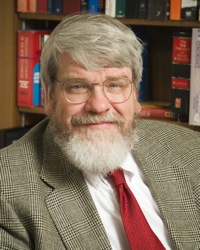
 by David W. Johnson
The questions
Ordained service in the Presbyterian Church begins the way that marriage begins: with questions. There are more questions in the ordination service — nine, most of which are really multiple questions — but they all have the same form. They begin with either “Will you” or “Do you,” followed by a verb: trust, acknowledge, believe, accept, receive and so on. In the Book of Order these are termed the “Constitutional Questions,” but they are often called “ordination vows,” which is exactly what they are.
The vows are in the verbs. A vow is a promise. It is a promise that is a personal commitment: One pledges to act in particular ways, to honor certain beliefs and values and live in accordance with them. The “Do you” questions go through the hierarchy of faith. The first question establishes one’s trust and obedience to Jesus Christ as the living Lord of the church. The second question acknowledges Scripture as the witness to Jesus Christ’s work of salvation. The third question describes the church’s confessions as derived from, and therefore subordinate to, Scripture. The sequence of verbs reflects this hierarchy: The Living Lord inspires trust and obedience. Scripture’s witness is to be accepted. The Confessions provide instruction. The fourth question really summarizes the first three: Obedience to Jesus Christ comes first; the authority of Scripture is second; and guidance of the confessions is third. That is the basis of ordained ministry.
The following questions, the “Will you” questions, turn this basis into action. If the first four questions are about Christian faith, the last five are about Christian love. The verbs here — love, work, serve, and all the rest — describe the love that expresses an enacted faith. It must be this way, for as Paul says, faith without love is nothing.
The third and fourth constitutional questions deal specifically with the confessions of the church. The language here is very carefully nuanced. One the one hand, the subordination of the confessions to Scripture is maintained: The “essential tenets” of the Reformed faith, which are contained in the confessions, reflect the teaching of Scripture, but they are not Scripture as such. Those tenets (which are deliberately left undefined) are guideposts. They teach, they lead, they point the way. They help illuminate the message of Scripture, but they do not replace Scripture — and in no way to they compete with or replace Jesus Christ as Lord of the church. The role of the confessions is to be useful in the corporate and individual life of faith. If the confessions are to be useful, however, they must be used.
 The confessions
The Book of Confessions came into being in 1967. It augmented the Westminster standards with creeds and confessions from other historical eras. The Brief Statement of Faith was added to the Book of Confessions as a result of the reunion of the United Presbyterian Church in the United States of America, colloquially known as the “northern church,” with the Presbyterian Church in the United States, the “southern church.” This year, the overture to add the Belhar Confession to the Book of Confessions has been approved by the presbyteries and awaits final enactment by the 2016 General Assembly. At that point, the Book of Confessions will consist of 2 documents, the oldest of which (the Nicene Creed) dates from 325 and the newest (the Brief Statement of Faith) from 1991.
The creation of the Book of Confessions was a significant shift in the confessional standards of the Presbyterian Church. The UPCUSA, and subsequently the PCUS, moved from having a single confession that could be (and was) amended, to a number of confessions. This was akin to moving from a soloist to a choir. In part, the move had the potential of creating some confusion, for the members of the choir seemed to be singing different words to different tunes. But there was also a gain, for the multiplicity of confessions gave theological and ecumenical breadth to the church’s understanding of its own beliefs. Only two of the documents in the Book of Confessions are not shared with other denominations or communions: The Confession of 1967 and the Brief Statement of Faith. None of the confessions arose from an identical situation. Each was prompted by its own time and attempted to speak to its own time. But each attempted to speak on the basis of the gospel that was for all times. Each of the confessions had to balance particularity and universality. When these confessions are gathered into a single book, each can be understood to speak to the rest to some extent.
Consequently, the Book of Confessions represents the polity of the Presbyterian Church. In all of its structures, from the individual congregations to the General Assembly, the Presbyterian Church provides for multiple voices, varying points of view, the uniqueness and value of individuals and the ultimate consensus of the majority. The Westminster Standards have a certain centrality in the history of the Presbyterian Church and retain something of a primacy of honor. But the move to a book of confessions, rather than a single confession, more authentically represents a Presbyterian ethos. No single point of view, even one hallowed by time, is privileged. Wisdom emerges from many voices, speaking and listening and considering what each other has to say.
The guidance
Speaking and listening and considering what each other has to say, however, can be a lot of work. This is true whether one is speaking of family life or committee service or national politics. It is certainly true when one seeks to be guided by a multiplicity of documents. Those seeking to be guided by the confessions must have received training and instruction in their use. All to often, however, that training is either superficial or lacking altogether.
How does one approach the Book of Confessions? The first step is to read them. But reading them itself is a challenge. Certain things must be kept in mind.
First of all, the history behind each confession must be respected. When was each confession written? What situation was each confession trying to address? Most, but not all, of the confessions were responses to crises. Nicea dealt with questions about the nature of the Trinity. The Westminster documents were composed in the midst of a political revolution. Barmen was a response to Nazism. Understanding the crisis is important for understanding the confession.
The Book of Confessions itself provides brief introductory prefaces to each of the confessions in addition to an overall discussion on the use of the confessions. Also, there is an important document, produced in 1986 and added to the Book of Confessions by action of the General Assembly in 1999, titled “Confessional Nature of the Church Report.” This is an extended consideration of the nature of confessional statements and the role (or roles) of the confessions in the life of the church. Study of this report is a logical and fruitful way for individuals and groups to begin their study of the Book of Confessions. Any of the many worthwhile histories of the Christian church can help illuminate the various historical eras in which the confessions were composed.
All this can supplement, but cannot replace, study of the confessions themselves. Some, such as the two creeds and the Brief Statement, can be read in a matter of minutes. Others, such as the Second Helvetic and the Westminster Confessions, require hours or days. All of them require time and attention.
One of the best ways to become acquainted with the Book of Confessions is provided by The Company of Pastors. This program of the PC(USA) provides a plan for daily study of Scripture and of the Book of Confessions. At one point there was a separate but similar Company of Elders, but recently the programs were combined into one. Through the brief daily readings, one can become well-acquainted with the various confessions, as well as increasing one’s knowledge of the Bible itself.
One can also interrogate the confessions topically or scripturally. The Book of Confessions provides a subject index that lists almost all of the items discussed in the various confessions. For example, if a session were faced with the question of its understanding of baptism, it would naturally turn to the Directory of Worship in the Book of Order. But it could —and should — also look up “baptism” in the subject index of the Book of Confessions to determine what the church has thought and taught about baptism through the centuries.
An index of biblical citations would be a great help in using the Book of Confessions, but one is not provided and Scripture is cited rather erratically. Some of the confessions have footnotes or endnotes and some have parenthetical references within the text. This makes it a rapture arduous task to use the paper edition of the Book of Confessions in determining how certain Bible verses have been used by the confessional documents. But if one downloads the electronic version of the Book of Confessions, which is available without charge from the PC(USA) website, a search will help find all the citations of particular verses.
Summing up
The Book of Confessions is a great resource for the Presbyterian Church (U.S.A.). It provides access to the mind of the church for those who struggle with contemporary problems and issues. Those who have gone before us in living the life of faith — particularly those who have lived and shared their lives by writing their thoughts and convictions — bequeath to us both their mistakes and their wisdom. We do not have to be bound by their errors, but we should profit from whatever they got right. They have done their part: Their writing is easily available to us. Our part is to read and study and think about what they said and did, and apply it to all that we face now and in the times to come.
There is no need to memorize the confessional documents, with the possible exception of the creeds. There is a need to study them — not just once, but as an ongoing discipline. The education and training of ruling and teaching elders is a logical and appropriate place to begin and cultivate such a discipline. The constitutional questions — the vows — bind us to the Book of Confessions, which is to say that we are bound to be guided by those who have gone before. We promise to use the past to help bring about the future. Knowing the wisdom of the past, and endeavoring not to repeat or perpetuate the missteps of the past, will help to ensure that the future we seek is the future God has ordained.
 DAVID W. JOHNSON is associate professor of church history and Christian spirituality at Austin Presbyterian Theological Seminary. He is an ordained teaching elder and has served churches in Texas and New Jersey. His book, “Trust in God: The Christian Life and the Book of Confessions,” is available from Westminster John Knox Press.