KNOXVILLE – As the people of Bethel Presbyterian Church in Kingston, Tennessee, have learned, the impact of immigration can be felt just about anywhere.

“You can do immigration advocacy anywhere in the United States,” Teresa Waggener, who is manager of legal services for the Presbyterian Church (U.S.A.)’s Office of Immigration Issues, said during a Big Tent workshop on August 1. “You don’t have to be in a big city or living on the border.”
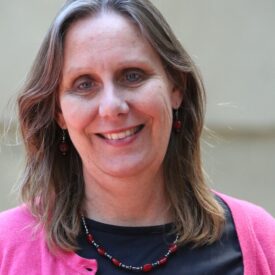
Bethel got involved when Viviana Vanegas, an undocumented immigrant from Guatemala, began attending the church with her family. Dark-haired and petite, Vanegas said she came to the United States 11 years ago on a tourist visa; stayed for a while in Colorado; then moved to Tennessee when her husband found work there. She was Catholic, but couldn’t find a Catholic church in Kingston. A family from Bethel invited her son to church, where “people welcomed us with open arms even when we couldn’t communicate,” Vanegas said.
People at Bethel weren’t just friendly. They also were willing to learn about immigration law and policy; the difficulties that immigrants experience; and “to learn about the issues of why people come to the United States,” said Venegas, who is now a ruling elder. “There are many ways you can help undocumented people.”
How Presbyterians can help immigrants
Children. In cooperation with the Methodists, the Bethel congregation raised funds for Venegas’ son to go to college, and helped him to get admitted – he graduated from college two years ago. Presbyterians also can help educate immigrant families about the Deferred Action for Childhood Arrivals (DACA) program, which provides temporary relief from deportation for some undocumented youth who came to the United States as children. Congregations could explain the DACA process to immigrant families, help them pay for the applications and offer assistance in filling out the paperwork, Waggener said.
Advocacy. Members of the Bethel congregation, including ruling elder Carol Brown, set out to educate themselves about immigration policy and effective advocacy. Brown, wearing a t-shirt with the message “No Human Being Is Illegal,” said she’s learned about the difficulty of obtaining visas – and how complicated immigration law can be. For example, in her advocacy work she met a man from Africa who’d been promised a green card but had been waiting eight years for the document. In that time, his daughter had turned 18 and now was being threatened with deportation. The man pleaded with government representatives at a meeting Brown attended to “please let my daughter stay.”

Education. Wendy Neff, Bethel’s pastor, said she’s worked to help people understand the implications of immigration policy, and the ways people of faith can help. Bethel has offered English as a Second Language classes; made connections with PC(USA) mission co-workers in Central America; and organized a mission trip to Guatemala “for the specific purpose of trying to understand better why people are leaving Guatemala to come here.”
Neff said her congregation is not monolithic, either politically or theologically, and she wants parishioners to get information about immigration policy not just from the news, but from “people who are living these issues every day.” She wants Presbyterians to know that immigrants live across the country, in towns and rural areas and cities, and that an undocumented person “could be the person sitting next to you in school, they could be the person in line behind you in the grocery store.”
When the mission trip to Guatemala was organized, two of Vanegas’ children – both of whom have DACA status – applied to go. Their mother could not. Neff said her son, who was eight then, asked, “Why is Viviana not going?” When he persisted in his questions, Neff explained that if Vanegas left, she could not return.
“Her children had a piece of paper that said they could travel and come back. But Viviana didn’t have that piece of paper,” Neff said. “He looked at me for a few seconds, and then he said, `So what are we going to do to get her that piece of paper?’ That’s the question the church needs to be asking itself. What are we going to do for people in our midst, to make this right?”