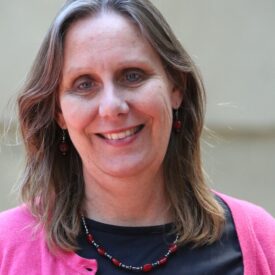
Gradye Parsons, stated clerk of the Presbyterian Church (U.S.A.) – the denomination’s top ecclesiastical officer – has announced that he won’t seek election to a third four-year term. That means the 2016 General Assembly will be asked to name a new stated clerk. It also means that the PC(USA) is facing a clean sweep of leadership at the top, as Linda Valentine, executive director of the Presbyterian Mission Agency, left that post as of July 10 and an interim executive director has not yet been named.

The Stated Clerk Nomination Committee will post application materials online in October, Parsons said. All application materials must be submitted by Dec. 21, and the committee will announce its nominee no later than April 19.
Following his announcement, Parsons, a teaching elder who was first elected stated clerk in 2008, sat down for a conversation with The Outlook about the accomplishments of his tenure, the challenges facing the PC(USA) and his expectations for the denomination in the years to come.
A longer interview will be published in the Outlook’s Oct. 12 print edition. Here’s a taste of the conversation.
The decision. Parsons, 63, said he struggled with the decision not seek another term, as he still enjoys the work and his colleagues. He and his wife, Kathy, plan to move to Kodak, Tennessee (near Gatlinburg), to help care for their aging mothers and to be closer to the families of their two adult children. Parsons said he might do some consulting, “a little preaching, a little teaching. Nothing that requires a daily alarm clock.”
Challenges. Parsons said he hopes the PC(USA) can live into the choices it has made to be a church where differing views may be held but all are welcome – an approach reflected by the recent decisions to permit the ordination of gays and lesbians who are sexually active, and to allow Presbyterian ministers to perform same-sex marriages.
The 92-percent white PC(USA) needs “to have some really serious conversations about our own white Presbyterian privilege and how that contributes to the mess we’re in,” he said.
In the years to come, both budgetary and leadership issues will be of concern. “Presbyterians are used to having a full-time minister and that’s just not going to be the case for lots of places,” Parsons said. “Nor will presbyteries have full-time leadership. So there’s a whole redistribution of how you lead and how we connect as a church that is going to have to be revisited.”
Hopes. What kind of Presbyterian Church does he foresee when his grandson Dylan grows up? “I hope it’s still a church where there’s good preaching. I know it will still be a church that cares about people and about justice and cares about understanding the Bible. I hope it’s a church that’s a little more porous, has permeable boundaries so people do feel more welcome,” regardless of ethnicity or age or education or economic level.
What Parsons describes as “our socioeconomic bubble” – the well-educated affluence in many Presbyterian congregations – is “probably our biggest speed bump in relating to other folks. I’ve seen it in Presbyterian churches in lots of places. People come, they’re white themselves, but they’re not the right kind of white. They’re not told, ‘Don’t come here,’ but every other subtle message in the world” says so.
Small congregations. Most PC(USA) congregations are small – so what would Parsons say to Presbyterians in congregations of only 50 people – or only a handful in the pews?
“I’d say don’t give up. The story I’ve told about the Spring City church in Spring City, Tennessee, which was down to seven, and now they’re back up to practically 50 because they just didn’t give up. They found a purpose beyond themselves. They didn’t sit in the church and wait for people to show up. They went out into the world and did good, and that paid off . . . I would encourage them to get involved in ministry in their community. To trust their own leadership, themselves as leaders. And to hang in there and be faithful.”
That’s not the same thing, Parsons acknowledged, as saying, “Keep your building and keep doing what you’ve been doing.”
Instead, it’s asking: “What do they think they have to offer their community? There/s no community in this country that doesn’t have some needs. And judging by the statistics there are lots of people who don’t have a church or don’t have a church family. So it’s not like there’s not room to grow out there.”