by Cynthia Campbell
Not long ago, I was with a group of women who were asked to do several sentence-completion exercises. One of them began “Literacy is … ” The answers were fascinating:
… a passport to opportunity and the grand adventure that is life;
… an open door to a future filled with hope and promise
… the key to worlds of adventure, ideas, beauty and imagination.
Usually we think of literacy as the ability to read and interpret printed words, but for these women, “literacy” goes far beyond the act of reading and assimilating information. Literacy is the doorway to new worlds and to a broader and deeper life.
 Using this definition, the true vocation of theological education is literacy. The most important thing a theological school can do is to help students discover wider possibilities for living the Christian faith. At its best, a theological school enables people to see that there is much more to Christian tradition, thought and practice than they knew was possible. If graduates become “literate” in this sense, then they are equipped to help others find their way into broader and deeper faith.
My own journey to literacy began over 40 years ago when I enrolled at Harvard Divinity School. I had an undergraduate degree in philosophy and learned to read before I entered kindergarten. I could read passably in German and had a smattering of Latin. I was a fluent reader of music and baseball box scores. But seminary opened new doors to hope and promise as I became more and more literate.
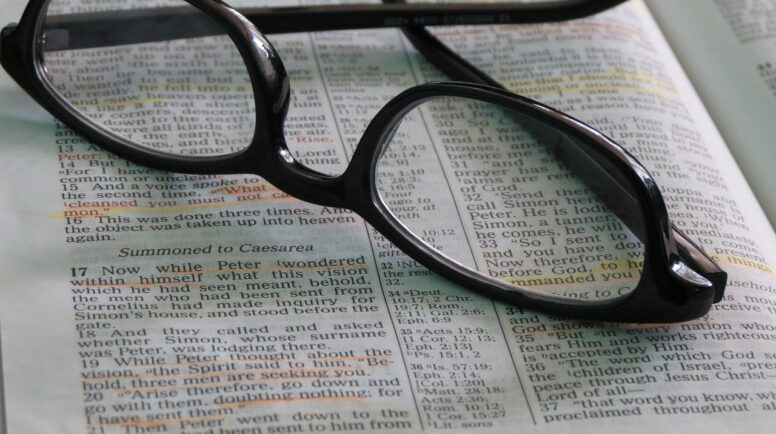
The first lesson in literacy came in a seminar on Calvin’s “Institutes of the Christian Religion.” At first, I was a bit suspicious as the professor came from a long line of Missouri Synod Lutherans. But he showed us how to understand Calvin by paying attention to his use of metaphors. Not only did I learn about Calvin’s appreciation of cutting-edge technology (as when he says that Scripture is like “spectacles” through which we can see God), I also come to appreciate his anxieties when he describes life without God as being trapped in a maze or labyrinth.
The second lesson I learned was not to import something into a text that isn’t there – no matter how winsome or compelling the idea may be. In a seminar on exegesis for preaching, I was assigned Matthew 18:10-14, which contains the parable of the lost sheep. In my paper, I nattered on about the love the shepherd had for his sheep so that he went out into the dangerous wilderness to search for one lost lamb. The first thing the professor said after reading the paper was, “Where did you get this stuff about love?” That may be a point of this parable when Luke tells is, but it is not the point in Matthew. It was a stern but immensely helpful lesson about reading carefully.
The third lesson had to do with the law of unintended consequences. I was auditing lectures by a distinguished professor of Old Testament who was writing a commentary on the book of Joshua. It is an ethically and theologically challenging text under the best of circumstances, but while he was lecturing on the conquest of Canaan, the news was full of scenes of the bombing of Cambodia during the Vietnam War. One of the professor’s primary concerns was to compare the events narrated in the text with archaeological evidence for the time period in question. But contemporary events cried out for at least some reflection on the meaning and impact of the text in the present as well as the past.
The fourth lesson in literacy has come largely since I graduated. Thanks to the significant increase in women and persons of color in theological education in the last four decades, we have all come to see how important social location is in discovering new layers of meaning in biblical texts. This began with feminist and liberation studies but has expanded as gender and post-colonial readings of biblical texts have greatly broadened our range of interpretation.
For some years now, there has been an increasing cry for theological schools to train new pastors in the skills of congregational leadership. Congregations and governing bodies have complained loudly when seminary graduates seem unable to perform important tasks in ministry. In the last few years, denominations have argued that seminary graduates need to be taught how to be entrepreneurs who can develop start-up ministries. Good programs, such as one or two yearlong pastoral residencies, have proven very helpful, but the debate continues on what a theological school should try to teach and how.
When I graduated from seminary, there was a great deal I didn’t know. I didn’t know how to read a balance sheet or construction documents. I wasn’t really proficient in interpreting personnel policies or manuals of operations. Fortunately, the congregations I served were full of people who were fluent in those texts and were more than happy to advance my education.
The most important thing a theological school can do is help people become life-long learners. My colleagues at McCormick Seminary regularly said that their goal was to help students learn how to read text and context. Our hope was that those preparing to be pastors would not only be able to understand the texts of the Christian tradition. They would also be able to interpret and understand the people, places and communities where they were called to serve. It turns out that the skills needed are remarkably similar. The careful reader of both text and people needs first of all to assume that one doesn’t know everything, but in fact needs and wants to learn. Therefore, one must be both curious and appreciative.
One of the problems is that theological schools often think that their primary – or perhaps only – vocation is offering degree programs for those who seek to be pastors, for pastors and other leaders seeking higher degrees or for those seeking to become professional scholars. Those functions are vital to the church, but theological schools could do so much more. If theological schools saw their mission as raising the level of theological literacy for the life of the church, think what doors could be opened for deeper and richer living of the Christian life.
Cynthia M. Campbell is pastor of Highland Presbyterian Church in Louisville, Kentucky, and president emerita of McCormick Theological Seminary.