In response to a “Call to the Church” that Heath Rada, moderator of the 2014 General Assembly, has issued – seeking urgent reform of the Presbyterian Church (U.S.A.) – the Presbyterian Mission Agency Board acted Sept. 24, seeking perhaps a slower course of action.
The board took action to “embrace the churchwide listening effort sponsored by the Committee on the Office of the General Assembly (COGA) regarding denominational identity as a priority” in the months leading up to the 2016 General Assembly.
The board will focus its attention on developing a mission work plan and budget for 2017 and 2018 – what it describes as a “two-year interim strategy.”
The board also voted to recommend that the 2016 General Assembly forward the results of research collected through the listening effort along with reviews of the Presbyterian Mission Agency and the Office of the General Assembly currently underway as input for the next cycle of reviews to be done. That action states that the review cycle for 2016 to 2018 is already designed to focus on “the review of the whole of the Presbyterian Church (U.S.A.) and its six agencies, focusing broadly on the effectiveness of the six agencies and other governing bodies in working collaboratively to implement the General Assembly’s mission directives.”
While much is yet to be determined about these proposals, it sounds as if Rada is asking for something to happen quickly – saying the church can’t afford to wait two or four years – and the Presbyterian Mission Agency Board is perhaps being more deliberative.
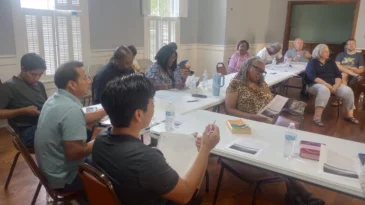
The board spent much of its time together Sept. 24 in cultural humility training – exploring aspects of racism, privilege and the ways in which people are formed by the backgrounds from which they come.

To get things started, board members and staff from the Presbyterian Mission Agency each drew a “cultural portrait” – a depiction of their background, the communities and connections that have helped to shape them.
They also talked about categories of privilege – such as race, gender, socio-economic class, and more. “I, from my place of privilege and majority culture, too often think everyone views the world and the church through my lenses,” said Marilyn Gamm, the board’s chair.
Through the day, board members discussed implications of racism and privilege – including how discrimination in housing, employment and education can have an economic impact that ripples through generations. Some board members of color shared personal stories – of comments that scalded and where the speakers were not even aware they had said something offensive.
“This is not something we do once and check off the list,” said Mark Koenig, of the PC(USA)’s United Nations office. “This is a journey for a lifetime.”